The sun shakes the solar system by sending out dramatic interplanetary shocks, and NASA has observed these shocks for the first time.
NASA’s Magnetospheric Multiscale mission (MMS) consists of four spacecraft which have been in orbit around Earth since 2015, moving through our planet’s magnetosphere to study a phenomenon called magnetic reconnection. The phenomenon only occurs in plasma, which includes the ionized gas which is found throughout most of space, and in the presence of magnetic fields. Sometimes, when magnetic field lines are close to each other in plasma, the lines can reconfigure into a new form and let out a burst of energy.
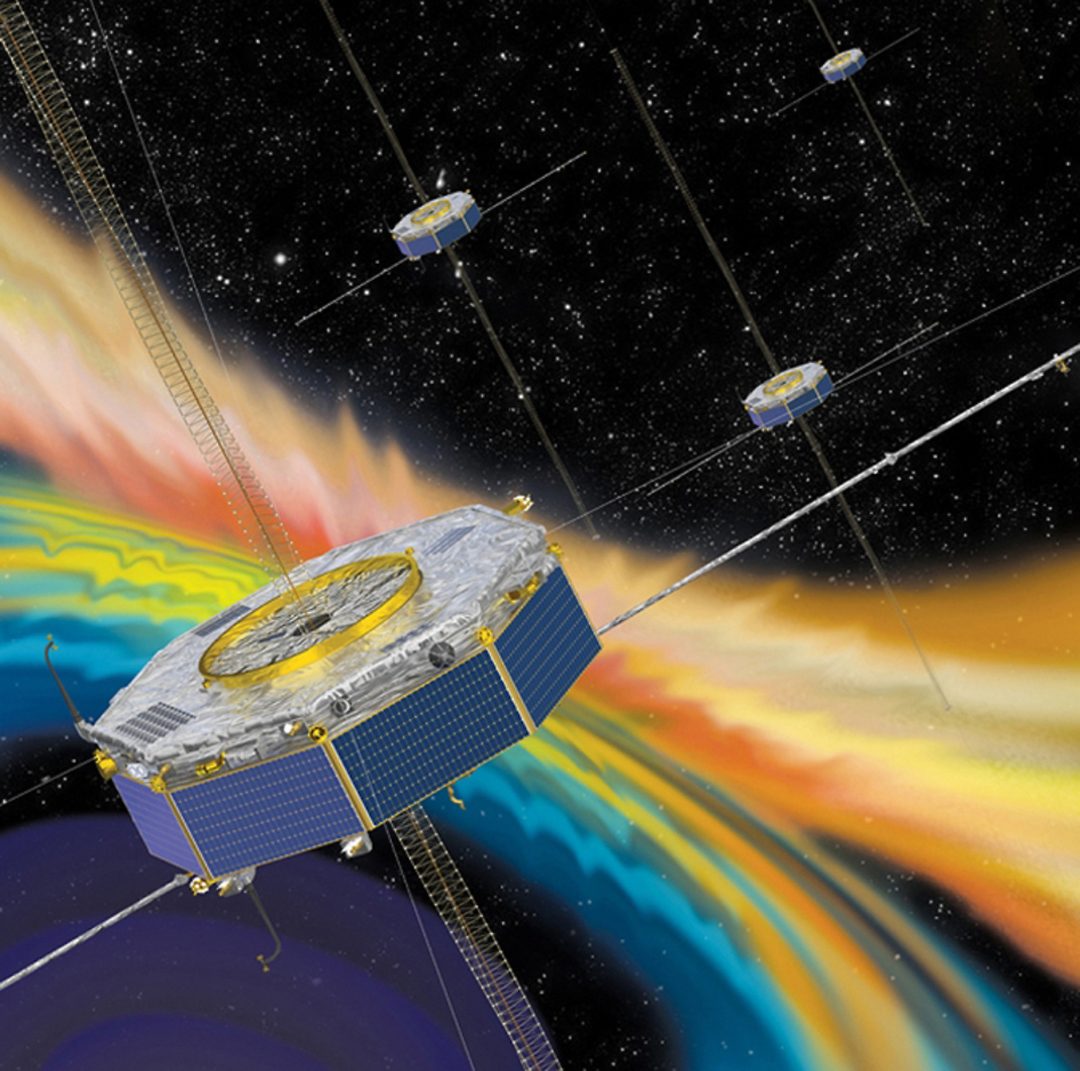
The energy given out by magnetic reconnection can be significant, with heat and kinetic energy exploding outwards from the origin point. But scientists still aren’t sure what triggers a magnetic reconnection event. The aim of the MMS is to observe Earth’s magnetic fields closely to learn more about sites where reconnection occurs.
Now MMS has learned about one such trigger for magnetic reconnection, which is solar wind. As the sun burns through fuel, it periodically releases streams of charged particles called solar wind. These streams can be fast or slow. “When a fast stream of solar wind overtakes a slower stream, it creates a shock wave, just like a boat moving through a river creates a wave,” according to NASA. This shock wave propagates out from the Sun and into the Solar System, and when it hits the Earth’s magnetic field it can cause the magnetic reconnection effect.
The MMS was fortunate to catch a shock as it happened, as the four craft need to be close together to detect accurately, and shock zips past the spacecraft in just half a second. MMS has an instrument called the Fast Plasma Investigation which takes measurements up to 6 times per second, so it was able to capture the shock. On January 8 this year, MMS detected two clumps of ions from the solar wind in quick succession, indicating that a first clump was from a shock and the second clump has bounced off the shock.
Now scientists have observed a powerful shock in action, they are confident they will be able to detect weaker shocks in the future.