  1. Home
  2. Emerging Tech
  3. News

Uncrewed Russian craft fails to dock with ISS, will make second attempt tomorrow

Add as a preferred source on Google

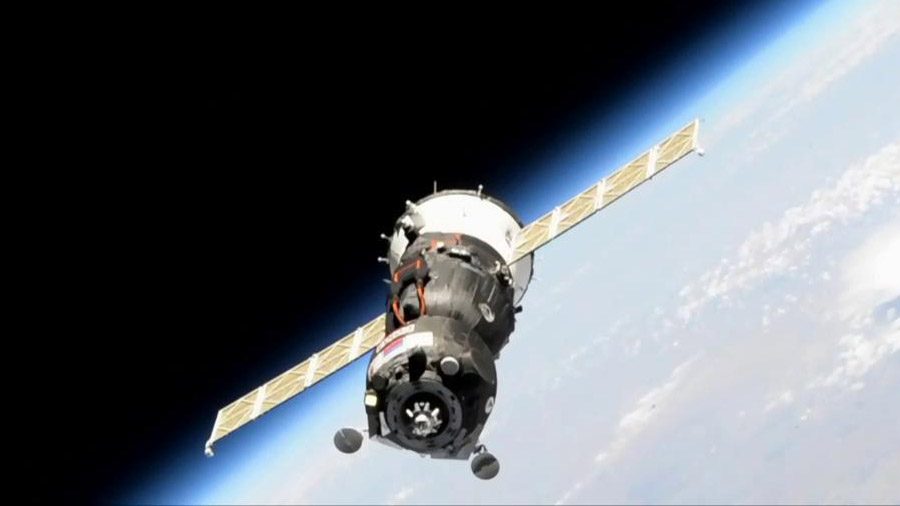
The Soyuz MS-14 spacecraft is pictured during its first docking attempt early Saturday. NASA

An uncrewed Russian spacecraft had issues docking with the International Space Station (ISS) on Saturday. The craft is still in orbit and will make a second attempt at docking on Monday night.

Recommended Videos

The Soyuz MS-14 craft was launched from the Baikonur Cosmodrome in Kazakhstan on Wednesday, August 21, at 11:38 p.m. EDT, and made a total of 34 orbits of Earth before attempting to dock with the ISS. However, as the craft approached the ISS at 1:36 a.m. EDT on Saturday, the Russian team overseeing the maneuver decided to abort the docking because the craft could not lock on to its target on the station’s Poisk module.

The craft withdrew to a safe distance from the ISS while Russian controllers investigated. The early results of the investigation showed the issue may have been due to the station’s part of the Kurs automated rendezvous system, rather than a fault with the Soyuz. To address the problem, Russian space agency Roscosmos will send instructions to the ISS crew to swap out the signal amplifier, a part of the docking system, to see if that fixes the target lock-on.

The craft will continue on its trajectory near to the station, and it will be close enough to dock again in 24 hours and 48 hours time. The plan is now for a second attempt at docking to take place on Monday night at 11:12 p.m. EDT. Instead of aiming to dock with the Posik module, the mini-research module which acts as the primary docking location for Soyuz and Progress logistics vehicles, the craft will aim for the aft port of the Zvezda service module instead. The ISS team has already checked the Kurs docking system there and found it to be working perfectly.

Once the Soyuz docks with the Zvezda module, ISS astronauts Alexander Skvortsov of Roscosmos, Luca Parmitano of the European Space Agency, and Drew Morgan of NASA will put on their spacesuits and enter the craft, then pilot it over to the Poisk module and dock it manually. This process should take around 25 minutes and because the docking will be manual, the Kurs system is not required.

To see how the second docking attempt goes, you can watch live on NASA TV on Monday night from 10:30 p.m. EDT.


Georgina Torbet
Georgina has been the space writer at Digital Trends space writer for six years, covering human space exploration, planetary…
Study finds humans will talk to AI ghosts of the dead as reincarnations, and it’s pretty grim
The first AI ghost study is in. The results are about as complicated as you'd expect.
VR Headset, Person, Face

A new study from the University of Colorado Boulder confirms something that sounds both impressive and concerning. People find interacting with AI simulations of their dead loved ones deeply meaningful, and most will come away wanting to do it again.

The researchers call it a "generative ghost," which is a clear reference to generative AI, but I’d still prefer to call it unsettling.

Read more
China’s UBTech unveils eerily lifelike companion robots, and yes, they want to move in with you
UBTech's new humanoid robots are built for companionship, using emotion-aware AI, long-term memory, and humanlike expressions to become part of your everyday life.
UBTech Uworld U1 series robot launch

A humanoid robot designed to live in your house, learn your habits, and pick up on your mood without being prompted is no longer science fiction. Shenzhen-based UBTech Robotics unveiled its Uworld U1 series this week, introducing three robots built for companionship rather than factory work or household chores.

A body that moves like yours, and a brain that reads how you feel

Read more
This $249 LED sign wants to fix your work-life balance
My productivity isn't worth $249... or is it?
Flipper Busy Bar

Flipper Devices has built a reputation among hackers and hardware enthusiasts with the Flipper Zero, a pocket-sized gadget capable of interacting with RFID, NFC, Bluetooth, and other wireless protocols. Now, the London-based company is taking a very different approach.

Its latest product, the Busy Bar, is a desktop productivity display designed to help users stay focused, signal their availability, and automate parts of their workflow. After being teased last year, the device is finally going on sale on July 14. While the concept is genuinely clever, its starting price of up to $249 may make many buyers think twice.

Read more