
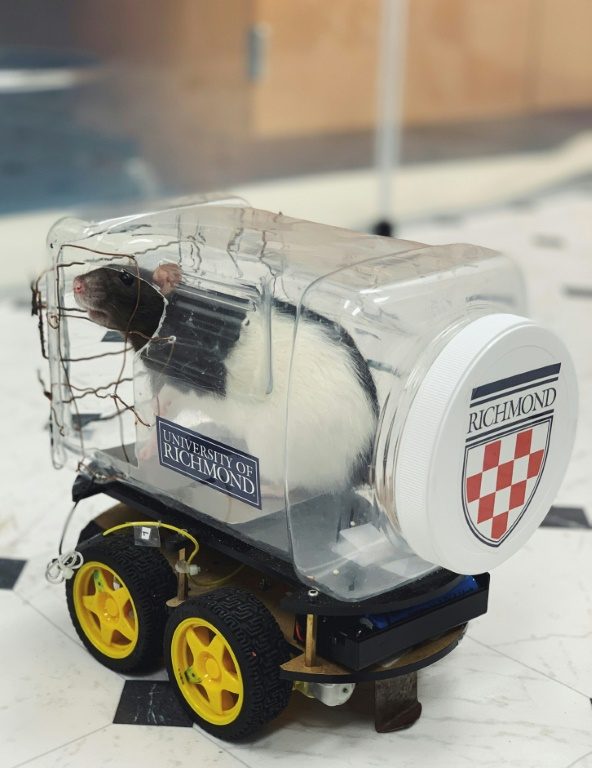
In this year’s most delightful behavioral neuroscience experience, scientists have taught rats how to drive tiny cars in exchange for pieces of breakfast cereal. Researchers at the University of Richmond showed that when rats were placed inside a clear plastic container on top of a robot car, they could learn to drive the vehicle by pressing bars and could navigate around a tiny rat arena.
The team wanted to know how the rats’ living conditions affected their ability to learn new skills, so they took two groups of rats from different environments and compared their performance. One group of rats had been kept in more natural, engaging environments with lots for them to do (called “enriched environments”), and they performed better at the driving task than rats who had been kept in lab cages. This was to be expected, as scientists know that the environment in which animals are kept can radically alter their behaviors and cognitive abilities. However, the degree to which the animals from enriched environments outperformed the rats from regular lab cages surprised lead researcher Kelly Lambert: “It was actually quite shocking to me that they were so much better,” she said to AFP.
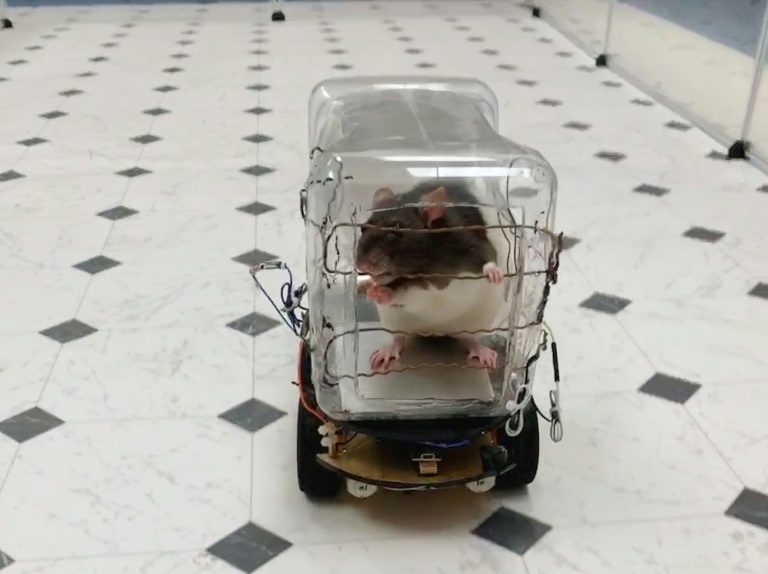
The researchers also wanted to know about how the rats found the driving experience — whether they were stressed out by it or relaxed by it. So they took fecal samples from the rats after they drove and analyzed them for hormone levels. They compared levels of two key hormones involved in stress: Dehydroepiandrosterone (DHEA) and corticosterone (CS). When animals are stressed, the ratio of DHEA to CS decreases, as the body produces more CS during stressful periods.
In the driving rats, the researchers found that the ratio of DHEA to CS increased, which the researchers said, “suggest[s] that driving training, regardless of housing group [enriched or lab cage], enhanced markers of emotional resilience.” You could argue that this finding shows a relaxed or satisfied response among the rats, related to having acquired a new skill. Of course, it’s difficult to ascribe human emotions and experiences to rats. But it does seem that the animals found riding around in the tiny car to be a positive experience.
In an interesting twist, rats who rode as passengers in the tiny cars without driving them showed lower levels of DHEA than the driving rats, meaning they had a less positive response. This supports the idea that it was the experience of taking agency or mastering a new skill that the rats enjoyed, not merely the experience of riding around in a novel vehicle.
The researchers think that the findings could help not only explain more about rat behavior, but also apply to human problems too. There could be ways that this research could eventually be applied to treat mental disorders, such as by emphasizing the importance of learning new skills and having agency over experiences in controlling stress.
“There’s no cure for schizophrenia or depression,” Lambert said to AFP. “And we need to catch up, and I think we need to look at different animal models and different types of tasks and really respect that behavior can change our neurochemistry.”
The findings are published in the journal Behavioral Brain Research.



