  1. Home
  2. Emerging Tech
  3. News

Here’s how to watch Boeing’s Starliner crew capsule abort system test on Monday

Add as a preferred source on Google

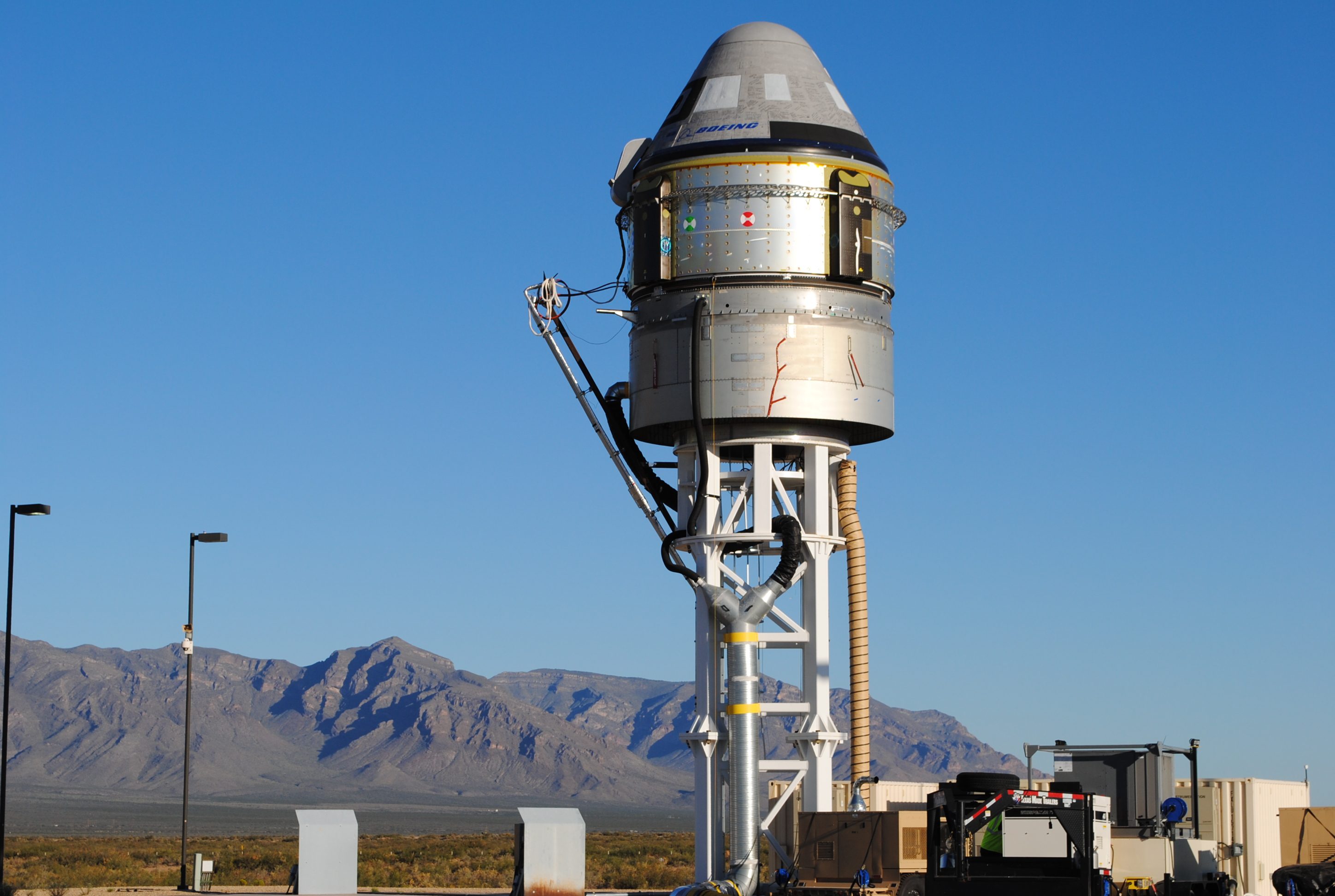
Boeing’s CST-100 Starliner spacecraft and its service module sit atop the test stand at White Sands Missile Range in New Mexico ahead of the company’s Pad Abort Test. The test is scheduled for Nov. 4, 2019, and will demonstrate the spacecraft’s ability to quickly escape the launch pad in the event of an emergency on launch day. Boeing

On Monday, Boeing will perform a key test of its Starliner crew capsule which NASA hopes will eventually ferry astronauts into orbit. The pad abort test is an important part of testing for manned launches and will be aired live on NASA TV.

Recommended Videos

“The test is designed to verify that each of Starliner’s systems will function not only separately, but in concert, to protect astronauts by carrying them safely away from the launch pad in the unlikely event of an emergency prior to liftoff,” NASA explained in a statement. “During the test, Starliner’s four launch abort engines and several orbital maneuvering and attitude control thrusters will fire, pushing the spacecraft approximately 1 mile above land and 1 mile north of the test stand.”

During the test, the crew module will be ejected away from the rocket and its descent will be slowed with parachutes and landing airbags. It should touch down in White Sands Missile Range, from where it will be collected and brought back to Launch Complex 32 to be analyzed and evaluated.

The commercial crew program is one way in which NASA is working with private companies in the hope of making space exploration more efficient and more affordable. The program has not always run smoothly, however, with delays and technical issues affecting both Boeing’s Starliner and SpaceX’s Crew Dragon capsule development.

The hope is that commercial companies will soon be able to take over the duties of delivering astronauts and supplies to the International Space Station (ISS). Currently, SpaceX performs resupply missions to the ISS but no company has yet declared itself ready to carry astronauts. The first commercial flights carrying astronauts are planned for May 2020 for SpaceX and December 2020 for Boeing.

Boeing’s latest test is scheduled to start at 6 a.m. PT on Monday, November 4, with live coverage beginning at 5:50 a.m. PT. The time window in which Boeing hopes to complete the test is three hours long, with a small amount of leeway to account for weather and other conditions.

You can watch the event live on NASA’s website through its NASA TV channel, or you can watch it right here:


NASA Live: Official Stream of NASA TV
Georgina Torbet
Georgina has been the space writer at Digital Trends space writer for six years, covering human space exploration, planetary…
AI agent reportedly carried out an entire ransomware attack on its own
AI didn't just write malware. It apparently clocked in for work.
Cybersecurity

Cybersecurity researchers say they have documented what could be the first ransomware attack carried out almost entirely by an autonomous AI agent, marking a significant shift in how cyberattacks could be conducted in the future. According to cloud security firm Sysdig, they have uncovered a ransomware operation dubbed JadePuffer that appears to have relied on a large language model (LLM) agent to perform nearly every stage of the attack without continuous human intervention.

If confirmed, the incident suggests AI is moving beyond writing malicious code and into actively planning, adapting, and executing cyberattacks in real time.

Read more
The Washington Post predicted how tech will advance 50 years ago and the success rate is humbling
The Washington Post predicted 2026 tech in 1976. It got a lot right.
Representative Image

Fifty years ago, when floppy disks were cutting-edge and the personal computer revolution had barely begun, The Washington Post attempted a remarkably ambitious exercise: predict what life in 2026 would look like. Some of those predictions now read like science fiction. Others feel surprisingly ordinary because they have become part of everyday life.

In a retrospective published for America's 250th anniversary, the newspaper revisited science editor Thomas O'Toole's 1976 article Inventing the Future, comparing its forecasts with today's technological reality. The results reveal that while predicting exact timelines is nearly impossible, identifying long-term scientific trends can be remarkably accurate.

Read more
Australian government warns doctors over AI scribing tools as privacy and safety concerns grow
AI medical scribes face regulatory scrutiny in Australia amid safety concerns
Representative Image

The Australian government is urging healthcare professionals to exercise caution when using AI-powered medical scribing tools, as regulators examine whether stronger safeguards are needed around one of healthcare's fastest-growing technologies, according to a report by The Guardian.

AI scribes have rapidly gained popularity by recording, transcribing, and summarising doctor-patient conversations into clinical notes, reducing the administrative burden on healthcare workers. However, government officials now warn that the technology's rapid adoption has outpaced oversight, raising questions around patient privacy, informed consent, and the accuracy of medical records.

Read more