  1. Home
  2. Emerging Tech
  3. News

Hubble investigates new type of super-puff planet with texture of cotton candy

Add as a preferred source on Google

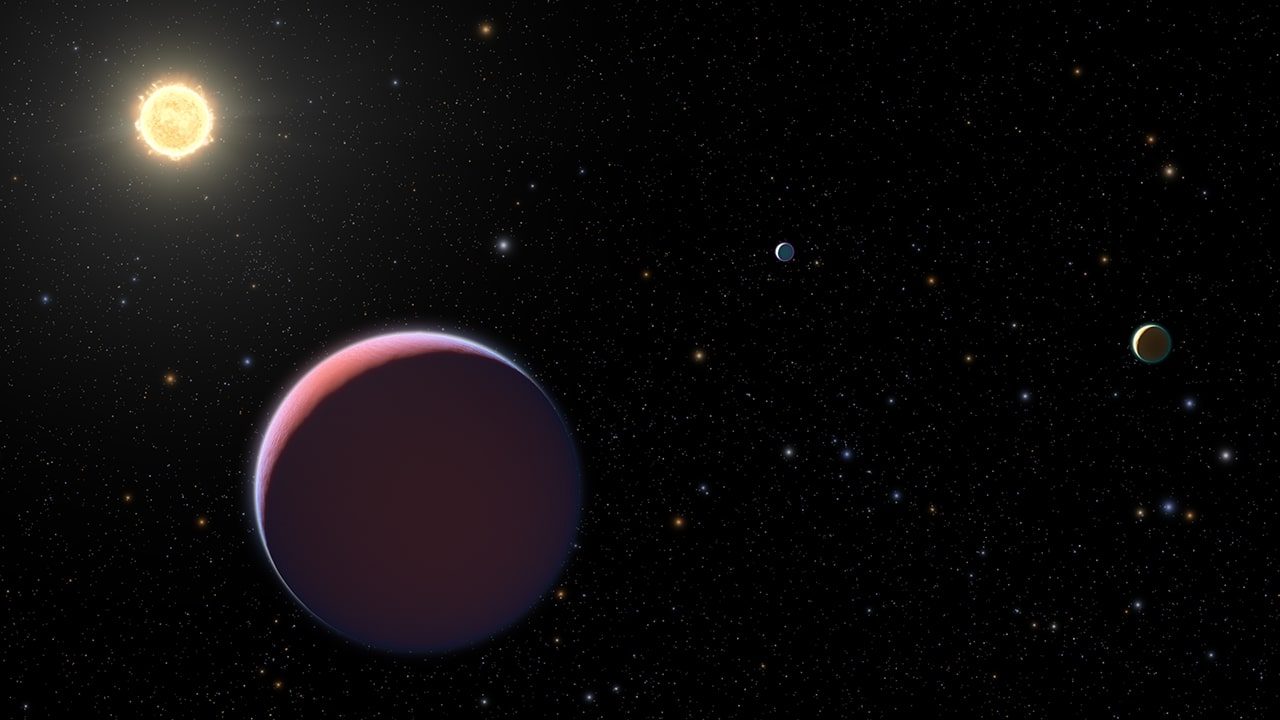
Illustration of star Kepler 51 and three orbiting planets.
This illustration depicts the sun-like star Kepler 51, and three giant planets that NASA’s Kepler space telescope discovered between 2012-2014. These planets are all roughly the size of Jupiter but a tiny fraction of its mass. This means the planets have an extraordinarily low density, more like that of Styrofoam rather than rock or water, as investigated by the Hubble Space Telescope. NASA , ESA , and L. Hustak, J. Olmsted, D. Player and F. Summers

Our solar system contains three types of planet: Rocky terrestrial planets like Earth and Mars, gas giants like Jupiter and Saturn, and ice giants like Uranus and Neptune. In our exploration of other solar systems, we’ve also found types including lava planets, gas dwarfs, and protoplanets. But observations from the Hubble Space Telescope have uncovered a new and most unusual class of planet: A “super-puff” with the density of cotton candy.

Recommended Videos

Three planets orbiting the star Kepler 51 were discovered in 2012, and the fact that they had notably low density was uncovered in 2014. Now, data from Hubble has allowed scientists to confirm that their masses are several times that of Earth, but they are so big and bloated that they are nearly as big as Jupiter. In other words, despite being a similar size to Jupiter, they are around one hundred times lighter.

The planets are puffed up in this way due to the expansion of their atmospheres, which consist of hydrogen and helium. But scientists don’t yet know what caused the atmospheres to behave in this manner.

One theory is that the puffiness of the planets is related to the young age of the system, which is only 500 million years old. For comparison, our sun in 4.6 billion years old. The planets may have formed at a distance from their star and migrated inward over time. As the planets move closer to the star, they will eventually lose the atmospheres which make them so large. Scientists estimate that the planet closet to Kepler 51 will eventually, in a billion years, become a type of planet called a hot Neptune.

So it could be that the unusual puffiness is a stage of planetary evolution that we haven’t seen much of before. However, Hubble scientists predict that the most distant planet, Kepler-51 d, “will continue to be a low-density oddball planet.”

To learn more about the super-puffs, the researchers hope to use the upcoming James Webb Telescope to get a closer look at the planets’ atmospheres.

Georgina Torbet
Georgina has been the space writer at Digital Trends space writer for six years, covering human space exploration, planetary…
I let Gemini take care of my houseplants, and they’ve never looked better
Study guide created by Gemini

I am, by every reasonable measure, a serial plant killer. I've lost count of the pothos, the peace lilies, the one very expensive fiddle-leaf fig that judged me silently for a month before giving up entirely. My problem was never a lack of love. It was that I'd either drown them out of guilt or forget they existed for a fortnight, with no middle ground. So when I started leaning on Gemini for the odd everyday question, letting it babysit my plants wasn't some grand plan. It happened almost by accident, and now my flat looks like something a person with their life together would own.

It started the way most of my plant emergencies do, with a leaf going a color it definitely shouldn't. Instead of doom-scrolling through contradictory Google searches like I usually would, I snapped a photo, handed it to Gemini, and asked what was wrong. What I got back was a proper answer, and it was the first of many.

Read more
I underestimated this NotebookLM feature until it completely changed how I study
google-adds-data-tables-feature-in-notebooklm

I'll admit it: I ignored NotebookLM's Mind Maps feature for far longer than I should have. I mostly used the app to ask questions about my documents or generate Audio Overviews and Short Video Overviews, while that little Mind Map button sat untouched. I assumed it was more of a nice-to-have than something I'd actually use. Turns out, I was completely wrong.

I stopped drowning in my own notes

Read more
The Concorde dream is within reach. NASA X-59 just has to silence the supersonic boom
The jet built to kill the sonic boom just reached full speed
Lockheed Martin’s X-59

NASA has already proved that its needle-nosed X-59 can move seriously fast in recent test flights. Now, the next step is to find out whether it can break the sound barrier without announcing its arrival to everyone below. The experimental aircraft recently reached Mach 1.4, or about 924 mph (1,487 kph), at an altitude of 55,000 feet. Those are the target conditions NASA plans to use during future tests of the X-59’s quieter sonic signature, making the flight a major milestone for the agency’s Quesst mission.

NASA’s supersonic jet has reached full speed

Read more