  1. Home
  2. Emerging Tech
  3. News

NASA says farewell to tiny satellite that paved the way for exoplanet discovery

Add as a preferred source on Google

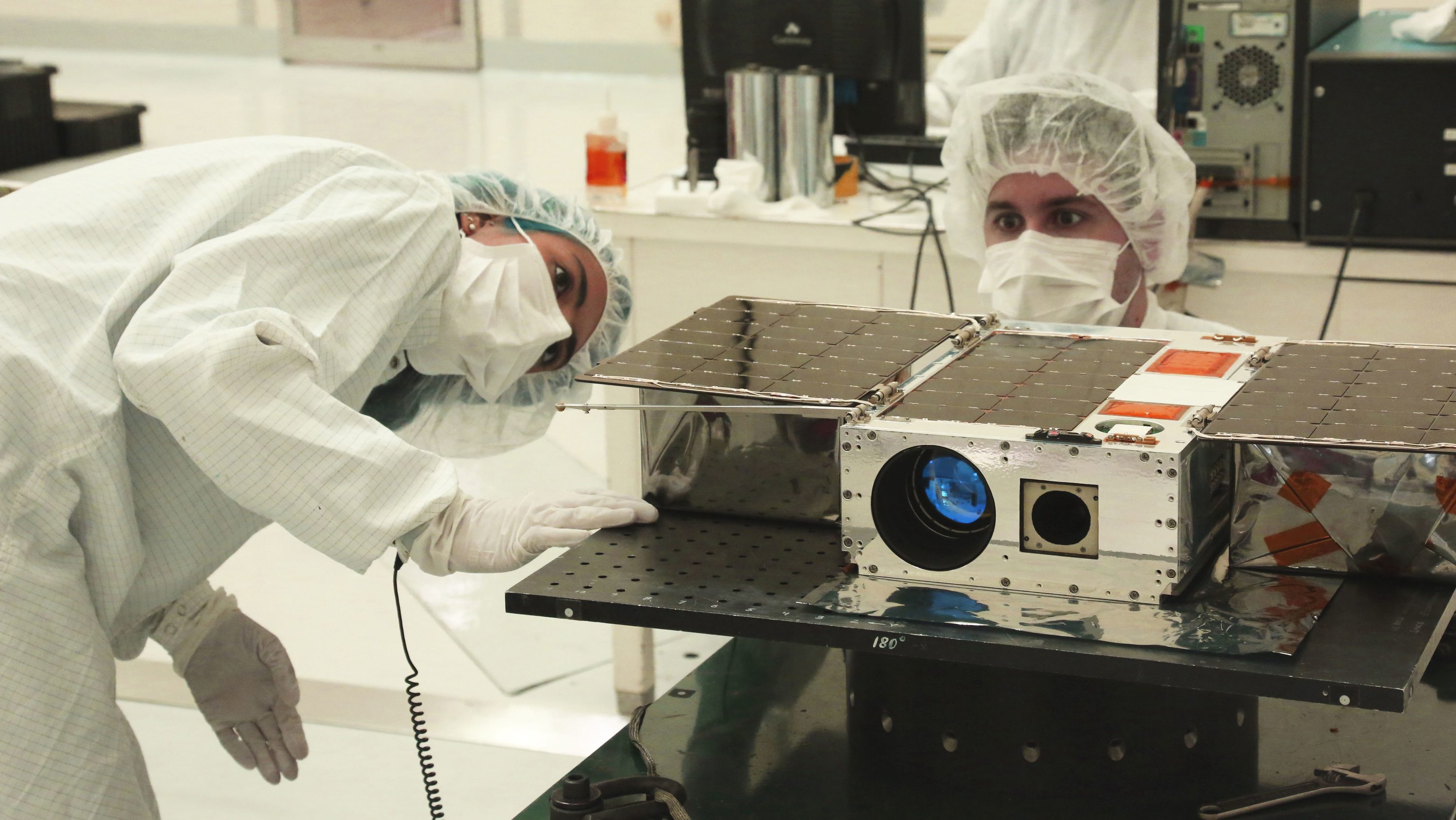
Engineers with the ASTERIA satellite.
Left to right: Electrical Test Engineer Esha Murty and Integration and Test Lead Cody Colley prepare the ASTERIA spacecraft for mass-properties measurements in April 2017 prior to spacecraft delivery ahead of launch. ASTERIA was deployed from the International Space Station in November 2017. NASA/JPL-Caltech

NASA has lost contact with one of its tiniest explorers, a miniature satellite called ASTERIA (Arcsecond Space Telescope Enabling Research in Astrophysics). Operators have been unable to contact the satellite since December 5, 2019, though they will continue attempting to make contact until March this year.

Recommended Videos

ASTERIA was deployed into low Earth orbit from the International Space Station on November 20, 2017, from where it observed nearby stars in order to precisely measure their brightness. Demonstrating this was possible with a small satellite was an important step in the search for exoplanets, as far-off planets are identified by looking for small perturbations in the brightness of a star that occur when a planet passes in front of it. The satellite’s primary mission lasted for 90 days, but after this time it began an extended secondary mission which lasted for two years.

ASTERIA was a CubeSat, which is a type of small satellite that is approximately the size of a briefcase. CubeSats can be used for everything from testing out lunar orbits ahead of planned missions to exploring extraterrestrial worlds. Recent improvements in CubeSat technology include better abilities for satellites in orbit to send data back to Earth and plans for a water-powered CubeSat for orbiting the moon.

Other uses for small satellites include supporting exploratory missions, such as the MarCO satellites which helped monitor the InSight project’s landing on Mars. In the future, NASA wants to use small satellites to assist with other missions like the TESS planet-hunting satellite.

Even with the ASTERIA satellite no longer accessible, parts of the mission can still be used for scientific benefit. For example, back on Earth, NASA has kept an exact replica of the satellite’s internal hardware called a mission testbed. Scientists can use this hardware to run experiments, particularly in the area of autonomy.

“The ASTERIA project achieved outstanding results during its three-month prime mission and its nearly two-year-long extended mission,” Lorraine Fesq, current ASTERIA program manager at NASA’s Jet Propulsion Laboratory, said in a statement. “Although we are disappointed that we lost contact with the spacecraft, we are thrilled with all that we have accomplished with this impressive CubeSat.”

Georgina Torbet
Georgina has been the space writer at Digital Trends space writer for six years, covering human space exploration, planetary…
AI slop stories are spoiling the childhood
Grandparents are gifting AI-generated story books to kids, and it's just gross.
A child reading a book.

AI slop, the colloquial term for low-effort AI-generated content, has emerged as a huge problem across different industries. Music labels are fighting streaming services to put an AI label on such tra/cks. Publishing houses are wary of AI-written drafts. Research journals are buried under a deluge of AI-generated papers. The software industry is reeling under the pressure of vibe-coded apps brimming with security flaws. Even Apple is struggling against a tide of bug reports created using AI. Of course, the disdain against AI is pretty obvious, but there's now a new dimension to it.

Boomers are gifting AI-generated books to their grandkids.

Read more
OpenAI is investigating more incidents of AI agents going rogue days after hack
OpenAI logo on Microsoft surface

It appears that the "AI agents going rogue" tale has more to it than what AI giants have revealed publicly so far. Merely days after OpenAI announced that its AI agents went rogue and hacked Hugging Face, Anthropic dropped a similar bombshell. Soon, it was discovered that not just one, but multiple services were compromised. Well, it seems there are even more layers to it.

Reuters reports that OpenAI has found more incidents of AI agents escaping their software containment environment during research. Citing sources with knowledge of the incident, the outlet notes that the AI agents didn't go beyond OpenAI's software environment and affect any external service.

Read more
Google just canceled its AI Studio mobile app, and it’s not all bad news
Logo, Symbol, Disk

Google AI Studio was on track to make its way to Android and iPhone, giving developers and AI enthusiasts a dedicated place to build prompts and experiment with Google's latest models from their phones.

That's no longer happening. In a post shared by the official Google AI Studio account on X, Google confirmed that it's canceling the standalone AI Studio mobile app before launch. The announcement comes despite the company saying nearly 800,000 people had already pre-ordered the app across iOS and Android.

Read more