1. Home
  2. Emerging Tech
  3. News

Autonomous sub videos the underside of an Antarctic glacier for the first time

Add as a preferred source on Google
Icefin Robot at Thwaites Glacier grounding zone

The glaciers of Antarctica have a tremendous influence on the climate worldwide, as their melting contributes to considerable sea-level rises. But it’s hard to know the extent to which glaciers are being affected by climate change because the region is changing so quickly.

Recommended Videos

But scientists have a tool to help them in this mission: The Icefin autonomous underwater vehicle, which has just captured the view from underneath the Thwaites Glacier in Antarctica for the first time.

Icefin explores beneath the ice using sonar, chemical, and biological sensors, so it can access and study difficult-to-access areas and collect information on the ocean and on structures like glaciers. The technology could even be used to explore ocean environments on other planets in our solar system, such as Enceladus, the moon of Saturn, which has an ocean beneath an icy crust.
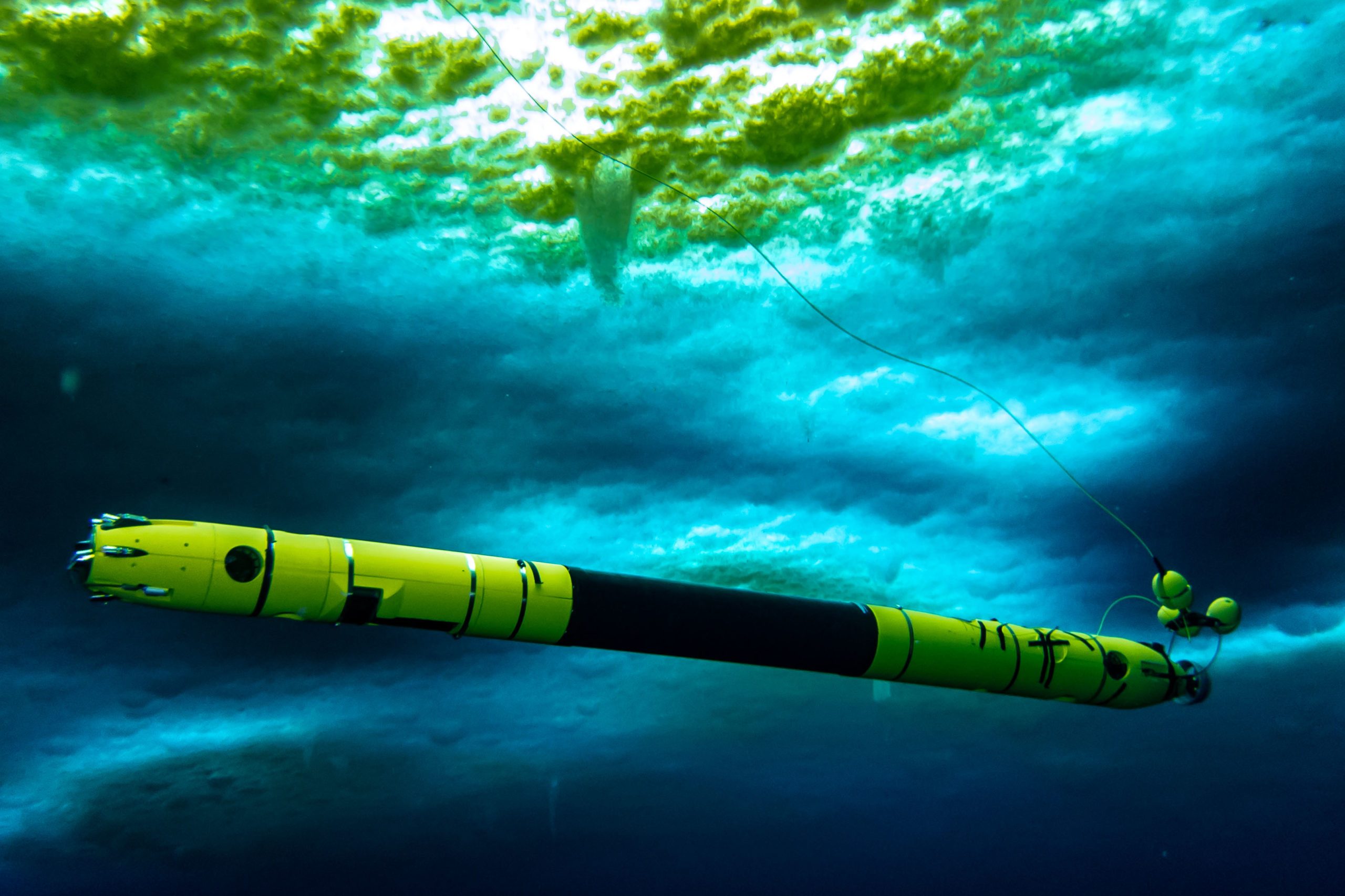
Icefin under the McMurdo sea ice in Antarctica. Photo from Rob Robbins, USAP Diver
Icefin under the McMurdo sea ice in Antarctica. Rob Robbins, USAP Diver

“We designed Icefin to be able to finally enable access to grounding zones of glaciers, places where observations have been nearly impossible, but where rapid change is taking place,” Britney Schmidt, lead scientist for Icefin and associate professor in Georgia Tech’s School of Earth and Atmospheric Sciences, said in a statement. “We’re proud of Icefin, since it represents a new way of looking at glaciers and ice shelves. For really the first time, we can drive miles under the ice to measure and map processes we can’t otherwise reach. We’ve taken the first close-up look at a grounding zone. It’s our ‘walking on the moon’ moment.”

Getting Icefin into place in one of the most hostile regions on Earth came with significant challenges, like extreme winds and temperatures which went as low as minus 22 degrees Fahrenheit. The team had to drill through almost half a mile of ice using hot water to open up access to the ocean, so that they could lower Icefin into place and let it explore.

The findings from Icefin are not only a demonstration of the sub’s capabilities, but also a shocking visual of the impact of climate change on Antarctica. The melting of the Thwaites Glacier accounts for 4% of global sea level rise, and it is one of the regions of the continent which is changing fastest, with scientists estimating that the amount of ice flowing off it and its surrounding glaciers has almost doubled in the last 30 years.

Georgina Torbet
Georgina has been the space writer at Digital Trends space writer for six years, covering human space exploration, planetary…
Remember Samsung’s Ballie home robot? It may finally be inching closer to reality
Leaked app wireframes give the strongest hint yet that Samsung's Ballie home robot, first shown at CES 2020, might still be headed toward an actual release.
Samsung Ballie robot in a room next to a dog feeder.

Samsung's rolling home robot has been the industry's longest-running "will it ever actually ship" joke, and I'll admit I'd mostly given up on it. Now, there's finally a glimmer of hope.

Samsung first unveiled Ballie as a concept at CES 2020. Then, it showed it as a significantly upgraded version four years later. However, the company never confirmed a release date or committed to releasing it at all. 

Read more
Polar is yet another AI browser, but it goes beyond just automating the mundane web chores
Polar wants to turn your browser into an AI-powered productivity tool
Polar AI browser

The AI browser race is entering a new phase. After spending much of 2025 trying to reinvent web search with built-in chatbots, startups are increasingly shifting their attention toward browser agents that can automate repetitive work instead of simply answering questions. The latest company to embrace that transition is Polar, a startup founded by former Perplexity engineer Kevin Zhang, which has raised $5.7 million in seed funding led by Madrona.

Unlike the first generation of AI browsers that targeted everyday consumers, Polar is designed specifically for knowledge workers. Its premise is straightforward: instead of replacing Google Search, the browser aims to eliminate repetitive tasks that professionals perform across dozens of browser tabs every day.

Read more
I use ChatGPT Pro everyday, and these 3 features keep me subscribed
ChatGPT on iPhone

I've used ChatGPT for years, but for the longest time, I never felt the need to pay for it. Instead, I subscribed to Claude Pro because it fit my workflow better. Between regular chat and Cowork, it gave me everything I needed in one place, so paying for another AI subscription didn't make sense.

That changed when OpenAI introduced ChatGPT Work. I was curious enough to give ChatGPT Pro a proper shot, expecting to test one new feature and move on. Instead, I ended up using it far more than I expected. The more I relied on it in my day-to-day work, the more I realized it offered a few things I didn't want to give up. Those are the three features that have kept me happily subscribed ever since.

Read more