
Astronomers have discovered an enormous, ancient galaxy which dates back 12 billion years, to when the universe was in its earliest stages. The galaxy, XMM-2599, “lived fast and died young,” according to the researchers, showing a high rate of star formation before its early demise.
“Even before the universe was 2 billion years old, XMM-2599 had already formed a mass of more than 300 billion suns, making it an ultramassive galaxy,” Benjamin Forrest, a postdoctoral researcher in the UC Riverside Department of Physics and Astronomy and lead author of the research, explained in a statement. “More remarkably, we show that XMM-2599 formed most of its stars in a huge frenzy when the universe was less than 1 billion years old, and then became inactive by the time the universe was only 1.8 billion years old.”
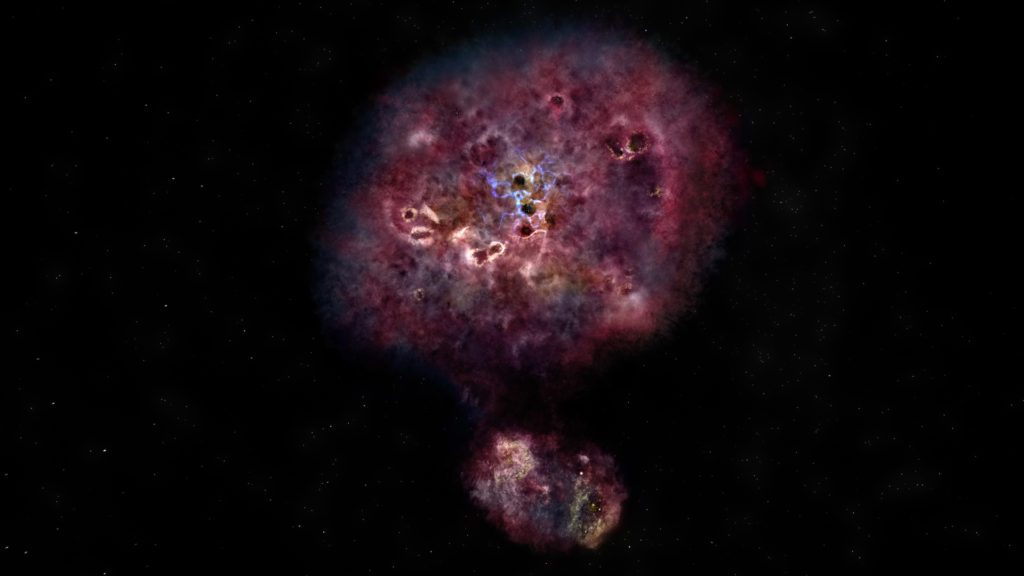
The research is shedding light on the way that galaxies develop over time. “In this epoch, very few galaxies have stopped forming stars, and none are as massive as XMM-2599,” Gillian Wilson, a professor of physics and astronomy at UCR, explained. “The mere existence of ultramassive galaxies like XMM-2599 proves quite a challenge to numerical models. Even though such massive galaxies are incredibly rare at this epoch, the models do predict them. The predicted galaxies, however, are expected to be actively forming stars.
What makes XMM-2599 so interesting, unusual, and surprising is that it is no longer forming stars, perhaps because it stopped getting fuel or its black hole began to turn on. Our results call for changes in how models turn off star formation in early galaxies.”
Due to the unusual nature of XMM-2599, researchers have some theories about how it developed and how it will evolve in the future. “XMM-2599 may be a descendant of a population of highly star-forming dusty galaxies in the very early universe that new infrared telescopes have recently discovered,” said Danilo Marchesini, an associate professor of astronomy at Tufts University and a co-author of the study.
And in terms of the future for this galaxy, “We have caught XMM-2599 in its inactive phase,” Wilson said. “We do not know what it will turn into by the present day. We know it cannot lose mass. An interesting question is what happens around it. As time goes by, could it gravitationally attract nearby star-forming galaxies and become a bright city of galaxies?”
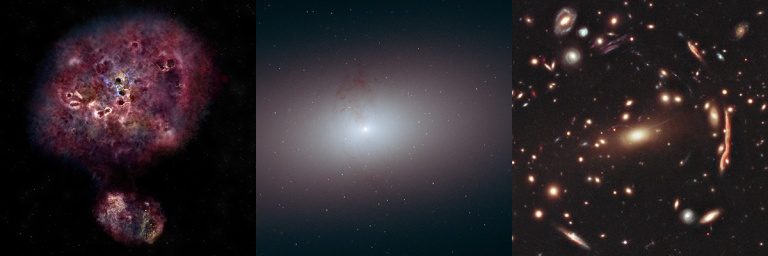
To take measurements of the galaxy, the team used an instrument at the W. M. Keck Observatory called the Multi-Object Spectrograph for Infrared Exploration, or MOSFIRE. This spectrograph splits light into different wavelengths and can select up to 46 objects to be recorded simultaneously, and was able to determine how far away the galaxy is.
“It’s exciting to see one of our most in-demand instruments successfully characterize such a rare, ancient galaxy with a short life span,” co-author Percy Gomez, an astronomer at Keck Observatory, said in the statement. “It took many hours-long observations, some as much as nine hours each, to determine XMM-2599’s distance and mass. It’s fulfilling to be a part of a team that continues pushing Keck and MOSFIRE to probe deeper into the mysteries about the origins of massive galaxies and protoclusters.”
The findings are published in the Astrophysical Journal.



