  1. Home
  2. Emerging Tech
  3. News

3D-printing technique produces tiny, highly detailed objects in seconds

Add as a preferred source on Google

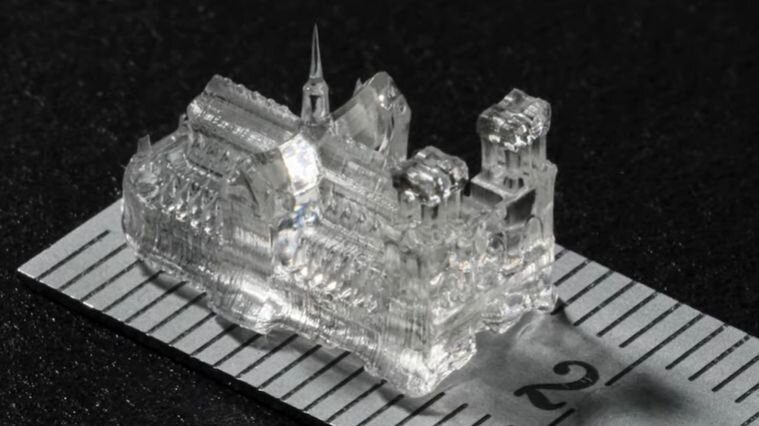
The new fast 3D printing technique developed by researchers at EPFL.
The new fast 3D printing technique developed by researchers at EPFL. Ecole Polytechnique Federale de Lausanne

3D printing has incredible potential for both research and home uses, but it has some limitations. The current technology takes some time to produce an object, and it produces hard structures only. But now, researchers from the Swiss Federal Institute of Technology Lausanne (EPFL) have come up with a method for printing highly-precise miniature objects with different textures.

Recommended Videos

Not only can the process produce more elaborate and detailed soft objects, but it is also extremely quick, requiring less than 30 seconds to print an object from start to finish. It works by using a translucent liquid and setting it into shapes, which can form scaffold-like structures in which cells can develop. It has potential uses in the area of 3D bioprinting, for example for creating artificial arteries that could eventually be used to replace or repair damaged heart parts in humans.

“Conventional 3-D printing techniques, known as additive manufacturing, build parts layer by layer,” Damien Loterie, microengineering researcher and the CEO of Readily3D, the company the team set up to market their technique, explained in a statement. “The problem is that soft objects made that way quickly fall apart.”

To address the issue of stability, the team used the principles of tomography to harden the objects using light. When an object is printed, a laser is fired through the translucent gel to set it into a firmer form.

“It’s all about the light,” Paul Delrot, Readily3D’s CTO, said in the statement. “The laser hardens the liquid through a process of polymerization. Depending on what we’re building, we use algorithms to calculate exactly where we need to aim the beams, from what angles, and at what dose.”

Printing tiny, high-precision objects in a matter of seconds

At the moment, the printer can create structures of up to two centimeters in size, with a precision level of 80 micrometers — which is approximately the width of a human hair. The next stage of research is to develop a printer that can create larger objects of up to 15 centimeters in size. Additionally, the researchers are considering using the process to create silicone or acrylic parts which, unlike traditional 3D printed objects, don’t need to be finished off with sanding.

The research is published in the journal Nature Communications.

Georgina Torbet
Georgina has been the space writer at Digital Trends space writer for six years, covering human space exploration, planetary…
The Apple Car may be dead, but it became the foundation of Apple Intelligence
A decade of work on a canceled car project reportedly laid the groundwork for Apple Intelligence.
Apple Intelligence in Apple Car

The Apple Car may have never left the garage, but it apparently gave birth to Apple's AI ambitions. According to Bloomberg's Mark Gurman, Apple's canceled autonomous vehicle project, one that consumed more than a decade of work and over $10 billion before being scrapped in 2024, ended up laying the technological foundation for Apple Intelligence. In a rather ironic twist, one of Apple's most expensive failures may also become one of its most important long-term investments.

The Apple Car forced Apple to think like an AI company

Read more
Researchers hid a prompt injection inside a PNG, and AI fell for it
Hacker

AI coding assistants like Claude are becoming every developer's favorite coworker. They can review code, explain confusing functions, and even write entire features with a single prompt. But new research suggests that this growing trust could also become their biggest weakness.

A team of security researchers (professor Sudipta Chattopadhyay and researcher Murali Ediga) has demonstrated an unusual attack that doesn't target the AI model directly. Instead, it targets what the AI doesn't pay enough attention to during code reviews. Rather than hiding malicious instructions in lines of code, the researchers tucked them inside an image file. Since many AI review tools treat images as decorative assets rather than as something worth inspecting, the pull request can appear perfectly harmless and sail through the review.

Read more
AI has already fallen into the wrong hands and they’re using it to make bombs
Logo, Text

Artificial intelligence has quickly become the go-to tool for everything from writing emails and summarizing meetings to helping students study or developers debug code. But the same technology that saves people time can also be misused, and a new report suggests that terrorist organizations are finding ways to do exactly that.

According to a research paper shared with The New York Times ahead of its publication, researchers found evidence that members of Boko Haram have been using popular AI chatbots to support both day-to-day activities and combat-related tasks. Interviews with 27 former members conducted in Nigeria over the past two years suggest that tools such as ChatGPT, Gemini, Claude, Grok, Meta AI, and DeepSeek were used to gather technical information, troubleshoot weapons, and even assist with planning attacks.

Read more