  1. Home
  2. Trash
  3. News

Einstein was right, and this star dancing around a black hole proves it

Add as a preferred source on Google

Astronomers have observed a star “dancing” around the supermassive black hole at the heart of our galaxy, Sagittarius A*, in an orbit that confirms Einstein’s theory of general relativity.

Einstein’s theory of relativity overrode the previous model of gravity laid down by Newton. Newton’s theory stated that gravity is a force of attraction between two massive objects, and that this force acted instantaneously. But Einstein contradicted that, saying that gravity was not really a force but was rather a curvature of space-time. Although that distinction sounds abstract, it in fact has profound effects on the way we think about physics, especially in astronomy where we often look at the gravitational interactions of massive bodies.

According to the Newtonian model of gravity, the star moving around the supermassive black hole, called S2, should be in an orbit in the shape of an ellipse. But according to the Einsteinian model, the curvature of space-time caused by the enormous mass of the black hole means that the star should orbit in a rosette pattern, coming in closer to the black hole before moving away again in a new direction. The new observations confirm that S2 does in fact move in a rosette-type orbit.
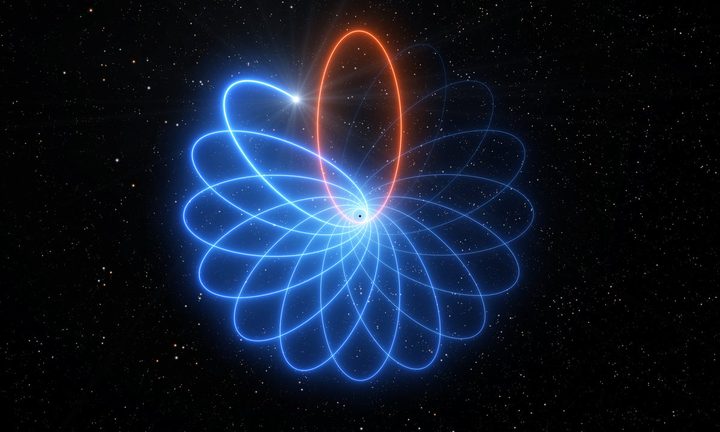
a star orbiting the supermassive black hole
An artist’s impression illustrating observations made with ESO’s Very Large Telescope (VLT), revealing for the first time that a star orbiting the supermassive black hole at the center of the Milky Way moves just as predicted by Einstein’s theory of general relativity in an orbit is shaped like a rosette and not like an ellipse as predicted by Newton’s theory of gravity. ESO/L. Calçada

“This famous effect — first seen in the orbit of the planet Mercury around the Sun — was the first evidence in favor of General Relativity,” said Reinhard Genzel, Director at the Max Planck Institute for Extraterrestrial Physics, the leader of the observations. “One hundred years later we have now detected the same effect in the motion of a star orbiting the compact radio source Sagittarius A* at the center of the Milky Way.”

The observations were made using the Very Large Telescope over a period of 27 years. This large amount of time was required by the star completes an orbit only once every 16 years, even though at times it moves incredibly fast — up to 3% of the speed of light.

The research can tell us not only about gravity but also about how matter moves around black holes, and future projects using the upcoming Extremely Large Telescope could even reveal how fainter stars respond to the rotation of black holes.

Georgina Torbet
Georgina has been the space writer at Digital Trends space writer for six years, covering human space exploration, planetary…
The Digital Trends App Bundle is yours to try for a whole week, free
Digital Trends App Bundle

Recently, we've entered an exciting collaboration with Maple Media, creating a bundle of 17 apps worth having on your phone. From relaxed fun to serious productivity boosts, these apps cover all your bases and provide a fun boost to your phone. Normally, the bundle is $9.99 per month (far lower than the cost of using the apps individually), but for your first 7 days you can get access to the bundle for free. View the full Digital Trends App Bundle for a complete list of the apps, or read on for a summarized take.

Start your free trial

Read more
The Galaxy S26 Ultra might not see much of a battery upgrade after all
It looks like it will stay the same as the last five years.
The back of the Samsung Galaxy S25 Ultra.

What's happened? This week, China's Quality Certification Center released information about a battery (EB-BS04898ABY) with a maximum capacity of 4,855mAh. That's the same capacity as was previously seen in the Samsung Galaxy S25 Ultra, and fans have taken this certification to mean the Galaxy S26 Ultra will not see a capacity increase after all.

The Samsung Galaxy Ultra models have had the same battery capacity for the last five years.

Read more
The Galaxy Tab S10 Lite is official, and it’ll be here sooner than you think
Galaxy Tab S10 Lite

What's happened? Samsung has officially announced the Galaxy Tab S10 Lite, a budget-friendly alternative to the Galaxy Tab S10. The device has been rumored for months, but this is the first time Samsung has officially acknowledged its existence.

The Galaxy Tab S10 Lite will have a 10.9-inch display and a peak brightness of 600 nits — a bit on the lower side, versus the iPad Pro's maximum brightness of 1,600 nits.

Read more