1. Home
  2. Space
  3. News

NASA is making ‘fetch’ happen with its Mars sample collection rover

Add as a preferred source on Google

Both the public and the space community are waiting with bated breath for the launch of the Perseverance rover this summer. The rover will travel to Mars and search for signs of ancient life, including collecting samples of Martian rock and soil.

However, even equipped with instruments including cameras and spectrometers, there is only so much science that can be done by a low-powered rover. To really analyze these Martian samples in full, we need to get them back to Earth.

Recommended Videos

That’s where the Mars Sample Return mission comes in. Organized by NASA together with the European Space Agency, the idea is to send another rover in Perseverance’s footsteps to collect up the samples and bring them to a spaceship on the surface of Mars which can carry them into orbit, where it can rendezvous with a second ship to carry them back to Earth.

The Sample Fetch Rover for this mission is currently under development by Airbus, involving engineers from both Europe and Canada.
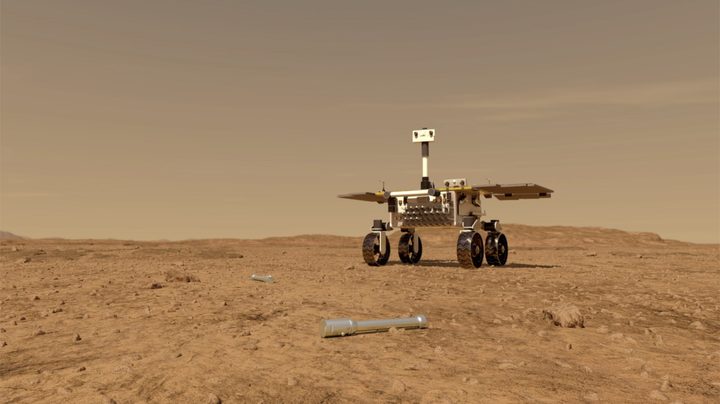
Artist's concept of the Sample Fetch Rover approaching sample tubes
Artist’s concept of the Sample Fetch Rover approaching sample tubes NASA/JPL-Caltech

This plucky little rover is planned to be launched in July 2026, and will land in the area of the Jezero Crater close to where the Perseverance rover will be landing next year. Then it will trundle out across the planet to collect the tubed samples which have been prepared and left on the surface by Perseverance. This means the sample return rover will have to travel quite some distance, in total around 9 to 12 miles, which doesn’t sound like much by Earth standards but is a long way to navigate on an alien planet.

The hope is that the rover will be able to navigate autonomously, moving around 650 feet per day, and tracking down up to 36 samples left by Perseverance. To allow the rover to navigate autonomously, the engineers are developing algorithms which use data from the rover’s cameras to recognize the sample tubes even if they are covered in dust, which is important as high winds and a thin atmosphere make dust a common issue on the planet.

The rover will grasp the tubes using a robotic arm, then place them onto its body to carry them safely. Once it has carried them back to the sample return spacecraft called the Mars Ascent Vehicle, the rover will unload the samples using a different robotic arm into a safe cocoon so they can be launched into orbit. Then they’ll be collected by the Earth Return Orbiter and brought back to Earth for study.

Georgina Torbet
Georgina has been the space writer at Digital Trends space writer for six years, covering human space exploration, planetary…
China’s answer to SpaceX’s reusable rockets literally catches boosters in a net
SpaceX catches boosters on legs. China just used a net.
Ammunition, Missile, Weapon

SpaceX's playbook for recovering a rocket booster generally involves legs, a precisely controlled vertical landing, and either a concrete pad or a drone ship. 

China just managed to pull off something similar, but in a slightly different way, and on July 10, it tested the method as well.

Read more
Dimming the sun sounds unhinged, but this new study on El Niño makes a surprisingly good case for it
A natural test case, Australia's worst-ever wildfire season, suggests the idea deserves serious consideration.
Nature, Outdoors, Sky

When I first saw "scientists propose dimming the sun," I rolled my eyes. It sounds like a science fiction movie cooked up after watching many climate documentaries. But a new study, published on July 8, 2026, in the journal Science Advances, seems to have a genuinely compelling argument.

A Super El Niño is currently forming in the Pacific, feared to be the most intense in decades. It could escalate floods, wildfires, and extreme heat events worldwide. However, Researchers at UC San Diego's Scripps Institution of Oceanography, led by climate scientists Kate Ricke and Jessica Wan, are now proposing one of the most interesting solutions I’ve come across.

Read more
You can now walk through space and gaze into a black hole at this VR exhibit
Smithsonian Starstruck lets you drift past dying stars and see the origin point of the universe for as little as $18 a person.
Smithsonian Starstruck featured

Most planetarium shows ask you to sit still and look up. The Smithsonian's new VR exhibit takes a different approach, letting visitors walk through the vast expanse of the universe, drifting past stars, planets, and a black hole to get a physical sense of its true scale.

A $29 ticket to the edge of the galaxy

Read more