1. Home
  2. Space
  3. News

NASA wants to build a steam-powered hopping robot to explore icy worlds

Add as a preferred source on Google
Hopping Robot Concept to Explore Frozen Ocean Worlds

A bouncing, ball-like robot that’s powered by steam sounds like something out of a steampunk fantasy, but it could be the ideal way to explore some of the distant, icy environments of our solar system.

Recommended Videos

That’s the idea behind NASA’s new robot concept, the Steam Propelled Autonomous Retrieval Robot for Ocean Worlds, or SPARROW. This round robot would be the size of a soccer ball, with instruments held in the center of a metal cage, and it would use steam-powered thrusters to make jumps from one area of terrain to the next.

As wacky as it sounds, it actually makes sense to use steam rather than a rocket fuel as it wouldn’t contaminate the areas the robot travels through. This makes SPARROW suited for exploring icy environments such as Jupiter’s moon Europa or Saturn’s moon Enceladus, which are believed to have a liquid ocean under an icy crust and may be some of the locations in our solar system most likely to support life.
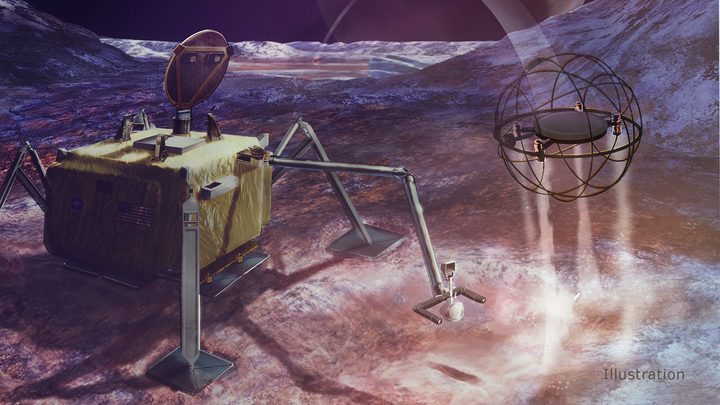
Moons In this artist's concept, a SPARROW robot uses steam propulsion to hop away from its lander home base to explore an icy moon's surface.
In this artist’s concept, a SPARROW robot uses steam propulsion to hop away from its lander home base to explore an icy moon’s surface. NASA/JPL-Caltech

“The terrain on Europa is likely highly complex,” Gareth Meirion-Griffith, JPL roboticist and the lead researcher of the concept, explained in a statement. “It could be porous, it might be riddled with crevasses, there might be meters-high penitentes [long blades of ice which could be dangerous to ground-based vehicles] that would stop most robots in their tracks. But SPARROW has total terrain agnosticism; it has complete freedom to travel across an otherwise inhospitable terrain.”

To figure out how to navigate this complex terrain, the JPL team ran computer simulations to see how a spherical robot could move across uneven ground, and what would happen as it returned to the ground after hopping upward. They found that the most efficient way to move would be for the robot to take big giant hops instead of smaller ones. “From this, and related propulsion calculations, we were able to determine that a single long hop would be more efficient than several smaller hops,” Meirion-Griffith said.

The SPARROW concept is still under development, so the next step will be to apply for Phase II funding under NASA’s Innovative Advanced Concepts program, which aims to encourage visionary new ideas for exploring the solar system and beyond.

Georgina Torbet
Georgina has been the space writer at Digital Trends space writer for six years, covering human space exploration, planetary…
China’s answer to SpaceX’s reusable rockets literally catches boosters in a net
SpaceX catches boosters on legs. China just used a net.
Ammunition, Missile, Weapon

SpaceX's playbook for recovering a rocket booster generally involves legs, a precisely controlled vertical landing, and either a concrete pad or a drone ship. 

China just managed to pull off something similar, but in a slightly different way, and on July 10, it tested the method as well.

Read more
Dimming the sun sounds unhinged, but this new study on El Niño makes a surprisingly good case for it
A natural test case, Australia's worst-ever wildfire season, suggests the idea deserves serious consideration.
Nature, Outdoors, Sky

When I first saw "scientists propose dimming the sun," I rolled my eyes. It sounds like a science fiction movie cooked up after watching many climate documentaries. But a new study, published on July 8, 2026, in the journal Science Advances, seems to have a genuinely compelling argument.

A Super El Niño is currently forming in the Pacific, feared to be the most intense in decades. It could escalate floods, wildfires, and extreme heat events worldwide. However, Researchers at UC San Diego's Scripps Institution of Oceanography, led by climate scientists Kate Ricke and Jessica Wan, are now proposing one of the most interesting solutions I’ve come across.

Read more
You can now walk through space and gaze into a black hole at this VR exhibit
Smithsonian Starstruck lets you drift past dying stars and see the origin point of the universe for as little as $18 a person.
Smithsonian Starstruck featured

Most planetarium shows ask you to sit still and look up. The Smithsonian's new VR exhibit takes a different approach, letting visitors walk through the vast expanse of the universe, drifting past stars, planets, and a black hole to get a physical sense of its true scale.

A $29 ticket to the edge of the galaxy

Read more