We know that black holes absorb everything that comes near them, even light, which is one reason why they’re so tricky to research. And dramatic things happen when two black holes collide — not only do these epic collisions give off gravitational waves, but a new theory suggests they may also explode with light.
Researchers from the California Institute of Technology spotted a strange flare of light from supermassive black hole J1249+3449 using the Zwicky Transient Facility (ZTF) at Palomar Observatory. They tracked its source to an area also being studied by the famous LIGO observatory which looks for gravitational waves from colliding black holes.
“This supermassive black hole was burbling along for years before this more abrupt flare,” Matthew Graham, a research professor of astronomy at Caltech and the project scientist for ZTF, explained in a statement. “The flare occurred on the right timescale, and in the right location, to be coincident with the gravitational-wave event. In our study, we conclude that the flare is likely the result of a black hole merger, but we cannot completely rule out other possibilities.”
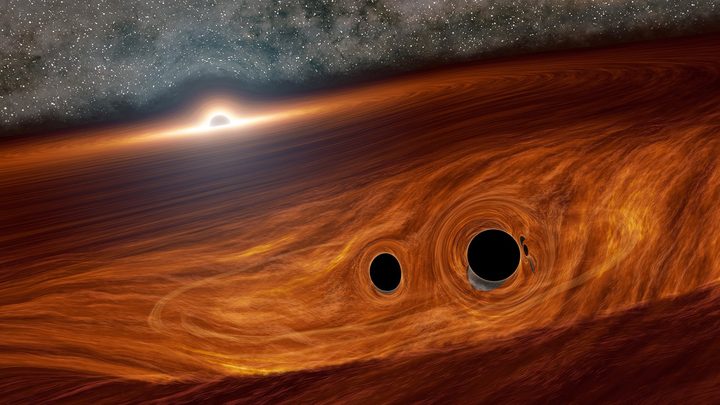
To explain how two light-absorbing black holes could collide and release a burst of light, the researchers theorized that the two merging black holes sit within a disk surrounding a much larger black hole.
“At the center of most galaxies lurks a supermassive black hole. It’s surrounded by a swarm of stars and dead stars, including black holes,” co-author K. E. Saavik Ford explained in the statement. “These objects swarm like angry bees around the monstrous queen bee at the center. They can briefly find gravitational partners and pair up but usually lose their partners quickly to the mad dance. But in a supermassive black hole’s disk, the flowing gas converts the mosh pit of the swarm to a classical minuet, organizing the black holes so they can pair up,” she said.
The two black holes within this disk merge, sending out a shockwave of energy through the cloud of gas. “It is the reaction of the gas to this speeding bullet that creates a bright flare, visible with telescopes,” co-author Barry McKernan explained.
Studying events like this could help scientists to learn more about black holes of all sizes. “Supermassive black holes like this one have flares all the time. They are not quiet objects, but the timing, size, and location of this flare was spectacular,” said co-author Mansi Kasliwal. “The reason looking for flares like this is so important is that it helps enormously with astrophysics and cosmology questions. If we can do this again and detect light from the mergers of other black holes, then we can nail down the homes of these black holes and learn more about their origins.”
The findings are published in the journal Physical Review Letters.