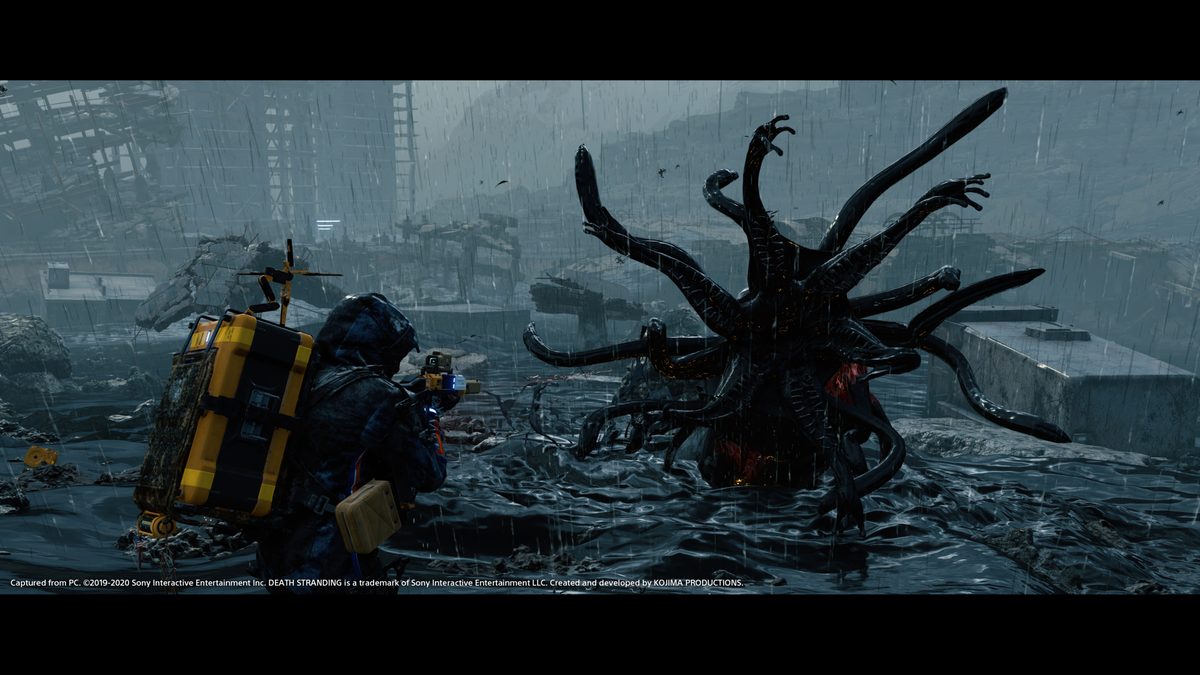
Death Stranding is ambitious. Whatever your thoughts about its bewildering narrative and travel-focused gameplay, there’s no denying director Hideo Kojima’s latest sets its sights high. It delivers massive open-world spaces alongside stunning in-engine cinematics that rival those shown by games planning to launch on next-generation consoles.
Its visual treats have left PC players eager to see how the game’s port will hold up. There’s a lot of good news and only a little bad news. PC gamers should be very happy with what they see.
The fiddly interface remains
Interface woes were a common criticism of Death Stranding when it released on the PlayStation 4 last year. Having played the game on PS4 Pro, I echo those concerns. There’s a lot going on in this game, from inventory management to massive maps full of locations and player-built structures, and information isn’t delivered clearly. I found myself struggling to navigate specific locales, and I never felt comfortable with the way specific packages and equipment were moved to and from my inventory.
The PC doesn’t fix these issues. Using a mouse to select inventory items is a little easier than using a controller, perhaps, but Death Stranding on PC suffers from mouse control that feels imprecise. The menus also retain the console-optimized look as before, so you’ll often run into interface elements that seem too large or poorly placed.
I’m not sure about the controls, either. Death Stranding is a true walking simulator, focusing primarily on traversal of tough terrain. On PS4, you maintain Sam Porter Bridges’ balance with the trigger and shoulder buttons. On PC, without a controller plugged in, you use a combination of the left and right buttons, along with the keyboard.
It feels like what it is – an attempt to wrangle a control scheme built with the PlayStation 4 in mind onto an entirely different set of inputs. I remember holding the DualShock4 close to my chest as I tried to keep Sam from stumbling. Keyboard and mouse can’t replicate that same tactile experience.
Of course, you can fix this by plugging in a controller. I imagine most PC gamers reading this have a controller already. If you’re a purist who insists on using a keyboard and mouse, however, I don’t think you’ll be satisfied by the port.
It’s beautiful and beautifully optimized
I received my preview of Death Stranding with a quirky embargo attached. As a result, I can’t share screenshots or videos I’ve captured. I can, however, describe the experience.
First, I launched the game on the Acer Predator Triton 500 laptop I recently reviewed. This laptop has Nvidia’s RTX 2080 Super Max-Q graphics chip with performance similar to a standard RTX 2080 desktop graphics card. It’s an extremely powerful system, and it made easy work of Death Stranding.
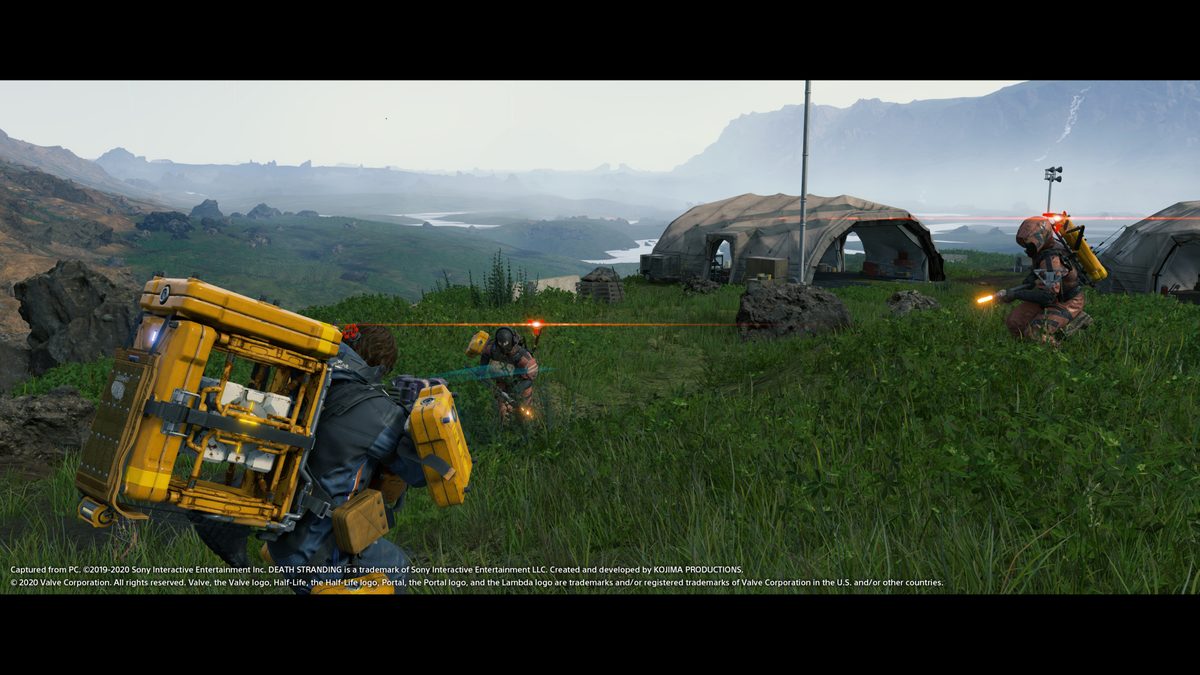
At 1440p and maximum quality settings, the game rendered smoothly at 70 fps (frames per second) to 80 fps in all situations aside from a few of the most demanding moments in cutscenes. A smooth and stable 60 fps was achieved with plenty of room to spare. While I don’t have a 4K monitor at my home setup, the game was stable enough that I’d imagine 4K at 30 fps is achievable on most high-end video cards in the RTX 2000-series.
It’s no surprise to see the RTX 2080 Super Max-Q do well, of course — but how does it run on more anemic hardware? To find out, I launched the game on my entry-level custom gaming desktop. This system had an AMD Ryzen 5 3400G processor with Nvidia’s GTX 1650 Super graphics card.
The results were excellent. Death Stranding was close to a stable 60 fps at maximum detail and 1080p resolution. I also saw a nearly stable 30 fps at maximum detail and 1440p resolution. The game did occasionally drop below the 60 fps or 30fps mark, respectively, but not so frequently that I would’ve noticed if I didn’t have benchmark software (OCAT) running.
I did notice one performance issue: Load times. They were long on both systems I tested. Load times on the entry-level gaming desktop could exceed one minute, which is unusual for a PC game in 2020 (load times for the PS4 version can also exceed one minute) Once loaded, though, the game’s performance is excellent.
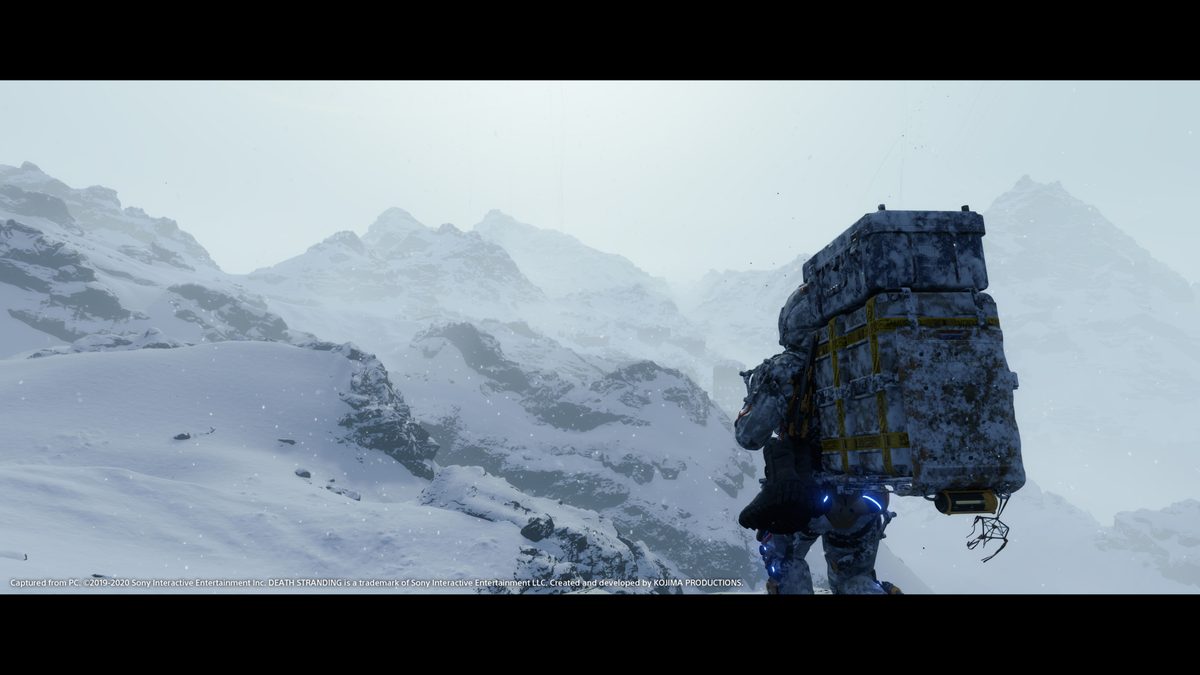
Nvidia is touting the inclusion of DLSS 2.0 in Death Stranding. I’m not sure this game will be the feature’s headliner, given how well it already performs. Still, DLSS 2.0 brought a performance boost without an immediately noticeable hit to image quality. I saw a gain of about 20 to 30 fps on the Acer Predator Triton 500. DLSS 2.0 could be useful if you have a high-refresh monitor and want to push performance toward the upper end of what your display can handle, or you want to power 4K gameplay on a relatively modest PC. I hope to test this more thoroughly over the next two weeks.
It’s worth noting that DLSS 2.0 has improved over the first version. Image quality suffers less softness and fewer artifacts than was common in DLSS when the feature first arrived.
Death Stranding is certainly a looker on PC, just as on the PS4. It doesn’t have a killer PC-specific feature, like RTX ray tracing or an ultra-high-res texture pack, but I’m OK with that. As I played, I couldn’t help but compare the PC port of Death Stranding to cross-platform games like The Division 2 or Borderlands 3. Those games don’t perform much better on PC and yet — in my opinion, at least — they deliver a much less impressive visual experience.
Good news for future PC ports
The performance of Death Stranding has implications that extend to other games. Kojima Productions built the game with Decima, a proprietary game engine from Guerilla Games. This is the same engine used for Horizon Zero Dawn, which is also due to see a PC port sometime this summer.
I’m hopeful that we’ll see the same level of performance from Horizon. And, based on what I’ve seen so far, I wouldn’t hesitate to recommend Death Stranding on PC.
Death Stranding comes to PC on July 14 for $60.