1. Home
  2. Space
  3. News

Crispy image of Jupiter shows its epic storms and icy moon Europa

Add as a preferred source on Google

Jupiter is not only our solar system’s most visually striking planet, it is also surrounded by a large number of moons — one of which is a promising location to search for life. Europa, one of the closest and largest of Jupiter’s 79 moons, has an icy crust which experts think could be hiding an ocean where life could potentially flourish.

Now, a new image from the Hubble Space Telescope captures both Jupiter and Europa in delightfully sharp detail.
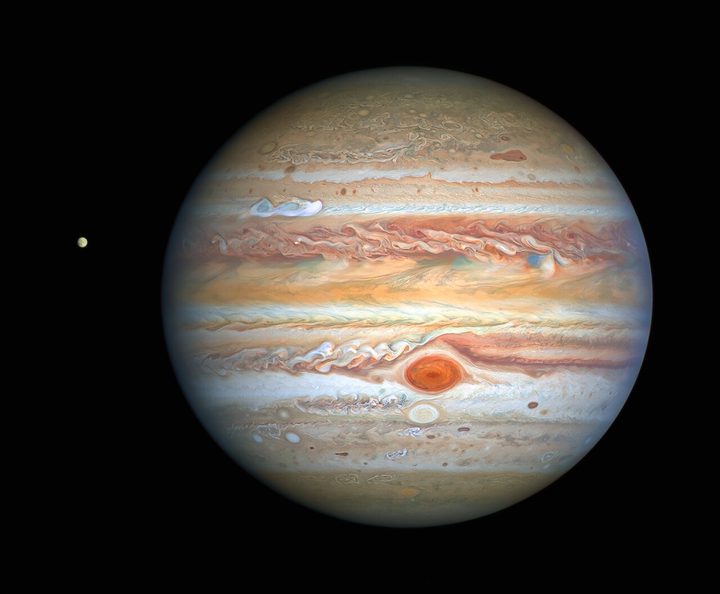
Hubble’s Crisp New Image of Jupiter and Europa
This latest image of Jupiter, taken by the NASA/ESA Hubble Space Telescope on 25 August 2020, was captured when the planet was 653 million kilometers from Earth. Hubble’s sharp view is giving researchers an updated weather report on the monster planet’s turbulent atmosphere, including a remarkable new storm brewing, and a cousin of the Great Red Spot changing color — again. The new image also features Jupiter’s icy moon Europa. NASA, ESA, A. Simon (Goddard Space Flight Center), and M. H. Wong (University of California, Berkeley) and the OPAL team.

Jupiter is full of surprises, and this image shows how the weather on the planet is changing — especially in the Great Red Spot, the large circular structure shown in orange which is a superstorm stretching nearly 10,000 miles across. That means this spot is so large it could swallow the Earth in its entirety.

Recommended Videos

This huge spot isn’t static though — it has actually been shrinking since early observations in the 1930s, but that shrinking seems to have slowed down and astronomers aren’t sure why. Another open question is why the spot is the color it is, in the attention-grabbing bright orange, as most storms on Jupiter appear white or brown. And its color changes over time as well, with this image showing it a more rich reddish color than it has been previously.

As for Europa, you can see it to the left of Jupiter. Hubble has previously observed water vapor being ejected from the moon’s surface which could be linked to liquid water beneath the icy crust. But it’s hard to know for sure what these plumes of water mean until we can study it up close. For that purpose, the European Space Agency is launching a mission to Jupiter’s moons in 2022, called JUICE (JUpiter ICy moons Explorer), which will explore Europa as well as its sibling moons Ganymede, Callisto, and Europa, to learn more about the ocean that could be hiding beneath the ice.

Georgina Torbet
Georgina has been the space writer at Digital Trends space writer for six years, covering human space exploration, planetary…
China’s answer to SpaceX’s reusable rockets literally catches boosters in a net
SpaceX catches boosters on legs. China just used a net.
Ammunition, Missile, Weapon

SpaceX's playbook for recovering a rocket booster generally involves legs, a precisely controlled vertical landing, and either a concrete pad or a drone ship. 

China just managed to pull off something similar, but in a slightly different way, and on July 10, it tested the method as well.

Read more
Dimming the sun sounds unhinged, but this new study on El Niño makes a surprisingly good case for it
A natural test case, Australia's worst-ever wildfire season, suggests the idea deserves serious consideration.
Nature, Outdoors, Sky

When I first saw "scientists propose dimming the sun," I rolled my eyes. It sounds like a science fiction movie cooked up after watching many climate documentaries. But a new study, published on July 8, 2026, in the journal Science Advances, seems to have a genuinely compelling argument.

A Super El Niño is currently forming in the Pacific, feared to be the most intense in decades. It could escalate floods, wildfires, and extreme heat events worldwide. However, Researchers at UC San Diego's Scripps Institution of Oceanography, led by climate scientists Kate Ricke and Jessica Wan, are now proposing one of the most interesting solutions I’ve come across.

Read more
You can now walk through space and gaze into a black hole at this VR exhibit
Smithsonian Starstruck lets you drift past dying stars and see the origin point of the universe for as little as $18 a person.
Smithsonian Starstruck featured

Most planetarium shows ask you to sit still and look up. The Smithsonian's new VR exhibit takes a different approach, letting visitors walk through the vast expanse of the universe, drifting past stars, planets, and a black hole to get a physical sense of its true scale.

A $29 ticket to the edge of the galaxy

Read more