1. Home
  2. Space
  3. News

Parker Solar Probe on record-breaking approach to the sun

Add as a preferred source on Google

NASA’s Parker Solar Probe is set to break a record tomorrow, becoming the closest-ever human-made object to the sun. The probe will break its own previous record, coming within 8.4 million miles of the sun’s surface and traveling at 289,927 miles per hour.

This will be the probe’s sixth flyby of the sun since it was launched in 2018. As it orbits around the sun, it gets gradually closer and closer with each pass, and over the summer it got an extra boost by using the gravity of Venus to adjust its trajectory. In July this year, the probe came within just 518 miles of the surface of Venus, and the gravitational assist from this maneuver allowed the probe to get 3.25 million miles closer to the sun than its last pass in June.

Recommended Videos

This flyby will also be the first time that the probe will pass within 0.1 AU of the sun. An AU, or astronomical unit, is a measurement of distance where 1 AU is equal to the average distance between the Earth and the sun.
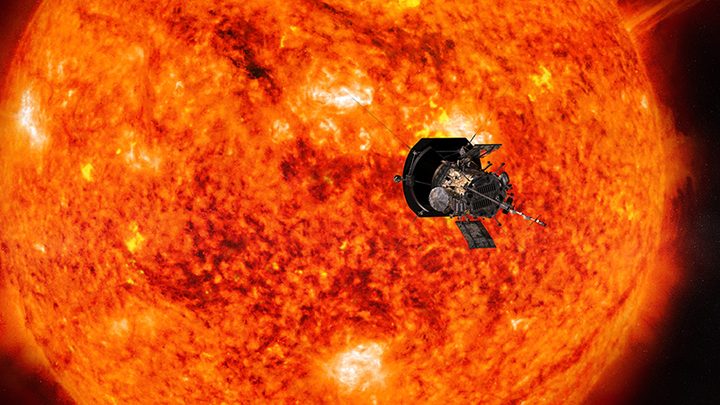
Artist’s concept of the Parker Solar Probe spacecraft approaching the sun. NASA/Johns Hopkins APL/Steve Gribben

“After our last orbit — during which we started science operations much farther out than this encounter — we’re returning our focus to the solar wind closer to the Sun,” said Nour Raouafi, Parker Solar Probe project scientist at the Johns Hopkins Applied Physics Laboratory in Laurel, Maryland, in a statement. “We always wonder if we’ll see something new as we get closer and closer. And as the solar cycle rises and the Sun becomes more active, we’ll be able to observe that activity from an unprecedented vantage point.”

The probe is collecting data on the sun’s activity to understand more about its outer atmosphere, called the corona. The approaches allow the probe to collect measurements from closer to the sun than ever before, and also to capture images of the corona up close.

Scientists want to know more about solar wind, a stream of charged particles released from the corona, as the wind can travel through the solar system and affect space weather. Here on Earth, space weather affects satellite communications and the electrical systems of craft in orbit, and the radiation can even affect astronauts too.

Georgina Torbet
Georgina has been the space writer at Digital Trends space writer for six years, covering human space exploration, planetary…
China’s answer to SpaceX’s reusable rockets literally catches boosters in a net
SpaceX catches boosters on legs. China just used a net.
Ammunition, Missile, Weapon

SpaceX's playbook for recovering a rocket booster generally involves legs, a precisely controlled vertical landing, and either a concrete pad or a drone ship. 

China just managed to pull off something similar, but in a slightly different way, and on July 10, it tested the method as well.

Read more
Dimming the sun sounds unhinged, but this new study on El Niño makes a surprisingly good case for it
A natural test case, Australia's worst-ever wildfire season, suggests the idea deserves serious consideration.
Nature, Outdoors, Sky

When I first saw "scientists propose dimming the sun," I rolled my eyes. It sounds like a science fiction movie cooked up after watching many climate documentaries. But a new study, published on July 8, 2026, in the journal Science Advances, seems to have a genuinely compelling argument.

A Super El Niño is currently forming in the Pacific, feared to be the most intense in decades. It could escalate floods, wildfires, and extreme heat events worldwide. However, Researchers at UC San Diego's Scripps Institution of Oceanography, led by climate scientists Kate Ricke and Jessica Wan, are now proposing one of the most interesting solutions I’ve come across.

Read more
You can now walk through space and gaze into a black hole at this VR exhibit
Smithsonian Starstruck lets you drift past dying stars and see the origin point of the universe for as little as $18 a person.
Smithsonian Starstruck featured

Most planetarium shows ask you to sit still and look up. The Smithsonian's new VR exhibit takes a different approach, letting visitors walk through the vast expanse of the universe, drifting past stars, planets, and a black hole to get a physical sense of its true scale.

A $29 ticket to the edge of the galaxy

Read more