One of science fiction’s most classic tropes is the dastardly plan to destroy the planet with a massive, world-ending bomb. You’ve almost certainly seen it before. The trope has made appearances in some of the world’s most beloved movie franchises, from Mission Impossible to Planet of the Apes. Sometimes the bomb in question will end all life on Earth, but in other cases, it’s powerful enough to blow the entire planet to smithereens.
The sheer ubiquity of this trope begs the question: Are weapons of this size and power possible in the real world? Sure, nuclear weapons are deadly and dangerous, but do they have realistic world-ending potential? Could someone build a nuke large enough to obliterate the planet? What would it take? To get an answer, Digital Trends spoke with Brian Toon, an atmospheric scientist at the University of Colorado Boulder, whose research led to the discovery of nuclear winter.
According to Toon, if you want to get a grasp on what kind of power it would take to blow up the planet, it’s helpful to think about the asteroid that killed the dinosaurs. The energy that was released by that collision was equivalent to a 100-million-megaton blast. Toon says the chance we’ll ever create a nuclear bomb that powerful is practically zero.
How can he be so sure? Well, the largest nuclear bomb ever detonated, the Soviet Union’s Tsar Bomba, had a yield of just 50 megatons. That’s over 1,570 times more powerful than the bombs the U.S. dropped on Hiroshima and Nagasaki combined. And while the blast the Tsar Bomba created was the largest man-made explosion in history, it was still only 0.0000001 percent as powerful as the asteroid that killed the dinosaurs.
Plus, even if we could cobble together enough fissile material to develop a bomb with the same destructive power as the aforementioned asteroid, it still wouldn’t be enough to destroy the planet. “The asteroid that killed the dinosaurs didn’t do anything to the orbit of the Earth or blow apart the Earth,” Toon says. “It made a hole in the Yucatán Peninsula and covered parts of the United States with a bunch of rocks from the crater and [exterminated] a fair fraction of all of the species on the planet, but it didn’t do anything of serious note to the planet itself.”
Not-so-assured destruction
So, we seemingly can’t blow up the Earth with a massive nuclear bomb — but could we destroy the planet in some other way with such a bomb? Another popular film trope is that nuclear warfare leads to what is called a nuclear winter. That’s the idea of nuclear blasts injecting soot into the stratosphere and blocking out the sun. Could a massive bomb do that all by itself?
According to Toon, the answer is no. One large bomb wouldn’t be enough to cause a nuclear winter. He says in order for a nuclear winter to occur, you’d need to have dozens of bombs going off in cities around the world around the same time. Plus, even if you completely decimated one of the world’s largest cities, it wouldn’t create enough soot to cause a nuclear winter.
“Toon says setting the Earth’s atmosphere on fire was actually a serious concern before the first nuclear bomb was detonated.”
“If you want to have a nuclear winter, you have to burn a lot of material, which is mainly in cities,” Toon says. “It’s a little bit difficult to quantify this, but it’s thought that if you set off typical-sized nuclear weapons in 100 cities — large cities — then you’d probably create a nuclear winter.”
So nuclear winter is unlikely from a single bomb — but what about setting Earth’s atmosphere on fire, like the bomb in Planet of the Apes supposedly could? Surely, an enormous bomb could accomplish that, right? Well as it turns out, that’s not particularly likely either.
Toon says setting the Earth’s atmosphere on fire was actually a serious concern before the first nuclear bomb was detonated. Back then, physicists worried that setting off the bomb could create a chain reaction that would set the atmosphere ablaze, but they decided to test the bomb anyway.
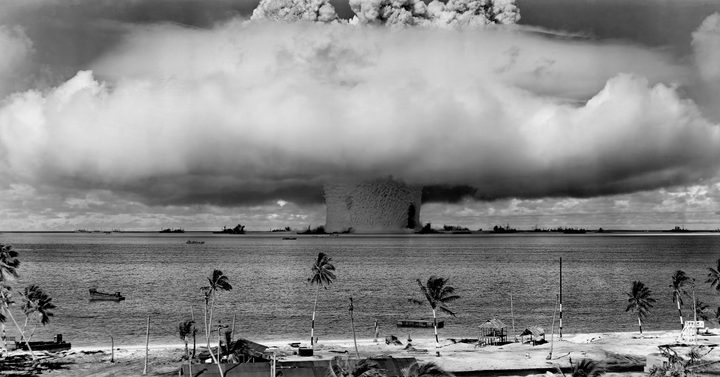
“People were concerned it would set off a chain reaction in the atmosphere — a fusion reaction — and basically burn up all of the water on the planet and destroy the Earth,” Toon says. “They had to know how likely it was that the atoms in the atmosphere would actually absorb the particles that come from the fusion reaction, and they weren’t 100 percent sure what it was, but somebody said there was a one-in-a-million chance of destroying the entire planet.”
Toon says these physicists decided a one -in-a-million chance was worth the risk, and they detonated the bomb. That explosion didn’t set the Earth’s atmosphere on fire, and neither have the many nuclear bombs we’ve set off since then. Thus, it seems quite unlikely our theoretical superbomb would do it.
What Toon worries about when it comes to nuclear bombs is less extravagant but very dangerous. He says the United States and Russia have both been working on increasing their nuclear weapons capabilities in recent years, and we could be moving toward another arms race if things continue to escalate.
“It could become one, and that would be very expensive and of no value unless you happen to be someone who works for companies that make weapons,” Toon says.