  1. Home
  2. Space
  3. News

This strange planet has three suns and orbits at a funky angle

Add as a preferred source on Google

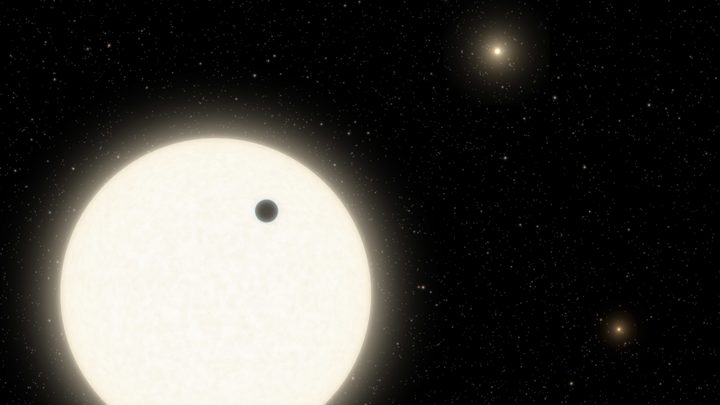
This illustration shows the planet KOI-5Ab transiting across the face of a Sun-like star, which is part of a triple-star system located 1,800 light-years away in the Cygnus constellation.
This illustration shows the planet KOI-5Ab transiting across the face of a Sun-like star, which is part of a triple-star system located 1,800 light-years away in the Cygnus constellation. Caltech/R. Hurt (Infrared Processing and Analysis Center, or IPAC)

The oddities in our universe are many, and new research has thrown light on one such strange star system discovered more than a decade ago. Researchers have found a planet with three suns and an unusual kink in its orbit.

Recommended Videos

Planet KOI-5Ab was discovered all the way back in 2009, as just the second candidate discovered by NASA’s then-new Kepler mission. But no one paid much attention to this particular world as Kepler continued to discover new and exciting planets.

But there’s some value in looking back into the past for things that others have overlooked, as the team from NASA’s Exoplanet Science Institute discovered. Chief scientist David Ciardi poked back through the available data on KOI-5Ab from various different telescopes and discovered that it was well worth a second look.

“KOI-5Ab got abandoned because it was complicated, and we had thousands of candidates,” said Ciardi in a statement. “There were easier pickings than KOI-5Ab, and we were learning something new from Kepler every day, so that KOI-5 was mostly forgotten.”

KOI-5Ab’s most notable feature is that it is part of a triple star system, meaning it orbits a star that is in an orbital pattern with two other stars. The elaborate dance of the three stars and the planet is a rare thing to find already, and this system is even more unusual because the planet’s orbit is tilted at an angle.
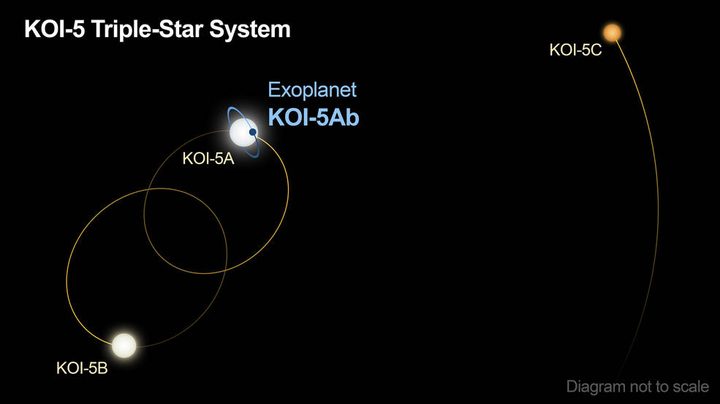
Diagram of the orbits of the KOI-5 star system
The KOI-5 star system consists of three stars, labeled A, B, and C, in this diagram. Stars A and B orbit each other every 30 years. Star C orbits stars A and B every 400 years. The system hosts one known planet, called KOI-5Ab, which was discovered and characterized using data from NASA’s Kepler and Transiting Exoplanet Survey Satellite missions, as well as ground-based telescopes. KOI-5Ab is about half the mass of Saturn and orbits Star A roughly every five days. Its orbit is tilted 50 degrees relative to the plane of stars A and B. Astronomers suspect that this misaligned orbit was caused by Star B, which gravitationally kicked the planet during its development, skewing its orbit and causing it to migrate inward. Caltech/R. Hurt (Infrared Processing and Analysis Center, or IPAC)

“We don’t know of many planets that exist in triple-star systems, and this one is extra special because its orbit is skewed,” said Ciardi. “We still have a lot of questions about how and when planets can form in multiple-star systems and how their properties compare to planets in single-star systems. By studying this system in greater detail, perhaps we can gain insight into how the universe makes planets.”

The tilt of the planet suggests that it and the stars in the system may not have formed from the same disk of gas and dust, as is typical. The current theory to explain the planet’s tilt is that one of the other stars interfered with the planet’s orbit, its gravity kicking the planet into a different plane.

Georgina Torbet
Georgina has been the space writer at Digital Trends space writer for six years, covering human space exploration, planetary…
Space is becoming Bezos and Musk’s next data center site, and we have every reason to worry
The AI boom is coming for the night sky
How Vast's space station will look in orbit.

AI data centers already consume vast amounts of electricity and water on Earth, so Silicon Valley has begun looking somewhere considerably more spacious... literally.

Elon Musk's SpaceX and Jeff Bezos' Blue Origin, along with several other companies, have proposed enormous constellations of satellites designed to operate as orbital data centers. However, environmental groups and former space officials are now warning that putting them into orbit at the proposed scale could have severe consequences for Earth's atmosphere and the night sky.

Read more
The first possible exomoon is here, and it makes our Moon look hilariously tiny
Scientists may have found the first exomoon, except this one is the size of Jupiter
This artist’s concept depicts a potential volcanic moon between the exoplanet WASP-49 b, left, and its parent star. New evidence indicating that a massive sodium cloud observed near WASP-49 b is produced by neither the planet nor the star has prompted researchers to ask if its origin could be an exomoon.

We have already discovered more than 6,000 planets outside of our immediate neighborhood. Yet, finding a moon orbiting one of those distant worlds has proved considerably harder. Astronomers may finally have something close to the real deal, but this particular object stretches the word “moon” almost beyond recognition.

Using the European Southern Observatory’s Very Large Telescope in Chile, researchers detected strong evidence for a moon-like object in the CD-35 2722 system. Further observations are still necessary to confirm the discovery, but it could become the first confidently detected natural satellite outside our solar system. There is still one tiny complication though. This moon is apparently massive.

Read more
China’s answer to SpaceX’s reusable rockets literally catches boosters in a net
SpaceX catches boosters on legs. China just used a net.
Ammunition, Missile, Weapon

SpaceX's playbook for recovering a rocket booster generally involves legs, a precisely controlled vertical landing, and either a concrete pad or a drone ship. 

China just managed to pull off something similar, but in a slightly different way, and on July 10, it tested the method as well.

Read more