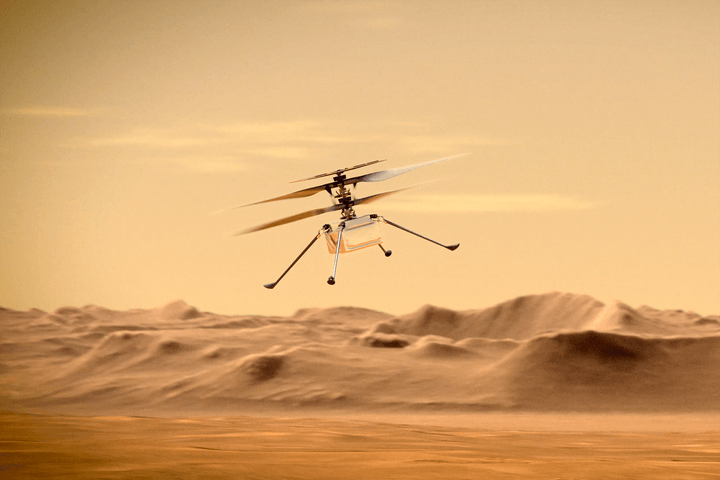
With NASA’s textbook landing of the rover Perseverance on Mars this week, the public’s attention has been captured by a very special companion tucked inside the aeroshell along with the rover: The helicopter Ingenuity. This tiny four-blade craft will be the first aircraft to fly on another planet, in a technology demonstration that could change the way we explore Mars and beyond.
Now, NASA’s Jet Propulsion Laboratory (JPL) has shared the first update from Ingenuity as it has checked in from the red planet. The signal came from the rover’s location in the Jezero Crater and was received by JPL in California at 3:30 p.m. PST (6:30 p.m. EST) on Friday, February 19, having been relayed by the Mars Reconnaissance Orbiter.
The helicopter is still tucked away safely inside the belly of the rover, and the signal indicates the both the helicopter and its base station are healthy and operating. That means Ingenuity should be ready for its first flight on Mars, which will occur between 60 and 90 Martian days from now.
That’s good news for the team at JPL, who are keen to try out this new and experimental piece of technology.
“There are two big-ticket items we are looking for in the data: The state of charge of Ingenuity’s batteries as well as confirmation the base station is operating as designed, commanding heaters to turn off and on to keep the helicopter’s electronics within an expected range,” said Tim Canham, Ingenuity Mars Helicopter operations lead at JPL, in a statement. “Both appear to be working great. With this positive report, we will move forward with tomorrow’s charge of the helicopter’s batteries.”
The heaters are an important element of the helicopter as the electronics are sensitive to cold, and the temperatures on Mars can be between -20 degrees Celcius during the day to as low as -90 degrees Celsius at night. Charging the batteries for one hour should give them a charge of around 30%, with future charging sessions scheduled weekly to keep the helicopter topped up with power and toasty warm.
When it’s ready to fly, Perseverance will gently release Ingenuity onto the Martian surface and drive away to a safe distance. Ingenuity’s first test flight will be a brief hover in the air for a short while. If all goes well there are up to four more test flights planned, each increasing in complexity. This will be a groundbreaking feat for the little 4-pound craft, and for its operators and designers too.
“We are in uncharted territory, but this team is used to that,” said MiMi Aung, project manager for the Ingenuity Mars Helicopter at JPL. “Just about every milestone from here through the end of our flight demonstration program will be a first, and each has to succeed for us to go on to the next. We’ll enjoy this good news for the moment, but then we have to get back to work.”