1. Home
  2. Space
  3. News

Here are an astronaut’s favorite photos of Earth taken from space

Add as a preferred source on Google
Picturing Earth: Eye of the Beholder

Seeing our planet from orbit is, by all accounts, a truly remarkable experience. There’s even a phenomenon called the overview effect in which seeing the Earth from space can result in a profound change in how a person sees the world and their place in it.

Recommended Videos

Those of us who are stuck on the ground can get a small glimpse of what that experience might be like from the photographs taken by astronauts or by instruments that show incredible views of our planet from high above.

The Picturing Earth series from the Earth Science and Remote Sensing (ESRS) unit at NASA’s Johnson Space Center has cataloged many of the images taken of Earth from above and has now shared some favorite images selected by team members and an astronaut who served on the International Space Station (ISS).

Jeff Williams was a member of the International Space Station’s Expedition 13 in 2006, and while in orbit he noticed the Cleveland Volcano on Chuginadak Island in Alaska erupting and spewing out a plume of ash. He notified the Alaska Volcano Observatory of the event and snapped this photograph from the ISS using a digital camera and an 800 mm lens.
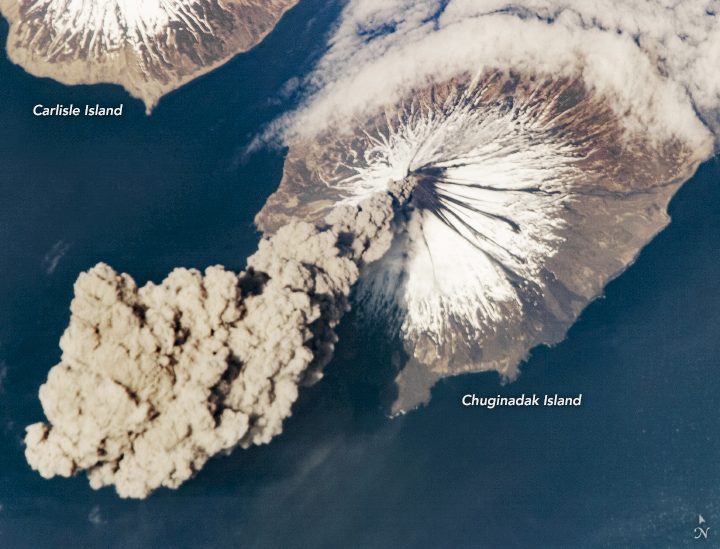
At 3:00 p.m. Alaska Daylight Time on May 23, 2006, flight engineer Jeff Williams from International Space Station (ISS) Expedition 13 contacted the Alaska Volcano Observatory (AVO) to report that the Cleveland Volcano had produced a plume of ash. Shortly after the activity began, he took this photograph.
At 3:00 p.m. Alaska Daylight Time on May 23, 2006, flight engineer Jeff Williams from International Space Station (ISS) Expedition 13 contacted the Alaska Volcano Observatory (AVO) to report that the Cleveland Volcano had produced a plume of ash. Shortly after the activity began, he took this photograph. NASA, Earth Science and Remote Sensing (ESRS) unit

Another photograph Williams chose as one of his favorites was this shot of the Grand Canyon. This was taken in 2009 as the ISS passed over the Pacific Ocean near Baja, and he was able to see the canyon at around midday there. Also captured with a digital camera and an 800 mm lens, Williams took a series of photos which were then stitched together into a mosaic.
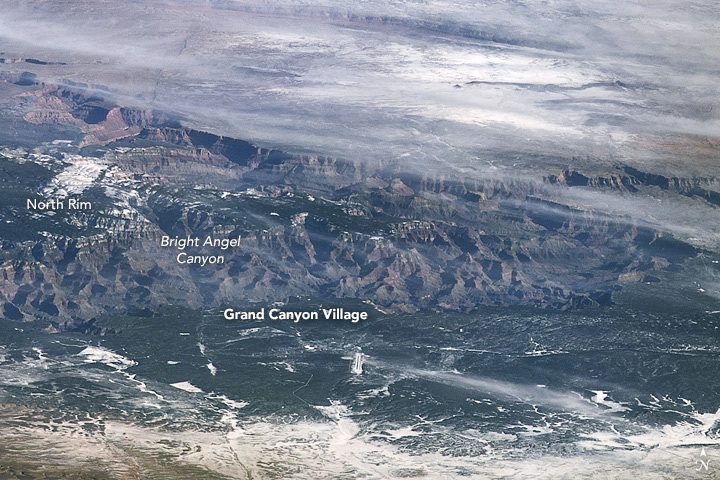
The Grand Canyon shot from the International Space Station (ISS) on December 18, 2009, by astronaut Jeff Williams
The Grand Canyon shot from the International Space Station (ISS) on December 18, 2009, by astronaut Jeff Williams. NASA, Earth Science and Remote Sensing (ESRS) unit

Another favorite photograph chosen by team member Andrea Meado is this remarkable night-time view of Bangkok, Thailand, which was captured from the ISS in 2017. It shows not only the illumination of the city lights, but also a large swath of green lights out at sea. These green lights are fishing boats, with the lights used to lure in plankton and fish, which are fed on by the squid that the fishermen catch.
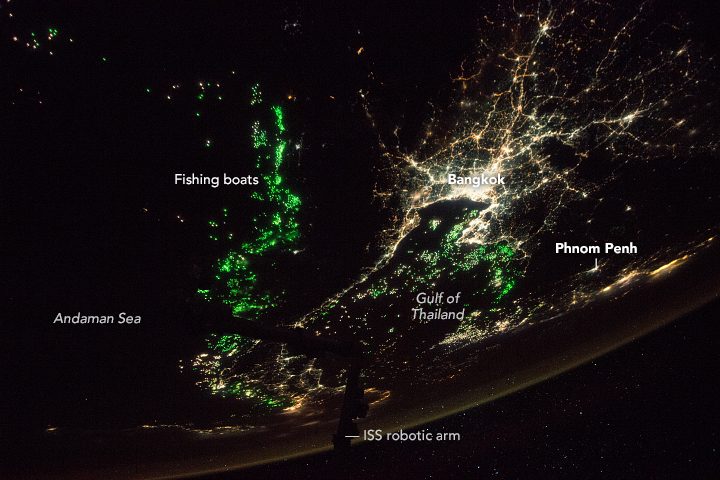
This oblique photograph, taken by an astronaut from the International Space Station, shows the city of Bangkok illuminated by city lights.
This oblique photograph, taken by an astronaut from the International Space Station, shows the city of Bangkok illuminated by city lights. NASA, Earth Science and Remote Sensing (ESRS) unit

Finally, this haunting shot taken from the ISS in 2012 shows delicate polar mesospheric clouds, taken as the ISS passed over the Tibetan Plateau. This shot was selected by data scientist Mark Lambert for the way it shows these beautiful clouds which we don’t see from Earth because they are too high up.
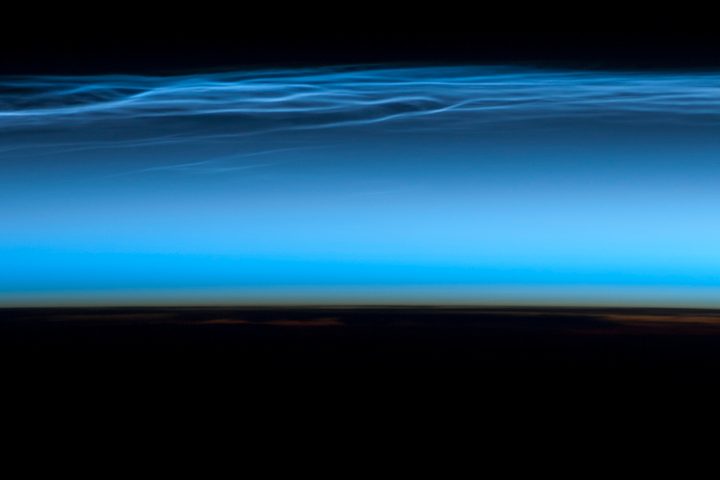
“Night-shining” clouds form at high altitudes in late spring and early summer.
Polar Mesospheric Clouds in the Northern Hemisphere. “Night-shining” clouds form at high altitudes in late spring and early summer. NASA, Earth Science and Remote Sensing (ESRS) unit

For even more amazing photographs taken by astronauts, you can spend a calming afternoon browsing through the NASA Earth Observatory’s Astronaut Photography gallery.

Georgina Torbet
Georgina has been the space writer at Digital Trends space writer for six years, covering human space exploration, planetary…
China’s answer to SpaceX’s reusable rockets literally catches boosters in a net
SpaceX catches boosters on legs. China just used a net.
Ammunition, Missile, Weapon

SpaceX's playbook for recovering a rocket booster generally involves legs, a precisely controlled vertical landing, and either a concrete pad or a drone ship. 

China just managed to pull off something similar, but in a slightly different way, and on July 10, it tested the method as well.

Read more
Dimming the sun sounds unhinged, but this new study on El Niño makes a surprisingly good case for it
A natural test case, Australia's worst-ever wildfire season, suggests the idea deserves serious consideration.
Nature, Outdoors, Sky

When I first saw "scientists propose dimming the sun," I rolled my eyes. It sounds like a science fiction movie cooked up after watching many climate documentaries. But a new study, published on July 8, 2026, in the journal Science Advances, seems to have a genuinely compelling argument.

A Super El Niño is currently forming in the Pacific, feared to be the most intense in decades. It could escalate floods, wildfires, and extreme heat events worldwide. However, Researchers at UC San Diego's Scripps Institution of Oceanography, led by climate scientists Kate Ricke and Jessica Wan, are now proposing one of the most interesting solutions I’ve come across.

Read more
You can now walk through space and gaze into a black hole at this VR exhibit
Smithsonian Starstruck lets you drift past dying stars and see the origin point of the universe for as little as $18 a person.
Smithsonian Starstruck featured

Most planetarium shows ask you to sit still and look up. The Smithsonian's new VR exhibit takes a different approach, letting visitors walk through the vast expanse of the universe, drifting past stars, planets, and a black hole to get a physical sense of its true scale.

A $29 ticket to the edge of the galaxy

Read more