  1. Home
  2. Space
  3. News

10 crew members cram aboard International Space Station, but not for long

Add as a preferred source on Google

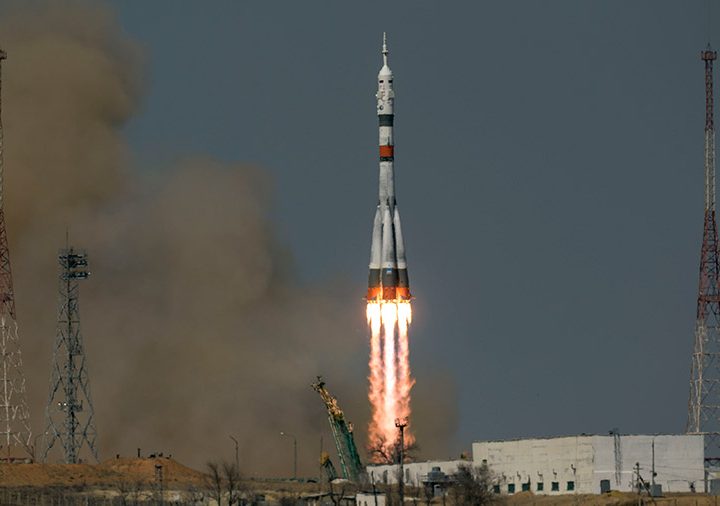
The Soyuz MS-18 rocket blasts off from the Baikonur Cosmodrome in Kazakhstan carrying three Expedition 65 crew members to the space station.
The Soyuz MS-18 rocket blasts off from the Baikonur Cosmodrome in Kazakhstan carrying three Expedition 65 crew members to the space station. NASA

Three new astronauts arrived at the International Space Station (ISS) yesterday, Friday, April 9, and it’ll be a tight squeeze for a few days as that brings the current crew of the station to 10.

Recommended Videos

The new astronauts arrived on a Russian Soyuz spacecraft that departed from Kazakhstan, on a flight taking approximately three hours. The craft docked with the station at 7:05 a.m. ET and the hatch was opened at 9:20 a.m. ET to allow them to pass into the station.

The ISS typically has a crew of three to six members any one time, with crews overlapping in what is referred to as Expeditions. Expedition 63, for example, ran from April to October last year and consisted of between three and six people. The current Expedition 64 includes three people who were members of that previous group, plus four new crew members who arrived on the SpaceX Crew Dragon in its second operational flight in April this year.

With the arrival of the three newest crew members, that brings the total of astronauts on the station to 10. These include five NASA astronauts (Kate Rubins, Michael Hopkins, Victor Glover, Shannon Walker, and Mark Vande), four Russian cosmonauts (Sergey Ryzhikov, Sergey Kud-Sverchkov, Oleg Novitsky, Pyotr Dubrov), and the Japanese Space Agency JAXA’s Soichi Noguchi.

These crew members also came on three different spacecraft, with some coming aboard a Space X Crew Dragon, and others coming on one of two Russian craft: The Soyuz MS-17 and the Soyuz MS-18.
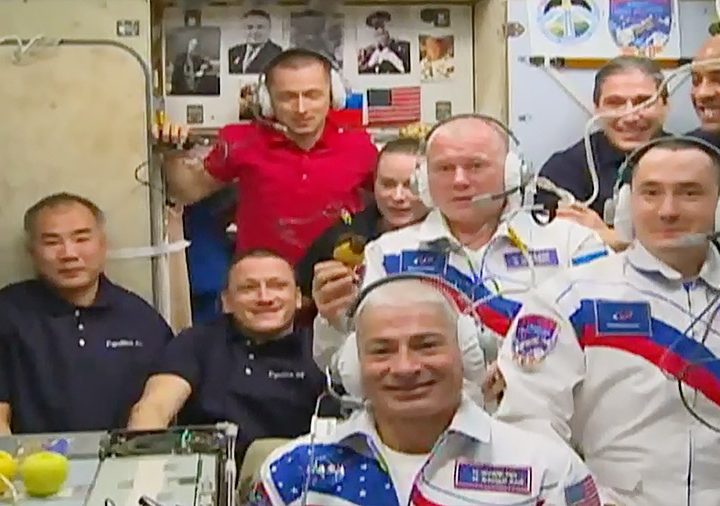
The newly-expanded 10-member station crew gathers in the Zvezda service module for a welcoming ceremony with family members and mission officials on Earth.
The newly-expanded 10-member station crew gathers in the Zvezda service module for a welcoming ceremony with family members and mission officials on Earth. NASA TV

Even though 10 is a much larger crew than is typical for the ISS, it isn’t the largest crew ever to stay on the station. That award goes to a crew of 13 who assembled on the ISS in 2009. And the current tightly-packed crew will be able to spread themselves out more soon, as Expedition 64 is about to come to an end.

On April 16, Rubins, Ryzhikov, and Kud-Sverchkov will depart the space station, and the remaining seven crew members will form Expedition 65. Shannon Walker will take over as commander of the station for this expedition.

Georgina Torbet
Georgina has been the space writer at Digital Trends space writer for six years, covering human space exploration, planetary…
China’s answer to SpaceX’s reusable rockets literally catches boosters in a net
SpaceX catches boosters on legs. China just used a net.
Ammunition, Missile, Weapon

SpaceX's playbook for recovering a rocket booster generally involves legs, a precisely controlled vertical landing, and either a concrete pad or a drone ship. 

China just managed to pull off something similar, but in a slightly different way, and on July 10, it tested the method as well.

Read more
Dimming the sun sounds unhinged, but this new study on El Niño makes a surprisingly good case for it
A natural test case, Australia's worst-ever wildfire season, suggests the idea deserves serious consideration.
Nature, Outdoors, Sky

When I first saw "scientists propose dimming the sun," I rolled my eyes. It sounds like a science fiction movie cooked up after watching many climate documentaries. But a new study, published on July 8, 2026, in the journal Science Advances, seems to have a genuinely compelling argument.

A Super El Niño is currently forming in the Pacific, feared to be the most intense in decades. It could escalate floods, wildfires, and extreme heat events worldwide. However, Researchers at UC San Diego's Scripps Institution of Oceanography, led by climate scientists Kate Ricke and Jessica Wan, are now proposing one of the most interesting solutions I’ve come across.

Read more
You can now walk through space and gaze into a black hole at this VR exhibit
Smithsonian Starstruck lets you drift past dying stars and see the origin point of the universe for as little as $18 a person.
Smithsonian Starstruck featured

Most planetarium shows ask you to sit still and look up. The Smithsonian's new VR exhibit takes a different approach, letting visitors walk through the vast expanse of the universe, drifting past stars, planets, and a black hole to get a physical sense of its true scale.

A $29 ticket to the edge of the galaxy

Read more