  1. Home
  2. Space
  3. News

Mars helicopter Ingenuity passes fourth flight and has a new mission

Add as a preferred source on Google

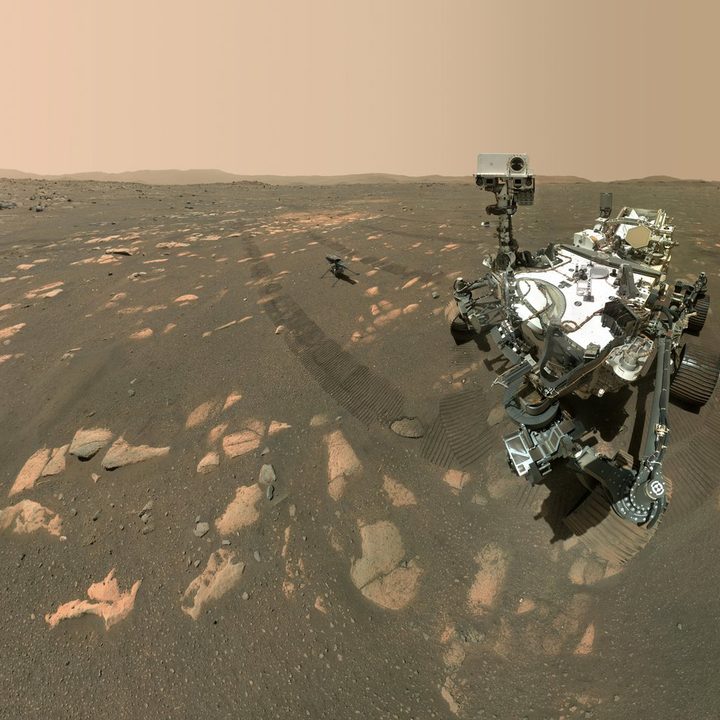
NASA’s Perseverance Mars rover took a selfie with the Ingenuity helicopter, seen here about 13 feet (3.9 meters) from the rover. This image was taken by the WASTON camera on the rover’s robotic arm on April 6, 2021, the 46th Martian day, or sol, of the mission.
NASA’s Perseverance Mars rover took a selfie with the Ingenuity helicopter, seen here about 13 feet (3.9 meters) from the rover. This image was taken by the WASTON camera on the rover’s robotic arm on April 6, 2021, the 46th Martian day, or sol, of the mission. NASA/JPL-Caltech/MSSS

After a small stumble, the Mars helicopter Ingenuity has completed its fourth flight successfully. At 10:49 a.m. ET (7:49 a.m. PT) on Friday, April 30, it took off from the Martian surface and rose to a height of 5 meters. It then flew 133 meters south before returning to its original position and landing, spending a total of 117 seconds in the air — the longest amount of time so far.

Recommended Videos

The flight had originally been planned for Thursday, April 29, but a software issue prevented it from taking off. Engineers on the ground created an update for the helicopter’s software and sent it to Ingenuity, which was then able to take off.

Ingenuity was also able to capture images of Mars from the air using its black and white navigation camera. And the Perseverance rover, stationed nearby, captured the helicopter in flight using its Mastcam-Z camera as well.
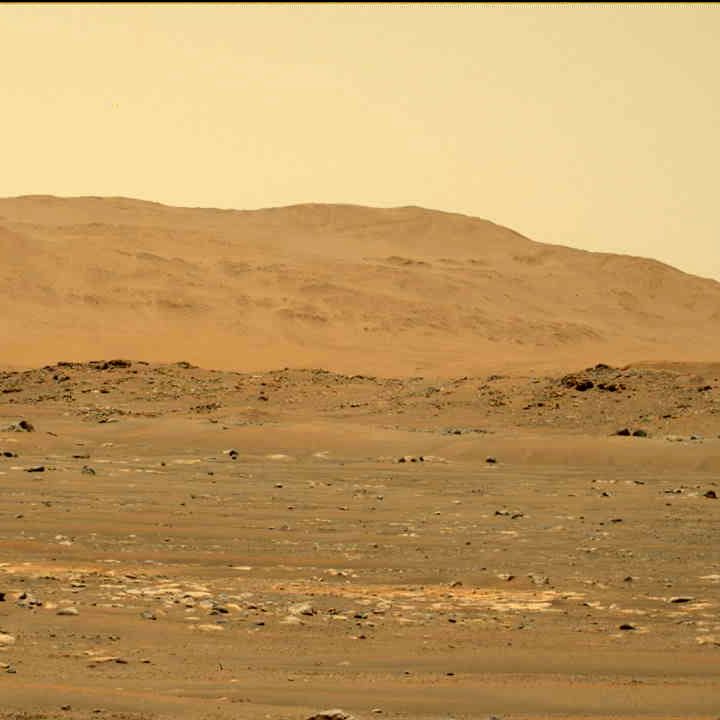
NASA’s Mars Perseverance rover acquired this image of the Ingenuity Mars Helicopter (upper right) using its left Mastcam-Z camera. Mastcam-Z is a pair of cameras located high on the rovers mast. This is one still frame from a sequence captured by the camera while taking video. This image was acquired on Apr. 30, 2021 (Sol 69) at the Local Mean Solar Time of 12:33:27.
NASA’s Mars Perseverance rover acquired this image of the Ingenuity Mars Helicopter (upper right) using its left Mastcam-Z camera. Mastcam-Z is a pair of cameras located high on the rover’s mast. This is one still frame from a sequence captured by the camera while taking video. This image was acquired on Apr. 30, 2021 (Sol 69) at the Local Mean Solar Time of 12:33:27. NASA/JPL-Caltech/ASU/MSSS

With this fourth test flight complete, NASA is declaring the Ingenuity technology demonstration mission a success, proving that flight on another planet is possible. Now, the helicopter will move onto a new mission, called its operations demonstration phase, which will explore how aerial craft could be used to support future rover missions, such as by identifying safe driving routes.

“The Ingenuity technology demonstration has been a resounding success,” said Thomas Zurbuchen, associate administrator for NASA’s Science Mission Directorate, in a statement. “Since Ingenuity remains in excellent health, we plan to use it to benefit future aerial platforms while prioritizing and moving forward with the Perseverance rover team’s near-term science goals.”

Rovers must move very slowly over the Martian surface to avoid obstacles, so they can only explore a relatively small area. But with support from an aerial craft, which can move much more quickly and cover a wider area, rovers could more accurately hone in on areas of scientific interest.

“We have so appreciated the support provided by the Perseverance rover team during our technology demonstration phase,” said MiMi Aung, project manager of Ingenuity at NASA’s Jet Propulsion Laboratory (JPL) in Southern California. “Now we have a chance to pay it forward, demonstrating for future robotic and even crewed missions the benefits of having a partner nearby that can provide a different perspective – one from the sky. We are going to take this opportunity and run with it — and fly with it.”

Georgina Torbet
Georgina has been the space writer at Digital Trends space writer for six years, covering human space exploration, planetary…
China’s answer to SpaceX’s reusable rockets literally catches boosters in a net
SpaceX catches boosters on legs. China just used a net.
Ammunition, Missile, Weapon

SpaceX's playbook for recovering a rocket booster generally involves legs, a precisely controlled vertical landing, and either a concrete pad or a drone ship. 

China just managed to pull off something similar, but in a slightly different way, and on July 10, it tested the method as well.

Read more
Dimming the sun sounds unhinged, but this new study on El Niño makes a surprisingly good case for it
A natural test case, Australia's worst-ever wildfire season, suggests the idea deserves serious consideration.
Nature, Outdoors, Sky

When I first saw "scientists propose dimming the sun," I rolled my eyes. It sounds like a science fiction movie cooked up after watching many climate documentaries. But a new study, published on July 8, 2026, in the journal Science Advances, seems to have a genuinely compelling argument.

A Super El Niño is currently forming in the Pacific, feared to be the most intense in decades. It could escalate floods, wildfires, and extreme heat events worldwide. However, Researchers at UC San Diego's Scripps Institution of Oceanography, led by climate scientists Kate Ricke and Jessica Wan, are now proposing one of the most interesting solutions I’ve come across.

Read more
You can now walk through space and gaze into a black hole at this VR exhibit
Smithsonian Starstruck lets you drift past dying stars and see the origin point of the universe for as little as $18 a person.
Smithsonian Starstruck featured

Most planetarium shows ask you to sit still and look up. The Smithsonian's new VR exhibit takes a different approach, letting visitors walk through the vast expanse of the universe, drifting past stars, planets, and a black hole to get a physical sense of its true scale.

A $29 ticket to the edge of the galaxy

Read more