1. Home
  2. Computing
  3. News

Intel Alder Lake-S leak reveals specs of its 16-core, 24-thread flagship

Add as a preferred source on Google

An engineering sample of Intel’s upcoming Alder Lake-S processors was obtained by Igor’s Lab, offering a look at clock speeds, core counts, and power draw from Intel’s next-generation chips. The leaked processor is tentatively named the Intel Core-1800, referencing the base clock speed of 1,800MHz the processor is currently able to hit.

It’s an engineering sample, so the base clock speed will go up. The leak shows that the processor can hit a boost clock of 4.6GHz on the first two cores, 4.4GHz on three to four cores, 4.2GHz on five to six cores, and 4.0GHz on seven to eight cores. This processor, which is apparently the most powerful out of the lineup, features 16 cores and 24 threads and a base thermal design power (TDP) of 125 watts.
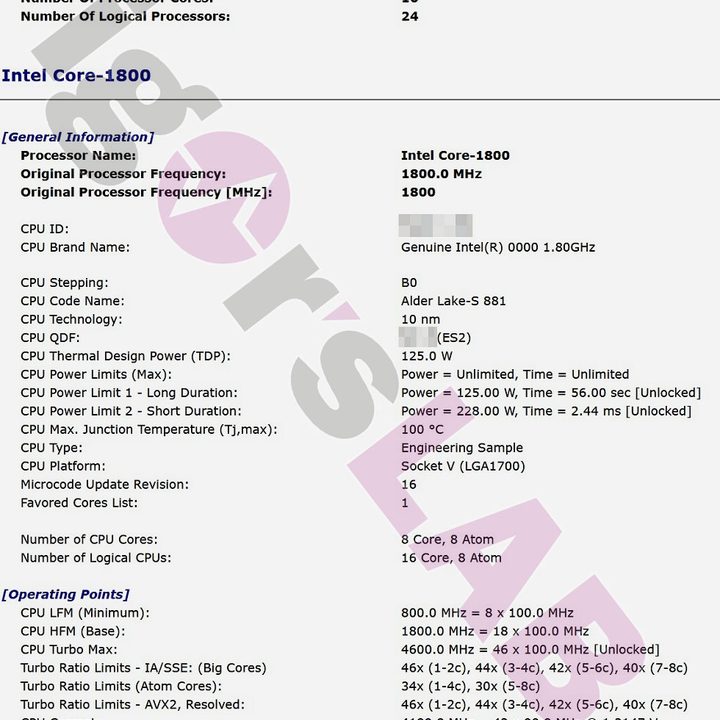
Image used with permission by copyright holder

Only eight of those cores are “big” cores, though. Intel is using a hybrid design with Alder Lake, using new, fast cores — named Golden Cove — for intensive tasks while employing slower Atom-based cores — named Gracemont — for simple or background tasks. The leaked processor comes with eight Golden Cove cores with 16 threads and eight Gracemont cores with eight threads, for a total of 16 cores and 24 threads. According to the leak, the Gracemont cores run at 3.4GHz for the first four cores and 3.0GHz for the subsequent cores.

Recommended Videos

This hybrid model is popular with mobile-based CPUs from ARM and has shown up in the Apple M1 chip. Intel is the first to bring the “breakthrough CPU architecture” to the desktop market. A leaked slide from Intel claims the new processors offer a 20% increase in instructions per clock and up to a 2x performance uplift in multithreaded workloads. The slide also shows the new range will support DDR5, PCIe 5.0, Thunderbolt 4, and Wi-Fi 6.

To use the new features, you’ll need a Z690 motherboard. The leak confirms that Alder Lake will use the LGA1700 socket, making Alder Lake incompatible with Z490 and Z590 boards that use the LGA1200 socket.

The leak shows a bright future for Intel, which it needs. Intel has long struggled to move away from its 14nm process. The company launched the Rocket Lake product line earlier this year using this process, and it was met with mediocre reviews due to subpar performance and high power draw. Alder Lake features the new 10nm process, which could help catapult Intel to the front of the desktop market.

Jacob Roach
Former Lead Reporter, PC Hardware
Jacob Roach is the lead reporter for PC hardware at Digital Trends. In addition to covering the latest PC components, from…
I let Radial menu take over my Mac, and I’m never going back
One mouse jiggle, endless shortcuts. My Mac has never felt this fast.
Radial app running on Mac

I have been testing Radial for the past week, and it's quickly become one of those apps I didn’t know how I could live without. It's a radial menu for macOS that puts your shortcuts, scripts, and automations right where your cursor is, so you never have to go hunting through menus to find what you need.

The app just received its 5.0 update, adding AI actions powered by Claude, window layouts, variables, a redesigned settings interface, a new Atmosphere background effect, and a squircle menu shape. I got to try most of these, and here's what I found.

Read more
Android desktop mode made me miss my laptop in record time
I tried writing and publishing from Google’s phone-to-monitor setup, and the future of mobile computing immediately started sweating.
Computer, Electronics, Laptop

Android 17 desktop mode has a very simple pitch. Plug your phone into a monitor, add a keyboard and mouse, and watch the slab in your pocket pretend to be a computer. I wanted to give that pitch a fair shot, so I tried using it for an actual workday instead of a cute demo.

The goal was boring on purpose: write an article, edit it, build the page in WordPress, upload whatever needed uploading, and publish the thing without running back to my laptop like a coward.

Read more
As AI turbocharges digital abuse, UK agencies urge parents to limit who sees kids’ photos online
The National Crime Agency and Internet Watch Foundation are asking parents to tighten privacy settings as AI-generated abuse material rises.
Social Media

Parents who post pictures of their kids online are being told to rethink the habit. The UK's National Crime Agency and the Internet Watch Foundation have issued new guidance urging families to lock down their social media accounts, warning that publicly shared photos are increasingly being pulled and altered by AI tools to create child sexual abuse material.

The two organizations say most parents have no idea this is happening. Criminals no longer need to contact a child directly to generate such material. They can scrape an ordinary photo and run it through widely available nudify apps.

Read more