1. Home
  2. Space
  3. News

Blue Origin names the date for its first-ever space tourism flight

Add as a preferred source on Google
Bid for the very first seat on New Shepard

Blue Origin has finally announced the date for the first crewed flight of its New Shepard rocket, and one seat is available for a space tourist.

Recommended Videos

The company led by Amazon founder Jeff Bezos announced this week that New Shepard’s first-ever crewed mission will take place on July 20, 2021.

The space tourist will be the winning bidder of an online auction that anyone can join, with the proceeds going to Blue Origin’s foundation, Club for the Future, which, in the company’s own words, aims to “inspire future generations to pursue careers in STEM [science, technology, engineering, and mathematics] and help invent the future of life in space.”

The auction will consist of three phases. First, between May 5 and 19, interested folks can bid any amount they like to have a chance of winning the seat for the sub-orbital space trip. All bids are sealed, so no one will know how much you bid (though we think you’re going to have to go a little higher than 10 bucks to have a chance).

On May 19, the bids will be made public and participants will have to exceed the highest bid to continue in the auction.

Finally, on June 12, the bidding will conclude with a live online auction to choose Blue Origin’s first-ever space tourist.

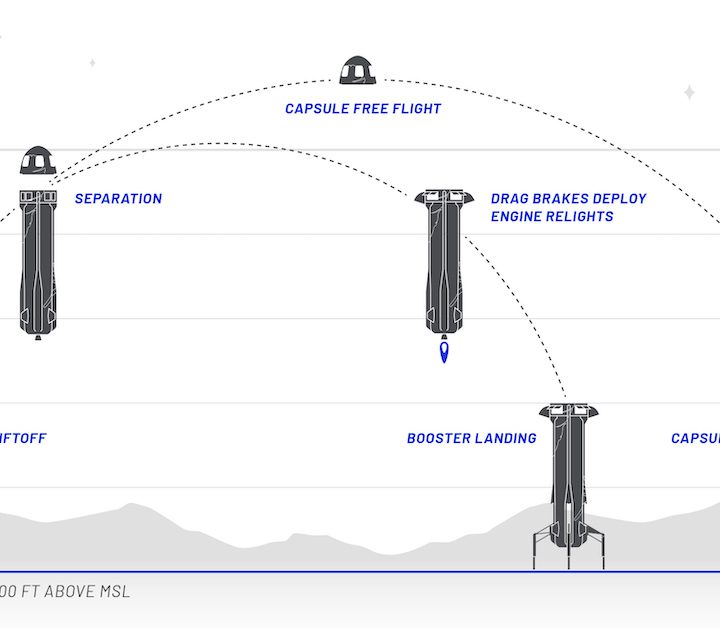
Blue Origin’s suborbital space trips will last for around 10 minutes, transporting six passengers at a time to around 62 miles above the surface of Earth. The experience will offer amazing vistas through the capsule’s large windows, as well as a short period of weightlessness where those on board will be able to leave their seats and float around inside the spacecraft. It will then return to Earth and perform a parachute-assisted landing near Blue Origin’s spaceport in West Texas.
Blue Origin

This test flight by Blue Origin a couple of years ago offers a clear idea — from launch to landing — of the kind of experience the first crew is likely to enjoy.

Blue Origin has achieved 14 successful test flights of its reusable New Shepard rocket since 2015, with the company now finally ready to send its first crew on the trip of a lifetime. Assuming everything goes to plan, Blue Origin will be looking to launch a regular space tourism service possibly by the end of this year.

Trevor Mogg
Contributing Editor
Not so many moons ago, Trevor moved from one tea-loving island nation that drives on the left (Britain) to another (Japan)…
China’s answer to SpaceX’s reusable rockets literally catches boosters in a net
SpaceX catches boosters on legs. China just used a net.
Ammunition, Missile, Weapon

SpaceX's playbook for recovering a rocket booster generally involves legs, a precisely controlled vertical landing, and either a concrete pad or a drone ship. 

China just managed to pull off something similar, but in a slightly different way, and on July 10, it tested the method as well.

Read more
Dimming the sun sounds unhinged, but this new study on El Niño makes a surprisingly good case for it
A natural test case, Australia's worst-ever wildfire season, suggests the idea deserves serious consideration.
Nature, Outdoors, Sky

When I first saw "scientists propose dimming the sun," I rolled my eyes. It sounds like a science fiction movie cooked up after watching many climate documentaries. But a new study, published on July 8, 2026, in the journal Science Advances, seems to have a genuinely compelling argument.

A Super El Niño is currently forming in the Pacific, feared to be the most intense in decades. It could escalate floods, wildfires, and extreme heat events worldwide. However, Researchers at UC San Diego's Scripps Institution of Oceanography, led by climate scientists Kate Ricke and Jessica Wan, are now proposing one of the most interesting solutions I’ve come across.

Read more
You can now walk through space and gaze into a black hole at this VR exhibit
Smithsonian Starstruck lets you drift past dying stars and see the origin point of the universe for as little as $18 a person.
Smithsonian Starstruck featured

Most planetarium shows ask you to sit still and look up. The Smithsonian's new VR exhibit takes a different approach, letting visitors walk through the vast expanse of the universe, drifting past stars, planets, and a black hole to get a physical sense of its true scale.

A $29 ticket to the edge of the galaxy

Read more