  1. Home
  2. Space
  3. News

Mars helicopter Ingenuity gearing up for 7th flight tomorrow

Add as a preferred source on Google

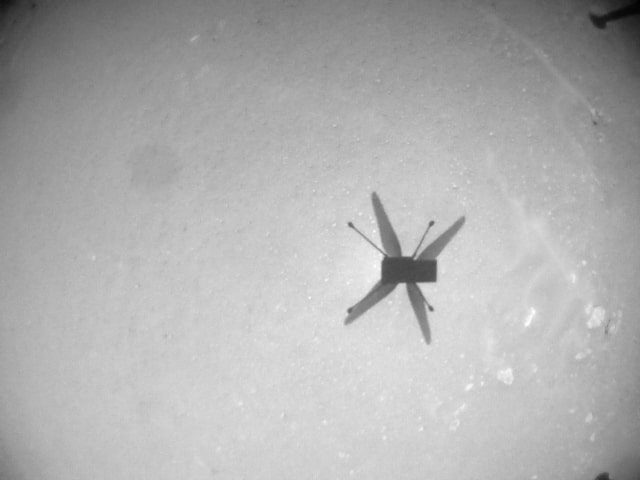
NASA’s Ingenuity Mars Helicopter acquired this image on May 22, 2021 using its black and white navigation camera. This camera is mounted in the helicopter’s fuselage and pointed directly downward to track the ground during flight.
NASA’s Ingenuity Mars Helicopter acquired this image on May 22, 2021, using its black and white navigation camera. This camera is mounted in the helicopter’s fuselage and pointed directly downward to track the ground during flight. NASA/JPL-Caltech

NASA is aiming for tomorrow, Sunday, June 6, for the Mars helicopter Ingenuity to take its seventh flight. The tiny helicopter has succeeded in demonstrating that it is possible to fly an aircraft on another planet, and has been performing a series of increasingly complex flights to test its capabilities. Now, it will be moving to a new location which will act as its latest base of operations.

Recommended Videos

Ingenuity’s last flight, which took place several weeks ago on May 22, was a troubled one. The helicopter took off and began to move as expected, but around a minute into the flight, a number of anomalies occurred. The helicopter changed its speed, tilted back and forward, and showed spikes in its power consumption. Fortunately, it was still able to land safely and did not suffer any damage. In a report on the incident, NASA said that there was a glitch in the helicopter’s motion system which keeps it stable in the air by using its cameras to image the ground below. One single camera frame had been lost, and that had caused subsequent frames to have the wrong timestamp which led to the issues.

NASA’s Jet Propulsion Laboratory, which runs the Ingenuity helicopter, did not say whether the underlying issue had been fixed yet. Presumably, the team is confident that the helicopter can fly safely on its next flight.

The seventh flight will see the helicopter relocate to a new home base — the second time it has moved bases since it began its operations on Mars. NASA writes, “The flight profile will send Ingenuity to a location about 350 feet (106 meters) south of its current location, where it will touch down at its new base of operations. This will mark the second time the helicopter will land at an airfield that it did not survey from the air during a previous flight. Instead, the Ingenuity team is relying on imagery collected by the HiRISE camera aboard NASA’s Mars Reconnaissance Orbiter that suggests this new base of operations is relatively flat and has few surface obstructions.”

Georgina Torbet
Georgina has been the space writer at Digital Trends space writer for six years, covering human space exploration, planetary…
Space is becoming Bezos and Musk’s next data center site, and we have every reason to worry
The AI boom is coming for the night sky
How Vast's space station will look in orbit.

AI data centers already consume vast amounts of electricity and water on Earth, so Silicon Valley has begun looking somewhere considerably more spacious... literally.

Elon Musk's SpaceX and Jeff Bezos' Blue Origin, along with several other companies, have proposed enormous constellations of satellites designed to operate as orbital data centers. However, environmental groups and former space officials are now warning that putting them into orbit at the proposed scale could have severe consequences for Earth's atmosphere and the night sky.

Read more
The first possible exomoon is here, and it makes our Moon look hilariously tiny
Scientists may have found the first exomoon, except this one is the size of Jupiter
This artist’s concept depicts a potential volcanic moon between the exoplanet WASP-49 b, left, and its parent star. New evidence indicating that a massive sodium cloud observed near WASP-49 b is produced by neither the planet nor the star has prompted researchers to ask if its origin could be an exomoon.

We have already discovered more than 6,000 planets outside of our immediate neighborhood. Yet, finding a moon orbiting one of those distant worlds has proved considerably harder. Astronomers may finally have something close to the real deal, but this particular object stretches the word “moon” almost beyond recognition.

Using the European Southern Observatory’s Very Large Telescope in Chile, researchers detected strong evidence for a moon-like object in the CD-35 2722 system. Further observations are still necessary to confirm the discovery, but it could become the first confidently detected natural satellite outside our solar system. There is still one tiny complication though. This moon is apparently massive.

Read more
China’s answer to SpaceX’s reusable rockets literally catches boosters in a net
SpaceX catches boosters on legs. China just used a net.
Ammunition, Missile, Weapon

SpaceX's playbook for recovering a rocket booster generally involves legs, a precisely controlled vertical landing, and either a concrete pad or a drone ship. 

China just managed to pull off something similar, but in a slightly different way, and on July 10, it tested the method as well.

Read more