  1. Home
  2. Space
  3. News

Richard Branson makes it to the edge of space in Virgin Galactic flight

Add as a preferred source on Google

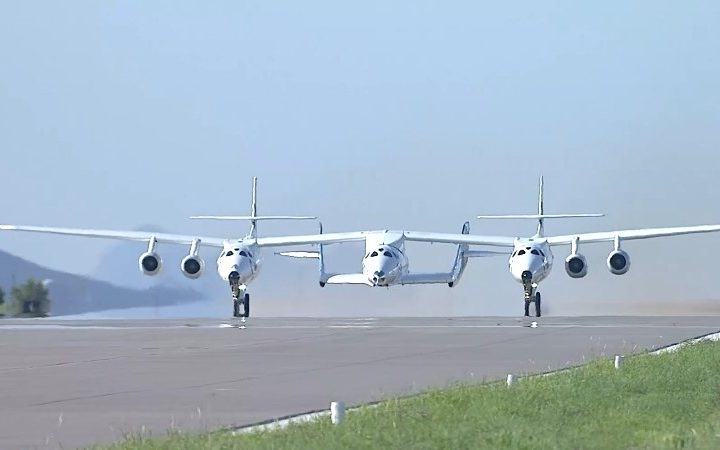
VSS Unity takes off from Spaceport America on Sunday, July 11.
VSS Unity takes off from Spaceport America on Sunday, July 11 Virgin Galactic

Founder of Virgin Galactic, Richard Branson, has made it to the edge of space along with five other crew members in the first fully crewed test flight of Virgin Galactic’s spaceplane VSS Unity.

Recommended Videos

On Sunday, July 7, the VSS Unity was taken to an altitude of just under 50,000 feet by the mothership VMS Eve before being released and firing its engines to reach the edge of space at 282,00 feet. After several minutes of weightlessness for the crew, the VSS Unity glided back down to Earth and landed safely on runway three at Spaceport America in New Mexico.

“It’s the experience of a lifetime,” Branson said from the VSS Unity as it headed back to the spaceport.

Branson was part of a six-person crew, along with three other Virgin Galactic employees and two VSS Unity pilots: Dave Mackay and Michael Masucci. This was the first time that the VSS Unity has flown with a full crew and also the first time that a Virgin Galactic flight was livestreamed.

The purpose of the flight was for Branson and the others to evaluate what the customer experience will be for those who pay for a seat on future flights. With a price tag of $250,000 per seat, future space tourists will be taken to the edge of space and experience several minutes of weightlessness before returning to Earth.

The altitude to which the VSS Unity flies has lead competitor company Blue Origin to question whether Virgin Galactic flights actually count as going to space. That’s because there is no one internationally agreed-upon standard for where the atmosphere of Earth ends and space begins. Most countries use the Kármán line to designate the boundary, which is defined as 100 km above the average sea level. However, other organizations, including the U.S. Air Force, consider the boundary of space to be 50 miles above sea level, which is around 80 km. The VSS Unity flies to a maximum of 90 km, so it is between these two boundaries. This is why you’ll see some people call the Virgin Galactic flight sub-orbital, but the passengers on the crew are still defined as astronauts.

With this test flight complete, the company now plans two further test flights before opening commercial services in 2022.

Georgina Torbet
Georgina has been the space writer at Digital Trends space writer for six years, covering human space exploration, planetary…
China’s answer to SpaceX’s reusable rockets literally catches boosters in a net
SpaceX catches boosters on legs. China just used a net.
Ammunition, Missile, Weapon

SpaceX's playbook for recovering a rocket booster generally involves legs, a precisely controlled vertical landing, and either a concrete pad or a drone ship. 

China just managed to pull off something similar, but in a slightly different way, and on July 10, it tested the method as well.

Read more
Dimming the sun sounds unhinged, but this new study on El Niño makes a surprisingly good case for it
A natural test case, Australia's worst-ever wildfire season, suggests the idea deserves serious consideration.
Nature, Outdoors, Sky

When I first saw "scientists propose dimming the sun," I rolled my eyes. It sounds like a science fiction movie cooked up after watching many climate documentaries. But a new study, published on July 8, 2026, in the journal Science Advances, seems to have a genuinely compelling argument.

A Super El Niño is currently forming in the Pacific, feared to be the most intense in decades. It could escalate floods, wildfires, and extreme heat events worldwide. However, Researchers at UC San Diego's Scripps Institution of Oceanography, led by climate scientists Kate Ricke and Jessica Wan, are now proposing one of the most interesting solutions I’ve come across.

Read more
You can now walk through space and gaze into a black hole at this VR exhibit
Smithsonian Starstruck lets you drift past dying stars and see the origin point of the universe for as little as $18 a person.
Smithsonian Starstruck featured

Most planetarium shows ask you to sit still and look up. The Smithsonian's new VR exhibit takes a different approach, letting visitors walk through the vast expanse of the universe, drifting past stars, planets, and a black hole to get a physical sense of its true scale.

A $29 ticket to the edge of the galaxy

Read more