1. Home
  2. Space
  3. News

SpaceX launches Cargo Dragon to ISS, catches booster on new ship for first time

Add as a preferred source on Google

SpaceX has successfully launched a Cargo Dragon resupply ship on its way to the International Space Station (ISS), where it will deliver both scientific experiments and supplies for the crew. The Dragon was launched using a Falcon 9 rocket from Launch Complex 39A at NASA’s Kennedy Space Center in Florida at 3:14 a.m. ET (12:14 a.m. PT) on Sunday, August 29, after a one-day delay from its original launch date due to poor weather.

The Dragon will now travel to the space station throughout Sunday before arriving at around 11 a.m. ET (8 a.m. PT) on Monday, August 30. This marks SpaceX’s 23rd resupply mission to the ISS.
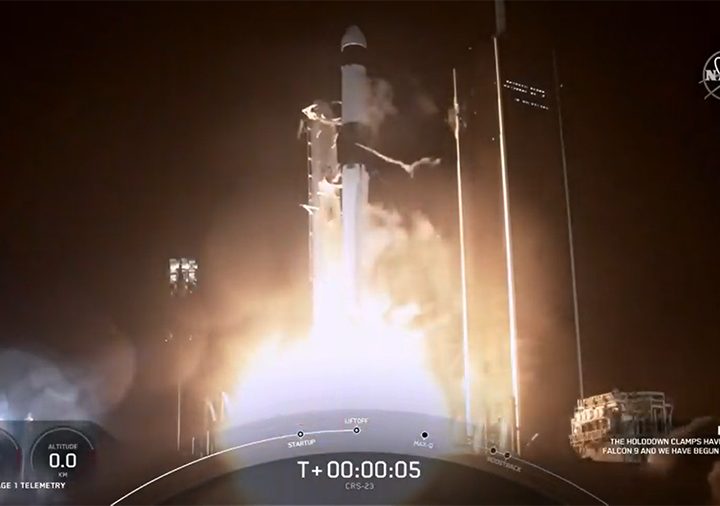
The SpaceX Falcon 9 rocket launches the Cargo Dragon spacecraft toward the International Space Station.
The SpaceX Falcon 9 rocket launches the Cargo Dragon spacecraft toward the International Space Station. NASA TV

In the most recent update from NASA on the progress of the Dragon, it confirmed that the nosecone was open and the spacecraft had reached orbit and was on its way to the space station: “Dragon’s nosecone is open, and the spacecraft is safely in orbit following a launch on the SpaceX Falcon 9 rocket at 3:14 a.m. EDT from NASA’s Kennedy Space Center in Florida, carrying more than 4,800 pounds of research, crew supplies and hardware to the International Space Station.”

Recommended Videos

A notable success of this launch was the catching of the first stage booster on SpaceX’s new droneship. The booster is only necessary for the first part of a launch, providing fuel for the difficult climb through the atmosphere against gravity. Once the rocket has reached a certain height, the booster is no longer needed and falls back to Earth. SpaceX has perfected the art of catching these boosters after a launch and reusing them, which should make space launches cheaper in the long run. The company recently debuted its newest droneship for catching boosters, named A Shortfall of Gravitas, which made its first catch yesterday.

SpaceX shared footage of the booster coming in to land on the droneship as well:

Falcon 9’s first stage booster has landed on A Shortfall of Gravitas – first landing on this droneship! pic.twitter.com/vaiqb30q0P

— SpaceX (@SpaceX) August 29, 2021

Once the Dragon arrives at the ISS it will dock autonomously with the Harmony module, attaching to the forward-facing port. The docking will be overseen by two members of the ISS crew, NASA astronauts Shane Kimbrough and Megan McArthur. You can watch the docking live as it will be shown on NASA TV, with coverage beginning at 9:30 a.m. ET (6:30 a.m. PT) on Monday.

Georgina Torbet
Georgina has been the space writer at Digital Trends space writer for six years, covering human space exploration, planetary…
China’s answer to SpaceX’s reusable rockets literally catches boosters in a net
SpaceX catches boosters on legs. China just used a net.
Ammunition, Missile, Weapon

SpaceX's playbook for recovering a rocket booster generally involves legs, a precisely controlled vertical landing, and either a concrete pad or a drone ship. 

China just managed to pull off something similar, but in a slightly different way, and on July 10, it tested the method as well.

Read more
Dimming the sun sounds unhinged, but this new study on El Niño makes a surprisingly good case for it
A natural test case, Australia's worst-ever wildfire season, suggests the idea deserves serious consideration.
Nature, Outdoors, Sky

When I first saw "scientists propose dimming the sun," I rolled my eyes. It sounds like a science fiction movie cooked up after watching many climate documentaries. But a new study, published on July 8, 2026, in the journal Science Advances, seems to have a genuinely compelling argument.

A Super El Niño is currently forming in the Pacific, feared to be the most intense in decades. It could escalate floods, wildfires, and extreme heat events worldwide. However, Researchers at UC San Diego's Scripps Institution of Oceanography, led by climate scientists Kate Ricke and Jessica Wan, are now proposing one of the most interesting solutions I’ve come across.

Read more
You can now walk through space and gaze into a black hole at this VR exhibit
Smithsonian Starstruck lets you drift past dying stars and see the origin point of the universe for as little as $18 a person.
Smithsonian Starstruck featured

Most planetarium shows ask you to sit still and look up. The Smithsonian's new VR exhibit takes a different approach, letting visitors walk through the vast expanse of the universe, drifting past stars, planets, and a black hole to get a physical sense of its true scale.

A $29 ticket to the edge of the galaxy

Read more