1. Home
  2. Computing
  3. News

The MacBook Pro’s ports have returned, but there’s one glaring omission

Add as a preferred source on Google

The new MacBook Pro‘s increased port selection is reason to celebrate. Even Apple admitted as much during its presentation at its Unleashed event.

But it’s not perfect.
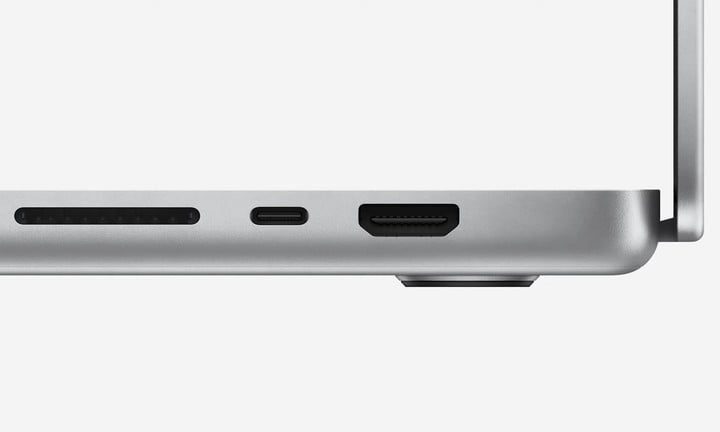
Connectivity on the new 2021 Macbook Pro. SD reader, USB-C port, HDMI port.
Image used with permission by copyright holder

Apple has brought back HDMI and a full-sized SD card slot — both of which are helpful additions to the mix of Thunderbolt 4. The SD card slot is convenient for direct transfers from a camera, while the HDMI port allows you to connect to an external display without using one of your Thunderbolt ports.

Recommended Videos

But as is noted in the technical specifications, this version of HDMI isn’t the latest. It’s HDMI 2.0 instead of 2.1, which leaves some significant power on the table.

HDMI 2.0 can connect to a 4K display, but is limited to just 60 frames per second (fps). HDMI 2.1 ups the ante to 4K at 120 fps, or 8K at 60 fps. I know that might not sound like the end of the world, but many creator-focused or gaming laptops coming out in 2021 have included it as a standard port.

Can you call this the most advanced connectivity without HDMI 2.1? Hardly.

As MacRumors points out, it’s a particularly strange misstep since the latest Apple TV includes an HDMI 2.1 port.

To be fair, Apple is likely looking at its Pro Display XDR, which is also stuck at HDMI 2.0 and 60Hz. Apple imagines you using the MacBook Pro connected to three Pro Display XDRs (because who doesn’t have three?), not an Apple TV.

There’s a certain amount of truth to that, but when you’re spending thousands of dollars on a new laptop, you want something you know will last you for the next decade.

Lifestyle image of someone using the new Macbook Pro 2021.
Image used with permission by copyright holder

Beyond HDMI 2.1, you’ll probably also notice the lack of USB-A ports. These were far less likely to make a return, despite the fact that many accessories still don’t use USB-C.

If you’re coming from a post-2016 MacBook Pro, though, you likely aren’t complaining. You’re probably more excited about being able to connect to more displays and bring over content directly from your camera.

Apple cut back ports to only USB-C back in 2016, much to the duress of the professional community. As powerful as Thunderbolt was, the lack of convenience was the most common complaint from this era of MacBooks.

Luke Larsen
Former Senior Editor, Computing
Luke Larsen is the Senior Editor of Computing, managing all content covering laptops, monitors, PC hardware, Macs, and more.
TSMC might set up a price hike that could come straight for your next phone, laptop, or tablet
Here's what TSMC's rumored 10% chip price increase actually means in dollar terms, and why your next phone or laptop could end up costing more.
TSMC Fab

My wallet flinched the second I saw the words "TSMC" and "price increase" in the same headline, and honestly, yours should too.

Turns out the company behind the silicon powering basically every flagship device out there, including Apple’s A-series and Qualcomm’s Snapdragon processors, is reportedly about to make all of it a little pricier.

Read more
Apple fixes Hide My Email bug that exposed users’ real email addresses
Here's how Apple's Hide My Email flaw leaked real addresses for over a year, and why it only got fixed once the story went public.
apple-merging-sign-in-with-apple-hide-my-email-icloud+

Turns out the "Hide" part of Hide My Email wasn't doing its job quite as advertised, something that I covered early in July. Security researcher Tyler Murphy reported the flaw in June 2025, but despite Apple claiming it was resolved in March 2026, independent tests confirmed it remained exploitable, at least until July 3, 2026.

So how did this bug actually work?

Read more
Gemini Notebook’s new Collections arrive just as Google turns it into a bigger workspace
Google is cleaning up notebook organization as the former NotebookLM expands across Gemini and Search
Gemini Notebook branding on a MacBook

Google has barely finished renaming NotebookLM, and it’s already addressing one of the headaches that comes with building a large research library.

Collections are rolling out to all Gemini Notebook users, giving them a way to group related notebooks while keeping everything visible under My Notebooks. The dashboard gets some structure without asking users to rearrange the library they’ve already built.

Read more