1. Home
  2. Space
  3. News

Hubble spots a ‘superbubble’ in a beautiful emission nebula

Add as a preferred source on Google

The Hubble Space Telescope may be experiencing problems this week, but it continues to offer a massive trove of data for astronomers to explore — including this week’s image of the beautiful and mysterious nebula N44.

This nebula has a highly unusual feature: A hole in its center, hundreds of light-years across, which forms a gap called a “superbubble.” N44 is a type of nebula called an emission nebula, which means it is a cloud of dust and gas which has been ionized by radiation from nearby stars and so which emits light in the visible wavelength. However, emission nebulae don’t typically have big holes in their centers, and scientists are still figuring out why N44 has this odd feature.
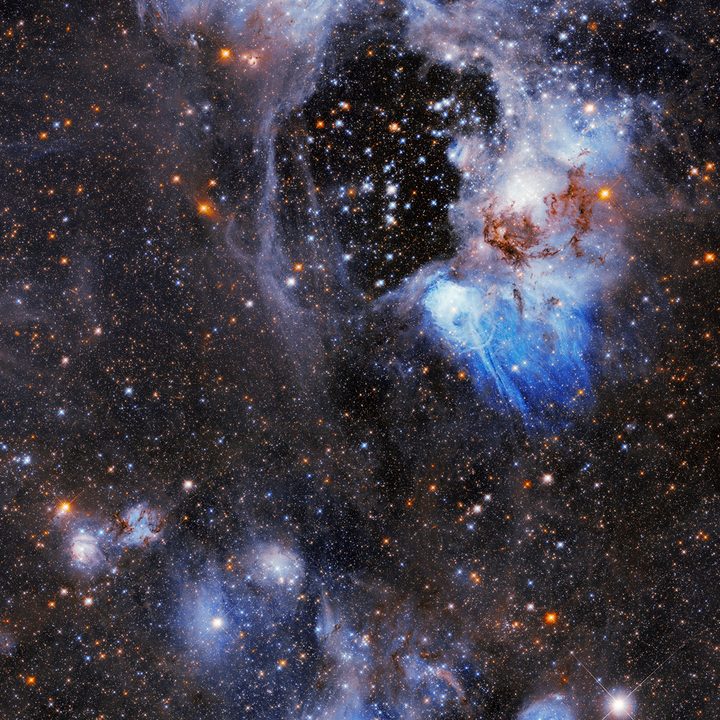
A dark, starry gap called a “superbubble,” visible in this Hubble Space Telescope image of Nebular N44 in the upper central region.
N44 is a complex nebula filled with glowing hydrogen gas, dark lanes of dust, massive stars, and many populations of stars of different ages. One of its most distinctive features, however, is the dark, starry gap called a “superbubble,” visible in this Hubble Space Telescope image in the upper central region. NASA, ESA, V. Ksoll and D. Gouliermis (Universität Heidelberg), et al.; Processing: Gladys Kober (NASA/Catholic University of America)

“The hole is about 250 light-years wide and its presence is still something of a mystery,” the Hubble scientists write. “Stellar winds expelled by massive stars in the bubble’s interior may have driven away the gas, but this is inconsistent with measured wind velocities in the bubble. Another possibility, since the nebula is filled with massive stars that would expire in titanic explosions, is that the expanding shells of old supernovae sculpted the cosmic cavern.”

Recommended Videos

N44 is huge, spanning 1,000 light-years across, and is located 170,000 light-years away in a satellite galaxy of the Milky Way called the Large Magellanic Cloud. Researchers have identified the bright blue area shown at the bottom right of the bubble as being the hottest region where stars are being formed at the fastest rate. The creation of hot stars gives rise to stellar winds which are unusually powerful in this nebula, reaching incredible speeds of over 4 million miles per hour.

Georgina Torbet
Georgina has been the space writer at Digital Trends space writer for six years, covering human space exploration, planetary…
China’s answer to SpaceX’s reusable rockets literally catches boosters in a net
SpaceX catches boosters on legs. China just used a net.
Ammunition, Missile, Weapon

SpaceX's playbook for recovering a rocket booster generally involves legs, a precisely controlled vertical landing, and either a concrete pad or a drone ship. 

China just managed to pull off something similar, but in a slightly different way, and on July 10, it tested the method as well.

Read more
Dimming the sun sounds unhinged, but this new study on El Niño makes a surprisingly good case for it
A natural test case, Australia's worst-ever wildfire season, suggests the idea deserves serious consideration.
Nature, Outdoors, Sky

When I first saw "scientists propose dimming the sun," I rolled my eyes. It sounds like a science fiction movie cooked up after watching many climate documentaries. But a new study, published on July 8, 2026, in the journal Science Advances, seems to have a genuinely compelling argument.

A Super El Niño is currently forming in the Pacific, feared to be the most intense in decades. It could escalate floods, wildfires, and extreme heat events worldwide. However, Researchers at UC San Diego's Scripps Institution of Oceanography, led by climate scientists Kate Ricke and Jessica Wan, are now proposing one of the most interesting solutions I’ve come across.

Read more
You can now walk through space and gaze into a black hole at this VR exhibit
Smithsonian Starstruck lets you drift past dying stars and see the origin point of the universe for as little as $18 a person.
Smithsonian Starstruck featured

Most planetarium shows ask you to sit still and look up. The Smithsonian's new VR exhibit takes a different approach, letting visitors walk through the vast expanse of the universe, drifting past stars, planets, and a black hole to get a physical sense of its true scale.

A $29 ticket to the edge of the galaxy

Read more