  1. Home
  2. Emerging Tech
  3. Mobile
  4. Legacy Archives

Samsung renames Orion mobile processors Exynos

Add as a preferred source on Google
Image used with permission by copyright holder

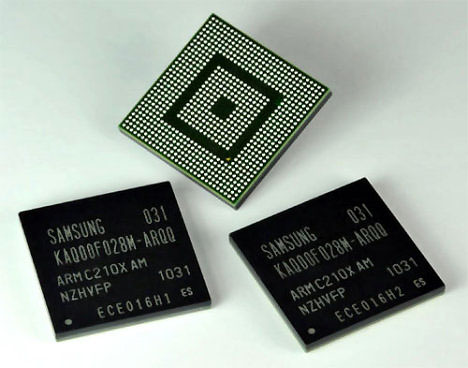
Samsung has had a hit on its hands with its Hummingbird mobile processors: they drive a wide range of Android devices (including Samsung’s own Galaxy S and Galaxy Tab devices), and aspects of the Hummingbird are part of the Apple A4 processor at the heard of the iPad and the iPhone 4. Samsung’s followup to the Hummingbird has been codenamed Orion, but today Samsung announced it’s not going to market with that name: instead, the chips will be marketed under the brand name Exynos, and Samsung says they will start shipping to equipment makers next month.

“Application processors for the mobile market are one of the flagship products in our semiconductor business,” said Samsung’s System LSI Division executive VP of marketing Seh-Woong Jeong, in a statement. “We are excited to introduce the brand name of Exynos for Samsung’s application processor family. As consumers demand more from their mobile products, Samsung’s Exynos chips will be the power inside enabling the coolest HD multi-media features with even longer battery life.”

Recommended Videos

South Korea’s Samsung is deriving the name Exynos from Greek: exypnos means “smart” and prasinos means “green,” so the company feels “Exynos” communicates a “smart and green” message.

The processor codenamed Orion will be renamed the Exynos 4210, and will feature dual Cortex A9 processing cores running at 1 GHz; the chip is expected to be handle a broader variety of rich media applications in mobile devices than current processors—including 1080p video at 30 frames per second. Some of its primarily competition will likely come from Apple’s own in-house processors, as well as new embedded chips from companies like Qualcomm. HP’s new TouchPad is driven by an Qualcomm APQ8060 SnapDragon processor, a previously un-announced CPU from Qualcomm.

Samsung announced the chip back in September, 2010.

Samsung originally developed the Hummingbird processor in conjunction with chip designer Intrinsity; Apple acquired Intrinsity about a year ago.

Geoff Duncan
Former Contributor
Geoff Duncan writes, programs, edits, plays music, and delights in making software misbehave. He's probably the only member…
Google’s new AI gives robots better balance, smarter hands, and teamwork capabilities
Google just made robots a lot less clumsy and a lot more helpful.
Gemini robotics 2.0

Google DeepMind just brought sci-fi robots closer to reality, and it is very exciting. Building on its original Gemini Robotics model, the company has introduced Gemini Robotics 2, an AI system designed to help robots think, move, and even work together. Unlike most robots today, which rely on pre-programmed routines or someone controlling them remotely, this new system lets robots figure things out on their own when situations get unpredictable.

Can robots finally handle whole-body tasks?

Read more
Remember Samsung’s Ballie home robot? It may finally be inching closer to reality
Leaked app wireframes give the strongest hint yet that Samsung's Ballie home robot, first shown at CES 2020, might still be headed toward an actual release.
Samsung Ballie robot in a room next to a dog feeder.

Samsung's rolling home robot has been the industry's longest-running "will it ever actually ship" joke, and I'll admit I'd mostly given up on it. Now, there's finally a glimmer of hope.

Samsung first unveiled Ballie as a concept at CES 2020. Then, it showed it as a significantly upgraded version four years later. However, the company never confirmed a release date or committed to releasing it at all. 

Read more
Polar is yet another AI browser, but it goes beyond just automating the mundane web chores
Polar wants to turn your browser into an AI-powered productivity tool
Polar AI browser

The AI browser race is entering a new phase. After spending much of 2025 trying to reinvent web search with built-in chatbots, startups are increasingly shifting their attention toward browser agents that can automate repetitive work instead of simply answering questions. The latest company to embrace that transition is Polar, a startup founded by former Perplexity engineer Kevin Zhang, which has raised $5.7 million in seed funding led by Madrona.

Unlike the first generation of AI browsers that targeted everyday consumers, Polar is designed specifically for knowledge workers. Its premise is straightforward: instead of replacing Google Search, the browser aims to eliminate repetitive tasks that professionals perform across dozens of browser tabs every day.

Read more