1. Home
  2. Space
  3. News

A spacewalk just took place that wasn’t at the ISS

Add as a preferred source on Google

The International Space Station (ISS) has been orbiting Earth for the last two decades, but did you know that another habitable satellite reached space in April?

China’s space station is currently hosting its second crew of Chinese astronauts, and on Sunday the facility saw its fourth spacewalk since deployment.
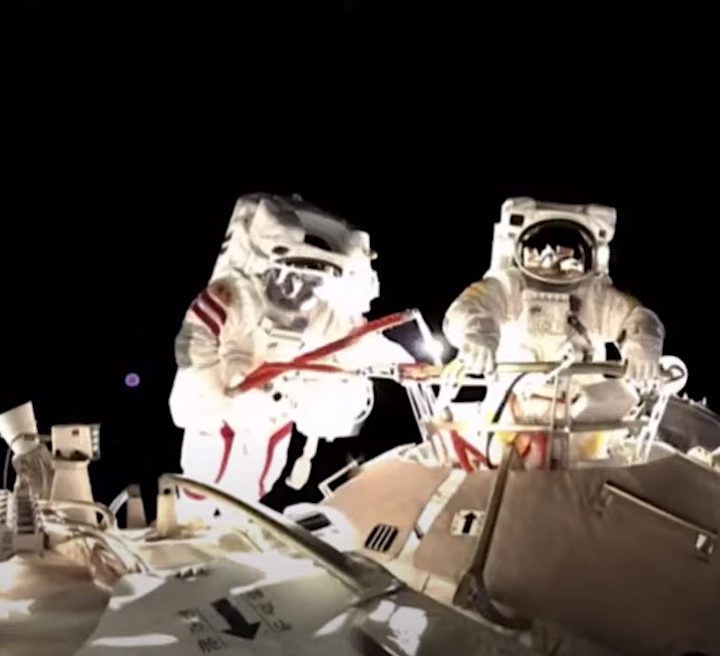
Two astronauts conduct a spacewalk at China's space station.
Mission commander Zhai Zhigang and fellow astronaut Ye Guangfu during Sunday’s spacewalk. CGTN

Two of the three Shenzhou-13 astronauts who arrived at the orbiting station in October emerged from the Tianhe core module over the weekend to install equipment on the exterior of the station, which orbits 230 miles above Earth, about 20 miles below the ISS.

Recommended Videos

Mission commander Zhai Zhigang and fellow astronaut Ye Guangfu participated in the spacewalk — or extravehicular activity (EVA) as the task is officially known — while Wang Yaping assisted from inside the station, Space.com reported.

This was Ye’s first spacewalk, and the third for Zhai. The more experienced of the two gained recognition in 2008 when he became the first Chinese citizen to conduct an EVA.

Zhai’s second spacewalk took place in November, which also saw Wang become the first Chinese woman to participate in an EVA.

Sunday’s work included raising a third panoramic camera outside Tianhe and carrying out various equipment tests, with the two astronauts returning to the interior of the station about six hours later.

China is planning to gradually expand the size of its space station and next year will launch two new modules designed for science research.

The current Shenzhou-13 mission, which is scheduled to run until April, followed the Shenzhou-12 mission that ran from June through October and which marked China’s first astronaut mission since 2016. Two successful spacewalks took place at Tianhe during the Shenzhou-12 mission.

China has been investing heavily in its increasingly ambitious space program, with President Xi Jinping earlier stating that China’s first fully operational space station will open “new horizons” in humanity’s efforts to learn more about the cosmos.

The country’s space program has been scoring some notable successes of late, including the successful deployment of its first Mars rover and the completion of an uncrewed moon mission that brought lunar rocks to Earth.

Trevor Mogg
Contributing Editor
Not so many moons ago, Trevor moved from one tea-loving island nation that drives on the left (Britain) to another (Japan)…
China’s answer to SpaceX’s reusable rockets literally catches boosters in a net
SpaceX catches boosters on legs. China just used a net.
Ammunition, Missile, Weapon

SpaceX's playbook for recovering a rocket booster generally involves legs, a precisely controlled vertical landing, and either a concrete pad or a drone ship. 

China just managed to pull off something similar, but in a slightly different way, and on July 10, it tested the method as well.

Read more
Dimming the sun sounds unhinged, but this new study on El Niño makes a surprisingly good case for it
A natural test case, Australia's worst-ever wildfire season, suggests the idea deserves serious consideration.
Nature, Outdoors, Sky

When I first saw "scientists propose dimming the sun," I rolled my eyes. It sounds like a science fiction movie cooked up after watching many climate documentaries. But a new study, published on July 8, 2026, in the journal Science Advances, seems to have a genuinely compelling argument.

A Super El Niño is currently forming in the Pacific, feared to be the most intense in decades. It could escalate floods, wildfires, and extreme heat events worldwide. However, Researchers at UC San Diego's Scripps Institution of Oceanography, led by climate scientists Kate Ricke and Jessica Wan, are now proposing one of the most interesting solutions I’ve come across.

Read more
You can now walk through space and gaze into a black hole at this VR exhibit
Smithsonian Starstruck lets you drift past dying stars and see the origin point of the universe for as little as $18 a person.
Smithsonian Starstruck featured

Most planetarium shows ask you to sit still and look up. The Smithsonian's new VR exhibit takes a different approach, letting visitors walk through the vast expanse of the universe, drifting past stars, planets, and a black hole to get a physical sense of its true scale.

A $29 ticket to the edge of the galaxy

Read more