1. Home
  2. Computing
  3. Trash
  4. News

TP-Link’s Wi-Fi 6E router comes with motorized antennas for better reception

Add as a preferred source on Google

To deliver better Wi-Fi reception and coverage, especially in larger homes, TP-Link is bringing new innovation to the router space. The company’s latest Wi-Fi 6E router, the TP-Link Archer AXE200 Omni comes with four antennas that are motorized, allowing them to pivot and swivel towards your devices as you move around the house.

Essentially, by tailing your connected devices, the TP-Link Archer AXE200 Omni will help to send out the strongest signals to your devices.

The TP-Link Archer AXE200 Omni with its antennas in motion.
Image used with permission by copyright holder

While stalking, motorized antennas won’t matter much to desktop gamers with stationary rigs, the novel concept could help improve Wi-Fi signals for mobile gamers as they move their laptops from room to room, or for smartphone and tablet users who roam the home. Combined with existing Wi-Fi technologies, like beamforming, the Archer AXE200 Omni helps to ensure you have strong Wi-Fi coverage.

The swiveling antenna looks similar to a quadrocopter drone. The design is definitely a different take on how antennas should be placed on a router — we have seen discrete internal antennas on mesh systems, aggressively placed antennas on gaming routers, and even the futuristic wing-shaped antennas on rival Netgear’s Nighthawk.

Aside from the motorized antenna design, the Omni is a tri-band router with a 6GHz band. The router can handle connection speeds up to 10Gbps, making it a future-proof addition for gamers — most home broadband plans top off at 1Gbps for fiber connections, and the average American home has broadband speeds far less than this currently.
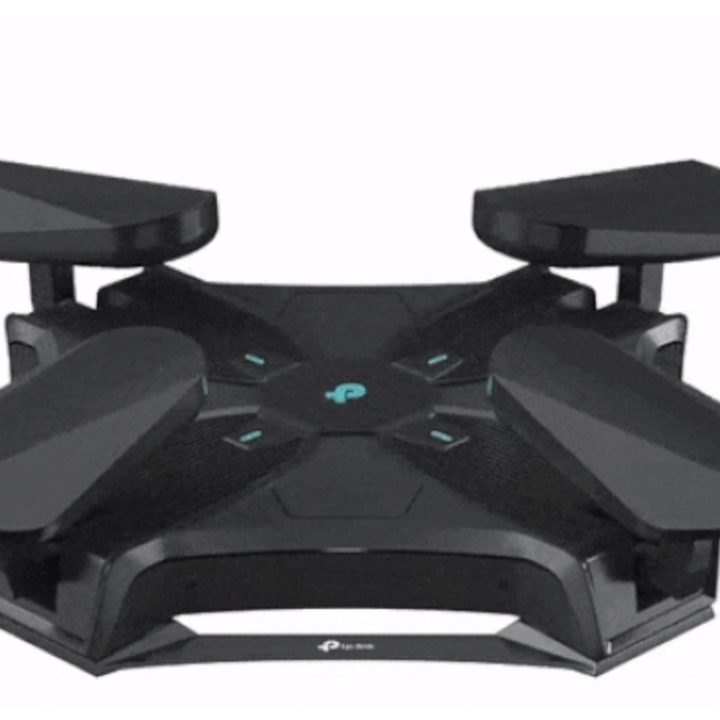
TP-Link's new Omni router features motorized antennas.
Image used with permission by copyright holder

In addition to the Archer AXE200 Omni, TP-Link also announced an AXE300 router with quad-band support that reaches 16Gbps speeds. The quad-band design allows the AXE300 to compete against the pricey Orbi Wi-Fi 6E mesh router. Though TP-Link didn’t disclose pricing for its system, the Orbi mesh network costs $1,500.

In the mesh networking space, the company also announced an update to its Deco router. The new TP-Link Deco XE200 comes with Wi-Fi 6E support that will help it reach speeds up to 11Gbps. A mesh system with two Deco routers can cover homes up to 6,500 square feet, the company claimed, and allow 200 devices to connect simultaneously. This should make the Deco suitable for use in small offices, home offices, and homes. The router boasts a simple, minimalist design that won’t seem as aggressive when placed in open spaces as the AXE200 Omni.

The company did not reveal pricing for its new router products at CES 2022.

Chuong Nguyen
Silicon Valley-based technology reporter and Giants baseball fan who splits his time between Northern California and Southern…
WhatsApp’s Liquid Glass redesign is finally coming to Mac after months of waiting
WhatsApp's Mac app is getting Apple's Liquid Glass-inspired makeover
WhatsApp

WhatsApp has been steadily adopting Apple's new design language across its apps, but Mac users have largely been left watching from the sidelines. That is finally beginning to change.

The messaging platform has started rolling out its Liquid Glass redesign for the WhatsApp Mac app, bringing the desktop experience much closer to what iPhone and iPad users have been seeing over the past few months. The update introduces a refreshed interface with redesigned navigation elements, updated menus, and a cleaner layout that aligns with Apple's latest software aesthetic. According to WABetaInfo, the rollout has begun through the latest Mac App Store update and is currently reaching a limited number of users.

Read more
NVIDIA’s new AI can detect deepfake videos in just 22 milliseconds
NVIDIA has a new AI tool that can tell fake videos from real ones in milliseconds
Nvidia logo

As generative AI becomes increasingly capable of producing videos that are nearly indistinguishable from real footage, the race is no longer just about creating synthetic media. It's about detecting it before it spreads.

At SIGGRAPH 2026, NVIDIA unveiled Synthetic Video Detector, a new AI-powered verification tool designed to identify AI-generated videos with remarkable speed and accuracy. Rather than replacing traditional fact-checking or forensic analysis, the company says the technology is intended to give newsrooms, broadcasters and enterprises another layer of confidence before synthetic videos enter the public domain.

Read more
Dell XPS 14 (2026) Review: Dell’s classic Windows laptop returns, and it’s hard to put down
The icon returns, and shows why it's still relevant
Dell XPS 14 Review: Featured

Quick take

Dell’s XPS line has always carried a certain weight. It is one of those Windows laptop families that people recognize even if they don’t follow laptops too closely. Clean design built with premium materials, sharp displays, and high-end hardware. The Dell XPS 14 DA14260 continues that legacy. 

Read more