1. Home
  2. Space
  3. News

Setting things on fire on the ISS to study flames in space

Add as a preferred source on Google

One of the biggest threats to any space mission, especially those involving astronauts, is fire. Space agencies like NASA create a wide range of fireproof materials for different purposes, but it is still hard to fully protect against fire as differences in airflow and gravity mean fire behaves differently in space than it does on the ground.

Now, a new series of experiments on the International Space Station (ISS) aims to study fire in space to better understand how to protect future space explorers.
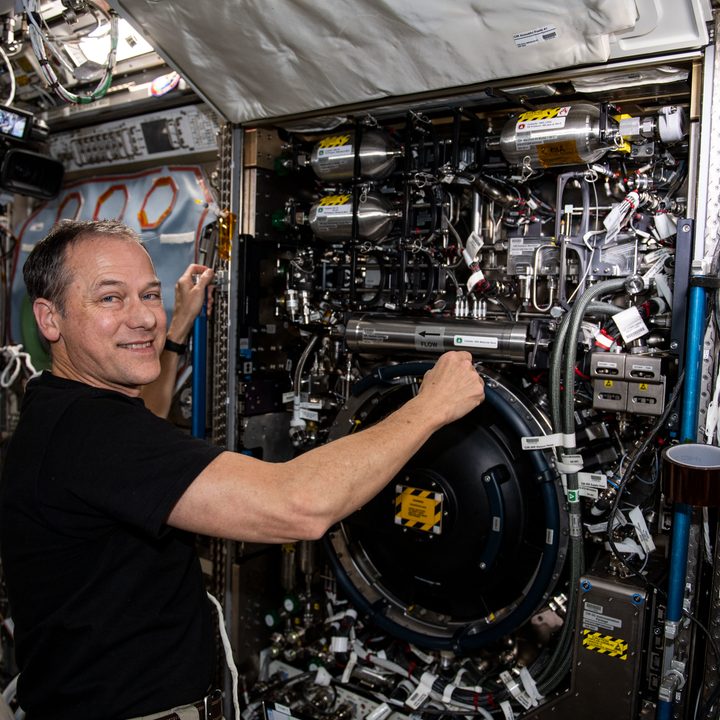
NASA astronaut and Expedition 66 Flight Engineer Thomas Marshburn configures the Combustion Integrated Rack to begin SoFIE operations.
NASA astronaut and Expedition 66 Flight Engineer Thomas Marshburn configures the Combustion Integrated Rack to begin SoFIE operations. NASA

“With NASA planning outposts on other planetary bodies like the Moon and Mars, we need to be able to live there with minimal risk,” said Paul Ferkul, SoFIE project scientist at NASA’s Glenn Research Center in Cleveland, in a statement. “Understanding how flames spread and how materials burn in different environments is crucial for the safety of future astronauts.”

Recommended Videos

A cargo ship launching today, Saturday, February 19, will carry a project called Solid Fuel Ignition and Extinction (SoFIE) to the ISS to be added to the station’s fire research chamber. As well as an experiment into fire suppression and fireproof materials, looking at how flammable materials like plexiglass and cotton-based fabrics are, it will also host experiments into how fire spreads.

“On Earth, gravity has a profound influence on flames, but in the reduced gravity of space, fire can behave unexpectedly and could be more hazardous,” Ferkul said.

The idea is to see how fire behaves when it is in the microgravity environment of the space station, as opposed to the gravity which is present here on Earth. This can then be used to predict how fire might behave in lower gravity environments like the moon or Mars.

“SoFIE builds on NASA’s prior flammability research,” said Lauren Brown, a project manager at Glenn. “Like other flame studies, this research will home in on how things ignite, burn, and are extinguished in space. It will provide a foundation for continuing human spaceflight beyond low-Earth orbit.”

Georgina Torbet
Georgina has been the space writer at Digital Trends space writer for six years, covering human space exploration, planetary…
China’s answer to SpaceX’s reusable rockets literally catches boosters in a net
SpaceX catches boosters on legs. China just used a net.
Ammunition, Missile, Weapon

SpaceX's playbook for recovering a rocket booster generally involves legs, a precisely controlled vertical landing, and either a concrete pad or a drone ship. 

China just managed to pull off something similar, but in a slightly different way, and on July 10, it tested the method as well.

Read more
Dimming the sun sounds unhinged, but this new study on El Niño makes a surprisingly good case for it
A natural test case, Australia's worst-ever wildfire season, suggests the idea deserves serious consideration.
Nature, Outdoors, Sky

When I first saw "scientists propose dimming the sun," I rolled my eyes. It sounds like a science fiction movie cooked up after watching many climate documentaries. But a new study, published on July 8, 2026, in the journal Science Advances, seems to have a genuinely compelling argument.

A Super El Niño is currently forming in the Pacific, feared to be the most intense in decades. It could escalate floods, wildfires, and extreme heat events worldwide. However, Researchers at UC San Diego's Scripps Institution of Oceanography, led by climate scientists Kate Ricke and Jessica Wan, are now proposing one of the most interesting solutions I’ve come across.

Read more
You can now walk through space and gaze into a black hole at this VR exhibit
Smithsonian Starstruck lets you drift past dying stars and see the origin point of the universe for as little as $18 a person.
Smithsonian Starstruck featured

Most planetarium shows ask you to sit still and look up. The Smithsonian's new VR exhibit takes a different approach, letting visitors walk through the vast expanse of the universe, drifting past stars, planets, and a black hole to get a physical sense of its true scale.

A $29 ticket to the edge of the galaxy

Read more