1. Home
  2. Space
  3. News

These huge solar arrays are set for a mammoth space voyage

Add as a preferred source on Google

NASA has shown off the massive solar arrays that will help power its Psyche spacecraft to a distant asteroid of the same name later this year.

A video (below) shared by NASA this week shows the spacecraft’s twin solar arrays opening to their full length of 37 feet (11.3 meters) during a test exercise at the space agency’s Jet Propulsion Laboratory (JPL) in California.

NASA’s Psyche Spacecraft Prepares for Trip to Asteroid by Testing Solar Arrays

“Seeing the spacecraft fully assembled for the first time is a huge accomplishment; there’s a lot of pride,” said Brian Bone, who leads assembly, test, and launch operations for the mission at JPL. “This is the true fun part. You’re feeling it all come together. You feel the energy change and shift.”

Recommended Videos

Covering 800 square feet (75 square meters) — about the size of a singles tennis court — the spacecraft’s five-panel, cross-shaped solar arrays are the largest ever installed at JPL, NASA said.

During the mission, which is expected to launch from the Kennedy Space Center in August, the enormous arrays will fully deploy about an hour after lift-off, with the procedure taking just eight minutes.

With the arrays fully open, the Psyche spacecraft will take about three-and-a-half years to travel 1.5 billion miles (2.4 billion kilometers) to the metal-rich Psyche asteroid, which is 173 miles (280 kilometers) at its widest point and said by NASA to be shaped “somewhat like a potato.”
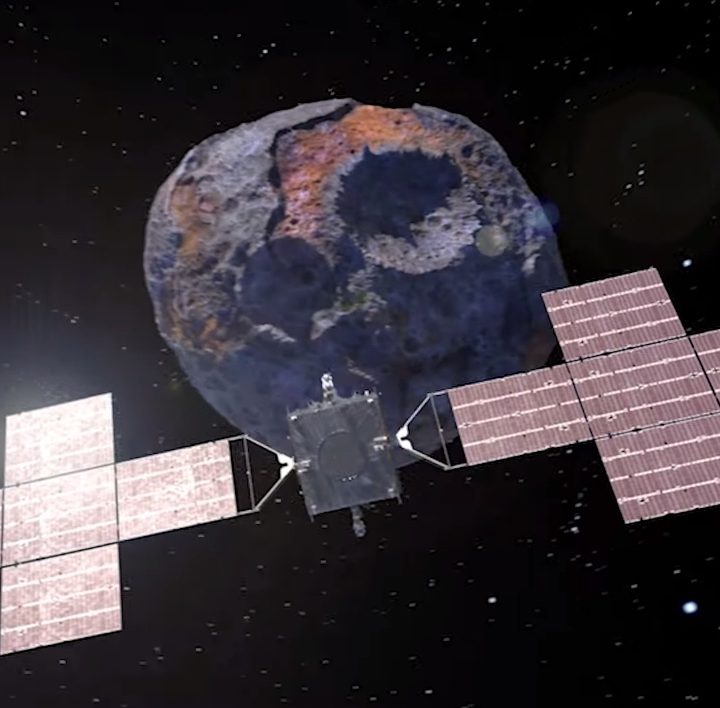
NASA's spacecraft approaching the Psyche asteroid.
An artist’s concept of NASA’s spacecraft, with its solar arrays clearly visible, approaching the Psyche asteroid, which lies in the main asteroid belt between Mars and Jupiter. NASA

The spacecraft will spend two years studying the asteroid from a close distance in a mission that scientists hope will help answer fundamental questions about the formation of our solar system.

This year is a busy one for NASA as it oversees a number of notable missions. It recently, for example, launched a next-generation satellite for National Oceanic and Atmospheric Administration and is also gearing up for the highly anticipated Artemis I mission using its new SLS rocket to send the Orion spacecraft on a flyby of the moon.

Trevor Mogg
Contributing Editor
Not so many moons ago, Trevor moved from one tea-loving island nation that drives on the left (Britain) to another (Japan)…
China’s answer to SpaceX’s reusable rockets literally catches boosters in a net
SpaceX catches boosters on legs. China just used a net.
Ammunition, Missile, Weapon

SpaceX's playbook for recovering a rocket booster generally involves legs, a precisely controlled vertical landing, and either a concrete pad or a drone ship. 

China just managed to pull off something similar, but in a slightly different way, and on July 10, it tested the method as well.

Read more
Dimming the sun sounds unhinged, but this new study on El Niño makes a surprisingly good case for it
A natural test case, Australia's worst-ever wildfire season, suggests the idea deserves serious consideration.
Nature, Outdoors, Sky

When I first saw "scientists propose dimming the sun," I rolled my eyes. It sounds like a science fiction movie cooked up after watching many climate documentaries. But a new study, published on July 8, 2026, in the journal Science Advances, seems to have a genuinely compelling argument.

A Super El Niño is currently forming in the Pacific, feared to be the most intense in decades. It could escalate floods, wildfires, and extreme heat events worldwide. However, Researchers at UC San Diego's Scripps Institution of Oceanography, led by climate scientists Kate Ricke and Jessica Wan, are now proposing one of the most interesting solutions I’ve come across.

Read more
You can now walk through space and gaze into a black hole at this VR exhibit
Smithsonian Starstruck lets you drift past dying stars and see the origin point of the universe for as little as $18 a person.
Smithsonian Starstruck featured

Most planetarium shows ask you to sit still and look up. The Smithsonian's new VR exhibit takes a different approach, letting visitors walk through the vast expanse of the universe, drifting past stars, planets, and a black hole to get a physical sense of its true scale.

A $29 ticket to the edge of the galaxy

Read more