

College students have never been more popular than today. No, not in terms of Facebook friends, although that’s likely true, too. Rather, it’s because of their role in the consumer electronics market. Every major CE manufacturer is targeting their demographic. David Roman, the new CMO at Lenovo, admitted recently that “the only way to build a consumer brand is to be relevant to the youth market,” however, the youth market tends to be elusive to everyone but Apple.
Feeling young again
Older generations, either because they want to be hip or because they don’t understand fast-changing technologies, are looking to 18- to 24-year-olds for direction. Apple is right there, attracting a wide spectrum of consumers. The company’s products “just work,” which appeals to the non tech-savvy crowd, but their offerings also have sleek designs, which appeals to the most tech-savvy of users. In a February survey, comScore found that nearly half of U.S iPad users make more than $100,000 per year. I don’t know too many college students making that kind of money. Although Apple markets the iPad to younger generations and employs young staff members at its retail branches, the truth is that most Apple customers are closer to 40 than 20. More than 50 percent of iPad users in the U.S. are over 35-years-old, while 27 percent are 25-34, and just 15.2 percent are 18 to 24.
Who is the iPad User?
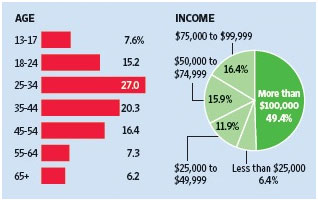
Lesson for manufacturers: Target 18 to 24-year-olds and their parents will follow.
Betting on Apple
The best thing for MacBook sales has been the success of Apple’s entry-level iDevices; the iPod, iPhone, and iPad, which serve as a way to introduce mainstream PC users to the Apple brand and iOS platform, boosting upstream sales. In its fiscal Q2, Apple posted $24.67 billion in revenue (up 83 percent) and sold 2.75 million MacBooks (up 53 percent, year on year), 4.69 million iPads, and 18.65 million iPhones (up 113 percent year on year). So it’s no surprise that every consumer electronics manufacturer in the world is having meetings trying to figure out how to be more like Apple. If they’re not, they should be! Did I mention $24.67 billion in quarterly sales?!
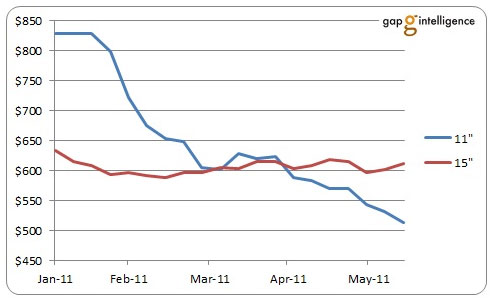
People forget that the MacBook Air did not sell well until Apple reduced the price and offered an 11-inch option for less than $1,000. Apple has since had success with its MacBook Air line, and shortly after, a flood of copycats arrived, driving down the average price of 11-inch notebooks. After all, if Apple is selling that size, that must be what consumers want, right?
Average notebook price by display size
What’s a Manufacturer to Do?
Apple sales are spurred by the success of the company’s retail stores and competitors have taken notice. Microsoft hired George Blankenship, former Apple real estate chief, to launch its retail outlets. In April, Sony began revamping its Sony Style stores with a new format complete with white display platforms and increased customer interaction, closely mirroring Apple’s format. And JC Penney shares rose over 17 percent in one day, in conjunction with the recent news that Ron Johnson, former Apple Senior VP of retail, would be taking over as CEO. Even shareholders believe that copying Apple can pay dividends (pun intended).
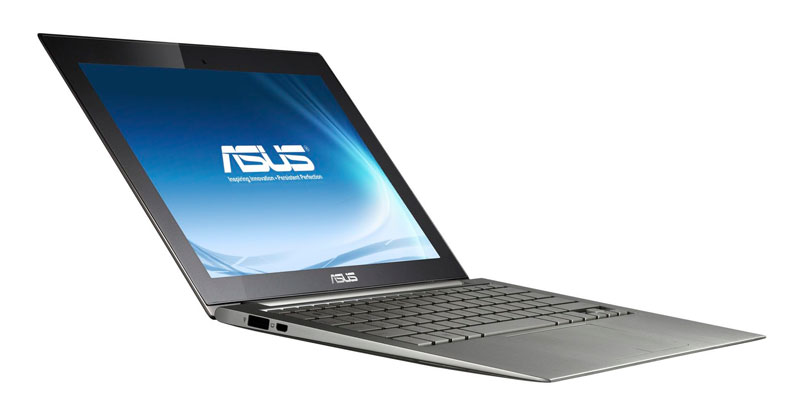 Competitors’ products have begun to resemble Apple’s products. Intel recently announced its “ultrabook” concept, which the company expects to make up 40 percent of the notebook market by 2012. Ultrabooks are being marketed as thin, portable, long battery life, quick startup time… sound familiar? They’re not ultra-small or ultra-cheap, but they’re ultra-similar to Apple’s MacBook Air and just about all tablets. Intel currently has an 80 percent share of the notebook market, so it has the leverage to tell manufacturers what to do. That said, the company’s 40 percent goal for ultrabooks is ambitious (read: a dream) so why not bet on Apple?
Apple’s competitors are beginning to adopt the company’s strategies:
- Lenovo’s global rebranding effort is focused on showing what its products can do, rather than just its specifications and what it looks like.
- Samsung has been searching for a popular and user-friendly operating system, partnering with Google and fully embracing both Android and Chrome.
- Sony, in addition to improving its retail stores, continues to focus on stylish designs and using its other entertainment products including TVs, Blu-ray players, cameras, camcorders, and even its Playstation consoles, to create a seamless entertainment experience.
- Intel is bringing user experience to the component level with its ultrabook chips, which will allow a wide range of manufacturers to take advantage of the technology.
- HP is creating an ecosystem around webOS, allowing multiple devices and form factors to access and sync content.
Faster horses
Henry Ford, who made the automobile popular in the early 1900’s admitted, “If I had asked the public what they wanted, they would have said a faster horse.” In the same way that Ford disrupted the burgeoning horse industry, Apple continues to disrupt markets (smartphone, gaming, music, PC), while creating new ones all together (tablet). In 1998, Steve Jobs said, “It’s really hard to design products by focus groups. A lot of times, people don’t know what they want until you show it to them.” He says innovation is about “the people you have, how you’re led and how much you get it.”
Apple gets it. In fact, Apple designers get the youth market so well that they’re able to tell them what they want before they know they want it. And that would be really annoying if sales didn’t prove them right each quarter.
About the author: Deron Kershaw is a market analyst for Gap Intelligence, a San Diego-based independent technology research firm with emphasis in helping product manufacturers and retailers understand current retail market trends in order to respond to customer demands as they occur. He can be reached at dkershaw@gapintelligence.com.


