After having teased its new line of Intel Arc discrete graphics cards last year, Intel is finally debuting its first discrete graphics for laptops. The Intel Arc A-series will comprise several different cards targeting both ultra thin and light laptops under the Intel Evo branding and traditional laptop form factors. Gamers and content creators will be able to choose between the Intel Arc 3-series, 5-series, and premium 7-series range of discrete GPUs, the company announced today.
“We built a foundation and power-efficient integrated graphics that ships in the majority of laptops today,” Roger Chandler, Intel vice president and general manager of graphics and gaming, said of his company’s journey to arriving at Arc. “From Ultrabook to EVO, our focus has always been platform-level innovation. And now we’ve arrived at the next big milestone completing the Intel platform — with discrete graphics.”

DirectX 12 Ultimate
The Arc series of graphics will include DirectX 12 Ultimate support, hardware-accelerated A.I. processing, ray tracing, and support for the new AV1 media engine. The new engine includes hardware-enabled encode and decode capabilities for faster performance. This makes the Arc discrete GPUs competitive against rival graphics cards from Nvidia and AMD.
“Every Arc GPU offers full support for DirectX 12 Ultimate, including hardware-accelerated ray tracing and Arc in conjunction with the 12th Gen Intel Core processors will be direct storage capable,” Intel said during its presentation.
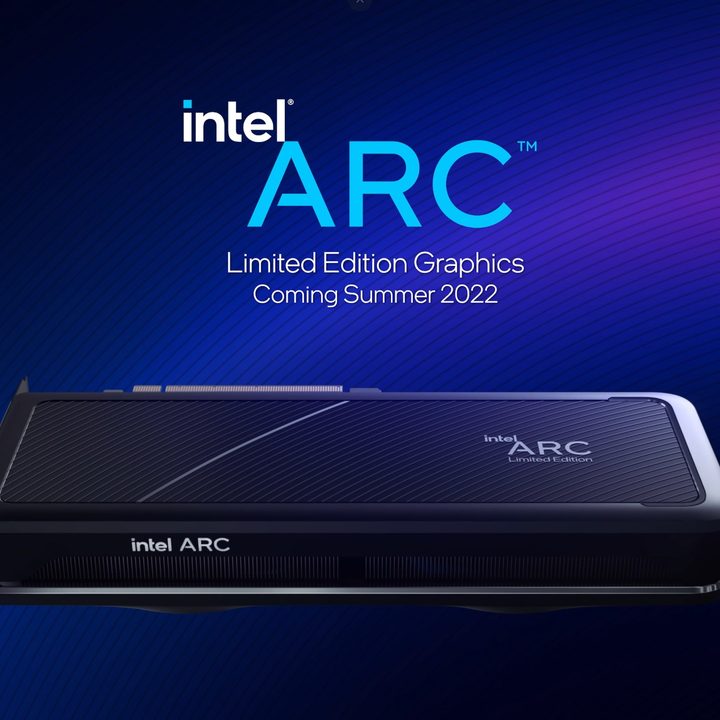
Intel announced that Arc will also launch on desktops and workstations later this year. Arc will launch first with the 3-series graphics for laptops, which will be available starting today, and expand to the 5-series and 7-series later this year.
Compared to integrated Iris graphics, Intel said that Arc essentially doubles the graphics performance in thin-and-light form factors.
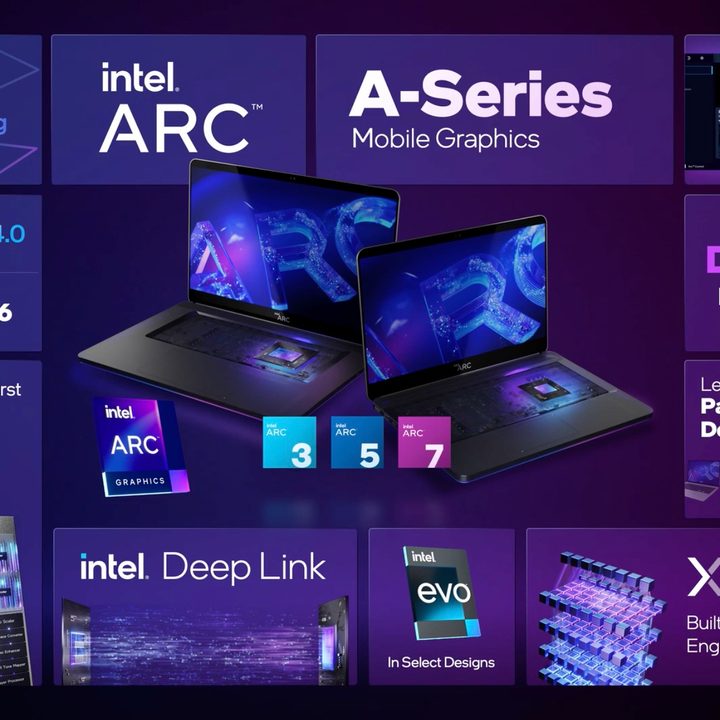
The first 3-series Arc laptops will be available with either a base A350M for Intel Evo laptops or a more performance-tuned A370M for thin and light — Ultrabook — notebooks.
“These laptops will deliver over 60 frames per second (fps) at 1080 p on a range of popular titles,” Chandler said. “You can see that Intel Arc 3 delivers over 90 frames per second, enabling competitive gaming on the go and some of the most portable designs in the industry.”
Intel announced that it is working with a growing list of game developers to bring more titles to the platform.

XeSS coming this summer
“Arc 5- and Arc 7-based laptops will be packed with even more,” Chandler added. “You’ll get more Xe cores, more fixed function ray tracing acceleration, more GDD6 memory, and ultimately more performance. They will also ship with a new technology designed to deliver more efficient performance, which we call Xe super sampling, known as XeSS.”
XeSS will upscale graphics for higher-resolution displays without taxing the system’s hardware resources, making details appear more clear and crisp on games. This is great for upscaling to a 2K or 4K resolution display, and Intel’s demo shows that there are more details in background and foreground game elements with XeSS enabled.

“XeSS is our solution,” Chandler said, noting that the technology leverages “the power of ARCs XMX A.I. engines to deliver high-performance A.I.-accelerated upscaling.”
XeSS will be coming later this summer and the technology will support all Arc discrete graphics. More than 20 game titles will be supported at launch, with Intel claiming that more will be added soon.

The power of XMX A.I.
In addition to XeSS, Intel is also making a huge push with A.I. on the Arc series of GPUs.
“We built Intel Arc’s XMX A.I. acceleration engines to power A.I. workloads now and in the future,” Chandler said. “Our A.I. engines have 16 times the compute for A.I. inferencing operations when compared to traditional GPU vector units, which can enable performance boosts in many productivity gaming and creator applications.”
In a demo, Intel showed how popular video-editing titles can denoise old family videos and upscale these videos to the modern era by emulating how they would look if captured through a 4K camera. An old NASA rocket launch, for example, showed how the “United States” font on the rocket appears more crisp with A.I. enhancements applied.
“Our XMX engines seamlessly accelerate this compute -ntensive A.I. process to give you amazing results in half the time,” Intel explained. “With the power of XMX, this upscaling is more than twice as fast as integrated graphics alone.”
Native AV1 support
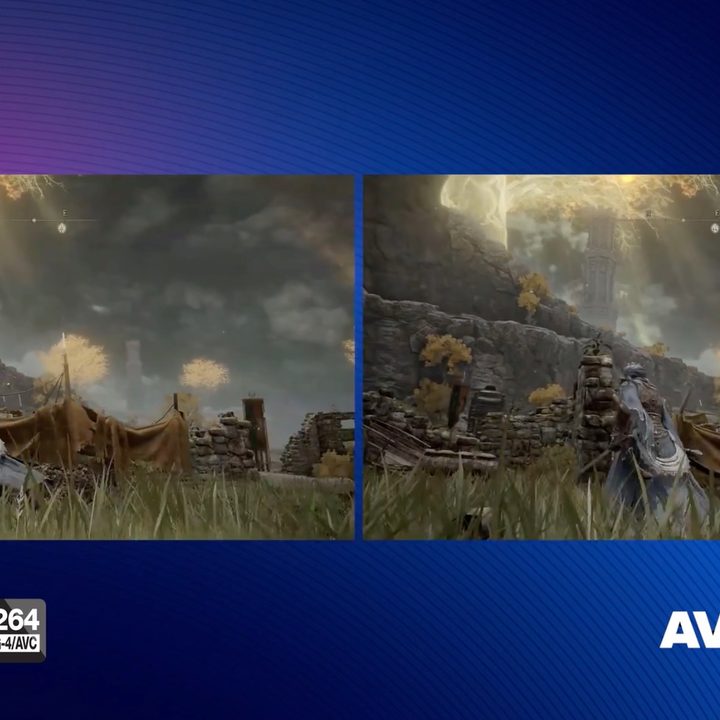
And with support for AV1 codecs, Intel’s Arc GPUs are the world’s first to come with native AV1 support. The company demonstrated how AV1 support will render more details in titles such as Elden Ring and that hardware support delivers a 50x improvement in encoding speeds versus traditional implementations.
The company is also rolling out a new Intel Deep Link integration to support every Intel Arc and Iris GPU to help gamers and creators leverage the technologies available to them.
“It enables dynamic power sharing, intelligently distributing power across the platform to increase application performance up to 30% on creation and compute intensive applications,” Intel said of Intel Deep Link. “It also includes hyper compute, which enables a significant speed up in A.I. heavy applications. In the XMX video demo we showed you earlier, we saw an additional 24% performance improvement when we leverage all available A.I. engines in the system.”

For gamers, a new Arc Control interface will bring day-zero-ready game drivers, custom performance profiles, and more.
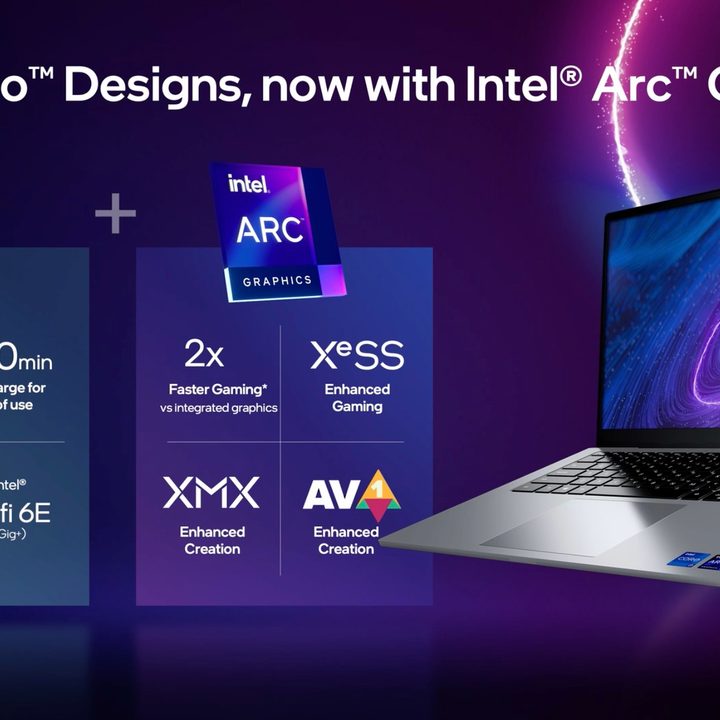
One of the Arc 3 laptops that will be available to pre-order today is the Samsung Galaxy Book 2, though Intel named a number of partners that it is working with — from Acer to HP — to launch new Ultrabooks and EVO notebooks featuring its new discrete GPUs.

Intel EVO laptops still retain their stated nine-hour battery life, the company claims.