The LTPO display tech has gained popularity in recent years. LTPO or low-temperature polycrystalline oxide is a type of backplane tech used in OLED displays that allows your screen to operate at variable refresh rates, while using less battery than a standard OLED display. However, this technology is currently limited to flagship devices, and it’s likely to be a while before we see this technology trickle down to more affordable devices. At the moment, you can only find LTPO displays on devices like the Apple iPhone 13 Pro, Samsung Galaxy S22 Ultra, Google Pixel 6 Pro, Apple Watch Series 7, and a few others.
Keep reading to find out how this display tech works, what makes it different from standard OLED panels, and everything else you need to know about LTPO displays.
What is an LTPO display and how does it work?
An LTPO display can dynamically switch between refresh rates, without an additional hardware component between the graphics controller and the graphics processing unit (GPU). This saves a considerable amount of battery life as your phone doesn’t have to render as many frames for the task being performed. For instance, while looking at a static image, the refresh rate can be dropped down low, reducing power needs and processor load. Conversely, it can be cranked up to the maximum when playing a game, when the extra frames would be useful.
In comparison, other displays, like LTPS (low-temperature polycrystalline silicon) displays, do not allow for dynamic refresh rates unless an extra component is installed. This is the reason a number of phones only switch between 90Hz and 120Hz, or 60Hz and 120Hz refresh rates. But with LTPO tech, phone displays are capable of a refresh rate as low as 1Hz and anything in between.

To fully understand what an LTPO display is, we must first know what an OLED display is made of. It has three major layers: An organic emissive layer, a protective glass surface, and a backplane. The backplane controls how each pixel acts. It is composed of thin film transistors (TFTs), mostly of two kinds — one for switching on a pixel (switching TFTs) and another for maintaining its brightness (driving TFTs).
We’ve seen three types of TFT backplanes in the past few years: Amorphous silicon (a-Si), low-temperature polycrystalline silicon (LTPS), and indium gallium zinc oxide (IGZO). An LTPO display is made by combining the capabilities of the LTPS and IGZO backplanes. The LTPS backplane brings energy efficiency, while the IGZO backplane provides the variable refresh rate.
Is it different from regular OLED?
LTPO is a tweaked version of OLED, but it is still classed differently from a regular OLED panel. As indicated before, an OLED display has an LTPS backplane, while an LTPO OLED panel uses a combination of LTPS and IGZO backplanes.
A normal OLED display needs an additional component to switch between multiple refresh rates, but that’s not the case with an LTPO OLED panel. The LTPO displays on phones these days can refresh in a range of 1-120Hz or more, without taking a major hit on battery life. That’s the reason a lot of manufacturers are switching to LTPO panels on their flagship phones.
Benefits of LTPO displays
The display is one of the most power-hungry components on a smartphone, and with high refresh features included, it becomes the biggest enemy of the battery. This is where LTPO tech comes into play. By dynamically switching between refresh rates an LTPO panel saves a considerable amount of battery.
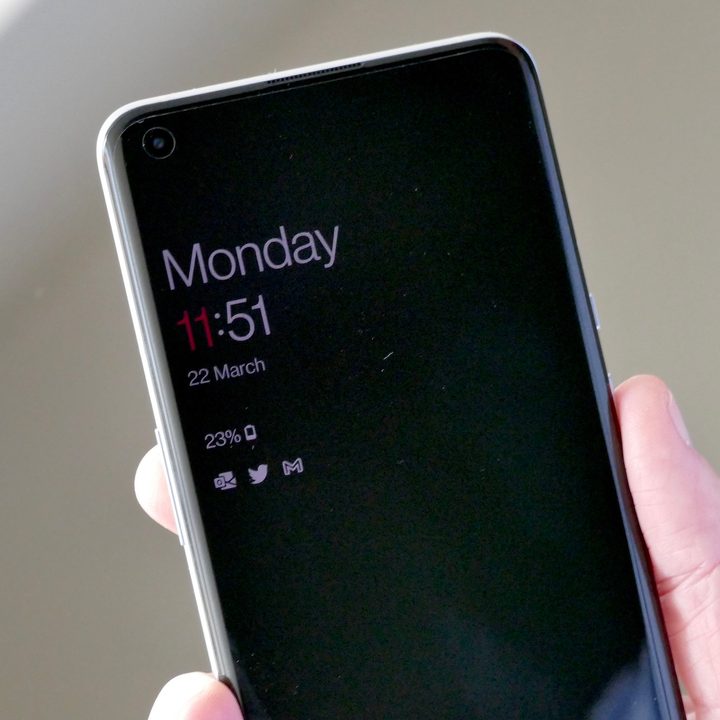
A device with a normal OLED panel can manually jump between refresh rates — but that capability is limited and isn’t as effective as an LTPO display, which can go as low as 1Hz depending on the activity. Let’s take an example of always on display, which, for the most part, displays static content and barely requires a refresh rate of more than 10Hz. Here, your phone will benefit from an LTPO display, as it will not have to display the content at a higher refresh rate like 60, 90, or 120Hz. Instead, it could keep it at 1Hz, and save battery power.
This applies to other scenarios, where your phone might lower the refresh rate when not required, and bump it up when necessary. While an exact figure is not known, it is believed that LTPO panels are 10% to 20% more efficient than regular OLED panels.
Phones with LTPO displays
Apple was the first to introduce the tech on the Apple Watch Series 4. Samsung became the first smartphone maker to offer a phone with an OLED LTPO display. The company’s last Note series device, the Note 20 Ultra, was the first to feature an LTPO display. Since then we have seen multiple high-end phones adopt these new panels. Provided below is the list of a few phones equipped with an LTPO display.
- Samsung Galaxy Note 20 Ultra
- Apple iPhone 13 Pro Max
- Samsung Galaxy Z Fold 3
- Samsung Galaxy Z Flip 3
- Google Pixel 6 Pro
- Samsung Galaxy S21 Ultra
- Oppo Find X3 Pro
- Oppo Find X5 Pro
- OnePlus 10 Pro
- OnePlus 9 Pro
- Realme GT 2 Pro
- Xiaomi 12 Pro