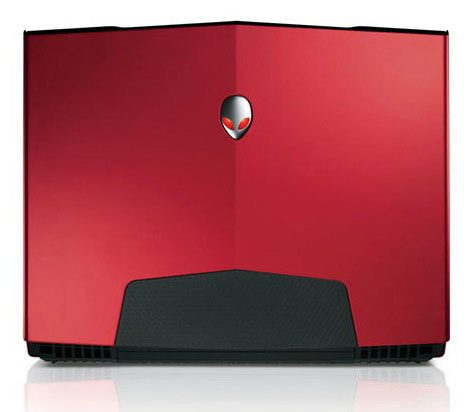
 Dell’s boutique high-performance Alienware division has been a little quiet lately, but that silence has now ended with the introduction of five new high-end gaming rigs at the Tokyo Game Show&mash;led by a new 15-inch notebook computer sporting a mobile Core i7 processor and Nvidia GeForce GTZ 260M graphics with 1 GB of video RAM.
“Alienware systems are, and always have been, our benchmark for PC gaming performance,” said Dell’s VP pf consumer sales and marketing Michael Tatelman, in a statement. “Through the Alienware brand, Dell is committed to offering gamers the richest possible PC gaming experience with the latest technology and coolest designs.”
First up, the new Alienware M15x notebook, which Dell is modestly characterizing as the “most powerful 15-inch gaming laptop in the universe.” The M15x sports a mobile version of the Intel’s Core i7 processor running at 1.6 to 2 GHz, along with optional Nvidia GTX 260 M graphics (with 1 GB of video RAM) and support for up to 8 GB of system memory. The system sports a 15.6-inch display with either a 1,600 by 900-pixel or 1,920 by 1,080-pixel native resolution, a slot loading DVD burner (Blu-ray is an option), 250 to 500 GB of hard drive storage (a 256 GB SSD is an option), VGA and DisplayPort video output, three USB 2.0 ports, FireWire, gigabit Ethernet, and an 8-in-1 card reader. As with all Alienware offerings, the system can be customized and cranked up considerably, but prices start at $1,499. However, like all other gaming notebooks, the system is questionably portable by today’s standards: the system is almost two inches thick and weighs almost nine pounds.
Next up, Alienware has announced the Aurora and Aurora ALX MicroATX desktops, featuring Core i7 processors (including an option to overclock them to 3.6 GHz); the systems can support dual ATI Radeon HD 5870 graphics cards (with 1 GB video RAM each) and up to 12 GB of main memory, along with up to 2 TB of onboard storage and gigabit Ethernet. As usual, a number of customization options are available—users can opt for Nvidia or ATI graphics. Prices start at $1,299 and go up quickly from there.
Finally, folks looking to a full PC tower will want to hold out for the Area-51 and Area-51 ALX systems, designed for hardcore gamers and severe computing enthusiasts: the systems feature Core i7 processors that can be factory overclocked all the way to 3.86 GHz, a wide variety of graphics options (including dual multi-GPU cards from Nvidia or ATI). The systems will have can support multiple optical drives, have enough room for up to six internal SATA II drives in cable-free bays, and support up to 12 GB of 1333MHz or 1600MHz DDR3 RAM. Prices will start at $1,999.