  1. Home
  2. Computing
  3. News

SK Hynix might dethrone Western Digital with this SSD

Add as a preferred source on Google

SK Hynix has just announced the release of a brand-new PCIe Gen 4.0 SSD that should prove to be one of the best SSDs in terms of input/output operations per second (IOPS).

Set to potentially become one of the fastest such drives on the market, the SSD is already available on Amazon. However, as is the case with many other SSDs, not every variant of the SK Hynix Platinum 41 will offer such top speeds.
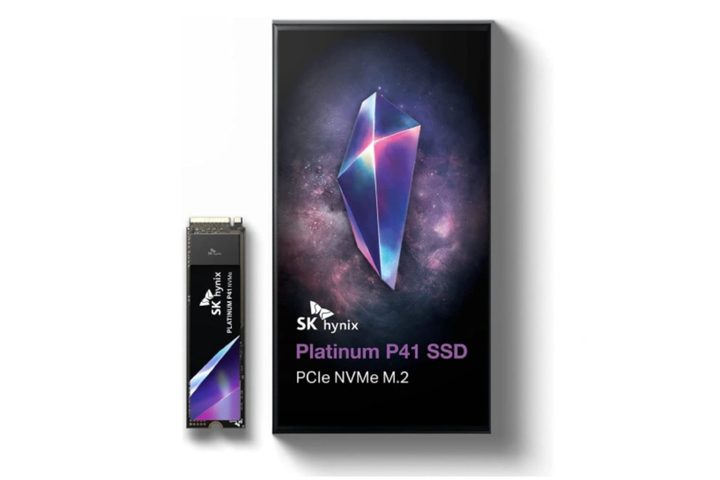
The box of an SK Hynix SSD.
Image used with permission by copyright holder

The new SK Hynix Platinum 41, at its most capable, comes with sequential speeds of up to 7000MB as well as capacities reaching as high as 2TB. It truly shines where IOPS are concerned, though, seeing as it’s rated for 1.4 million random read IOPS and 1.3 million random write IOPS. Although those numbers don’t make it the fastest SSD in 2022, it certainly has a chance to climb the ranks and land near the top among brands such as Kingston and Western Digital.

Recommended Videos

SK Hynix also breaks new ground with this SSD due to the 176-layer NAND flash — it’s the first consumer-based drive to utilize this kind of technology, and it delivers a huge upgrade, stepping up from 128-layer NAND. This adds up to a 20% increase in read cell speed as well as 1.6GT/s of bandwidth between the NAND flash and the SSD controller.

This kind of performance jump could definitely be felt by the end users in daily performance. Be it in gaming or various other workloads, the benefit from an increase in random read and write speeds could be significant. The data on an SSD’s NAND flash is rarely ever neatly organized, which means that the drive has to not just transfer data, but also locate it first. Upping the random read and write speeds should combat this problem to an extent, resulting in faster performance.

As mentioned above, the SK Hynix Platinum 41 is already available on Amazon in three capacities: 500GB for $105, , and 2TB for $260. All of the models are rated for maximum read speeds of 7000Mbps, which is the maximum PCIe Gen 4 can provide, but the write speeds vary by capacity — the better the model, the higher the write speeds.

SK Hynix has not released the exact random read and write speeds for each individual model, but it seems safe to assume that the same logic will apply here, with the higher-priced versions receiving the best speeds.

The cheapest, 500GB model has a write speed of just 4,700Mbps. Both the 1TB and the 2TB variants can hit at high as 6,500Mbps. The lifespan of the SSD is also reduced or enhanced based on capacity, with the 500GB version rated at 500TBW, the 1TB version at 750TBW, and last, 1,200TBW for the 2TB model.

This SK Hynix Platinum 41 SSD was first spotted by Tom’s Hardware. Until it is thoroughly benchmarked, it’s hard to know how high it will rank among the best SSDs, but on paper, it sounds like it will be one of the better options available on the DIY market.

Monica J. White
Monica is a computing writer at Digital Trends, focusing on PC hardware. Since joining the team in 2021, Monica has written…
Copilot could soon help diagnose issues with your PC
A new PC Insights feature will help you find what's slowing down your PC, though Copilot itself may be one of the main problems.
Microsoft Copilot Banner Featured

Copilot's next trick is diagnosing your PC's problems, but the catch is that the assistant doing the diagnosing is itself part of the problem. Windows Latest reports that Microsoft is testing a new Copilot feature called PC Insights, which will let you ask the AI assistant natural language questions about your computer's hardware and storage instead of digging through the Task Manager or Settings. The feature will reportedly allow users to ask questions like, "Do I have enough space for a 100GB game?" and Copilot will check the available storage to offer a response. Users will also be able to ask about CPU usage, battery health, etc., to diagnose issues.

What Copilot will be able to see

Read more
OpenAI just took the handcuffs off your ChatGPT Work and Codex usage limits, at least for now
The 5 hour limit is gone for now, your usage counter just reset, and GPT 5.6 Sol is about to get a lot lighter on your allowance.
OpenAI logo on Microsoft surface

It seems that OpenAI has been on a gallop lately, releasing new updates left and right. Just a few days back, the company launched its GPT-5.6 Sol, Terra, and Luna models for the general public, and now it's back with another update that will please its users even more. 

The headline change is that the 5-hour usage limit restriction in ChatGPT Work and Codex is being temporarily removed for all Plus, Business, and Pro plans. If you have ever been in the middle of a long working session and watched the limit message appear at the worst possible moment, this one is for you. 

Read more
This app gives your Mac a music player you’ll actually enjoy using
Apple Music on the Mac is a chore. Liqoria is the fix, and it plays nice with Spotify and YouTube too.
Liqoria music player

The Apple Music app on the Mac is not up to the mark. I don’t like how it looks or behaves, and Apple should take some inspiration from Spotify to make the app more modern and useful. Until that happens, we are stuck with a subpar app experience.

That’s why I never use the Apple Music app on my Mac and rely on third-party apps that let me control music. Today I am featuring one of the latest apps I discovered. It’s called Liqoria, and it’s probably the only music player app you will ever need.

Read more