A possible security attack has just been revealed by researchers, and while difficult to carry out, it could potentially endanger some of the most sensitive data in the world.
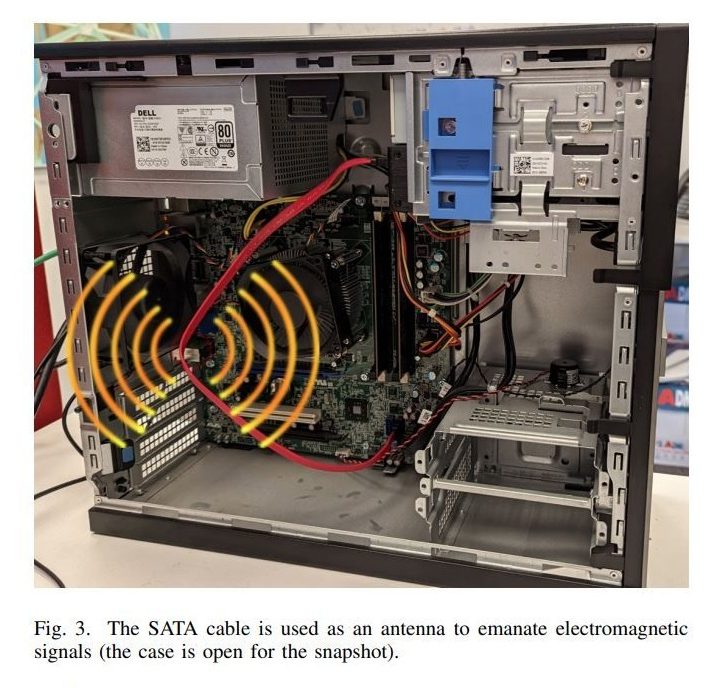
Dubbed “SATAn,” the hack turns a typical SATA cable into a radio transmitter. This permits the transfer of data even from devices that would otherwise not allow it at all.
As data protection measures grow more advanced and cyberattacks become more frequent, researchers and vicious attackers alike reach new heights of creativity in finding possible flaws in software and hardware. Dr. Mordechai Guri from the Ben-Gurion University of the Negev in Israel just published new findings that, once again, show us that even air-gapped systems aren’t completely secure.
An air-gapped system or network is completely isolated from any and all connections to the rest of the world. This means no networks, no internet connections, no Bluetooth — zero connectivity. The systems are purposely built without any hardware that can communicate wirelessly, all in an effort to keep them secure from various cyberattacks. All of these security measures are in place for one reason: To protect the most vulnerable and sensitive data in the world.
Hacking into these air-gapped systems is exceedingly difficult and often requires direct access in order to plant malware. Removable media, such as USB stealers, can also be used. Dr. Guri has now found yet another way to breach the security of an air-gapped system. SATAn relies on the use of a SATA connection, widely used in countless devices all over the globe, in order to infiltrate the targetted system and steal its data.
Through this technique, Dr. Guri was able to turn a SATA cable into a radio transmitter and send it over to a personal laptop located less than 1 meter away. This can be done without making any physical modifications to the cable itself or the rest of the targeted hardware. Feel free to dive into the paper penned by Dr. Guri (first spotted by Tom’s Hardware) if you want to learn the ins and outs of this tech.
In a quick summary of how SATAn is able to extract data from seemingly ultra-secure systems, it all comes down to manipulating the electromagnetic interference generated by the SATA bus. Through that, data can be transmitted elsewhere. The researcher manipulated this and used the SATA cable as a makeshift wireless antenna operating on the 6GHz frequency band. In the video shown above, Dr. Guri was able to steal a message from the target computer and then display it on his laptop.
“The receiver monitors the 6GHz spectrum for a potential transmission, demodulates the data, decodes it, and sends it to the attacker,” said the researcher in his paper.
The attack can only be carried out if the target device has malicious software installed on it beforehand. This, of course, takes the danger levels down a notch — but not all too much, seeing as USB devices can be used for this. Without that, the attacker would need to obtain physical access to the system to implant the malware before attempting to steal data through SATAn.
Rounding up the paper, Dr. Guri detailed some ways in which this type of attack can be mitigated, such as the implementation of internal policies that strengthen defenses and prevent the initial penetration of the air-gapped system. Making radio receivers forbidden inside facilities where such top-secret data is stored seems like a sensible move right now. Adding electromagnetic shielding to the case of the machine, or even just to the SATA cable itself, is also recommended.
This attack is certainly scary, but we regular folk most likely don’t need to worry. Given the complexity of the attack, it’s only worthy of a high-stakes game with nationwide secrets being the target. On the other hand, for those facilities and their air-gapped systems, alarm bells should be ringing — it’s time to tighten up the security.