A credit/debit card stealing scheme that was initially discovered in 2020 has now been detected in Singapore.
As reported by Bleeping Computer, threat analysts at cybersecurity company Group-IB link it to “Classicscam,” a global operation that has targeted individuals in Europe, Russia, and the U.S.

Phishing sites that imitate Singaporean classifieds sites are created and spread via Telegram, which is becoming an increasingly popular platform for hackers, drug dealers, and cybercriminals in general. A total of 18 phishing-related domains connected to the scheme were uncovered.
Furthermore, with the use of one-time passcodes (OTPs) associated with someone’s bank, scammers aim to divert the funds away from the victim and into their own accounts.
The threat actors initially contact the seller of an item on these classified sites to mention they want to buy it, after which an URL of the phishing site is sent.
Should the seller fall for the bogus URL and follow through, the site they load will resemble the classifieds portal, stating that the payment for buying the item has been processed successfully.
The seller is reportedly required to provide their full card details to receive the amount owed to them for selling their item, including their name, card number, expiration date, and the CVV code.
From here, the seller is given a doctored OTP (one-time password) page, which is when the scammer can then use that through a reverse proxy on the actual bank portal.
Classicscam operates as an automated “scam as a service,” which is undoubtedly popular among the hacking community. It primarily attempts to focus on users of classified sites, but its efforts also extend to banks, cryptocurrency exchanges, delivery companies, and moving companies to name a few.
In order to promote its services and for operational purposes, Classicscam is spread through Telegram channels — there’s said to be around 90 active rooms at the moment. Since it launched during 2019, it’s reported that it has been behind $29 million in damages.
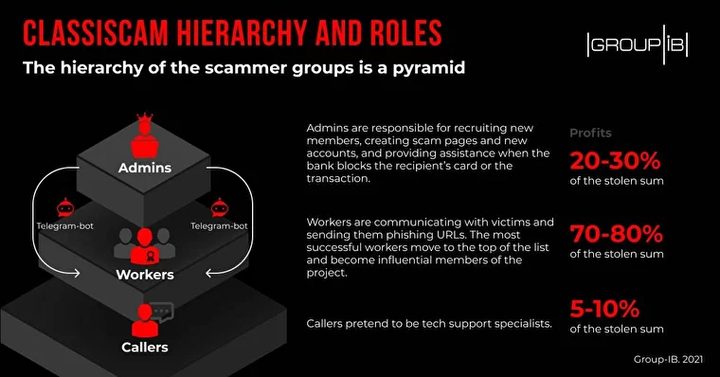
Group-IB highlights how the network is home to 38,000 registered users, all of whom receive around 75% of any stolen proceeds. Platform administrators, meanwhile, take the remaining 25% cut.
Although Group-IB has tracked down and blocked 5,000 malicious endpoints over the last three years, that hasn’t negatively affected Classicscam’s activity.
Ilia Rozhnov, Group-IB’s head of digital risk protection team, commented on the sophisticated nature of the scheme.
“Classiscam is far more complex to tackle than the conventional types of scams. Unlike the conventional scams, Classiscam is fully automated and could be widely distributed. Scammers could create an inexhaustible list of links on the fly. To complicate the detection and takedown, the home page of the rogue domains always redirects to the official website of a local classified platform.”