The sound of a meteoroid crashing into Mars has been captured by NASA’s InSight lander, marking the first time for seismic signals from a meteoroid impact to be detected on another planet.
The InSight Lander was sent to Mars in 2018 to detect so-called “marsquakes,” in this case seismic activity happening beneath the surface of the red planet. But its highly sensitive detection tool also picked up a meteoroid slamming into Mars’ surface last year, and you can hear it happen in the video below.
A new paper published this week in Nature Geoscience reports on the impact, which took place on September 5, 2021.
In fact, there were three separate strikes, as the space rock exploded into three parts when it hit Mars’ atmosphere.
According to the data, the meteoroids struck the martian surface between 53 and 180 miles (85 and 290 kilometers) from InSight’s location.
NASA’s Jet Propulsion Laboratory, which is overseeing InSight’s mission, said the audio of one of the strikes sounds like a “bloop” due to “a peculiar atmospheric effect heard when bass sounds arrive before high-pitched sounds.”
It elaborates: “After sunset, the atmosphere retains some heat accumulated during the day. Sound waves travel through this heated atmosphere at different speeds, depending on their frequency. As a result, lower-pitched sounds arrive before high-pitched sounds. An observer close to the impact would hear a ‘bang,’ while someone many miles away would hear the bass sounds first, creating a ‘bloop.’”
After determining the precise impact locations, NASA used the High-Resolution Imaging Science Experiment camera (HiRISE) on its Mars Reconnaissance Orbiter to get a color close-up of the craters.
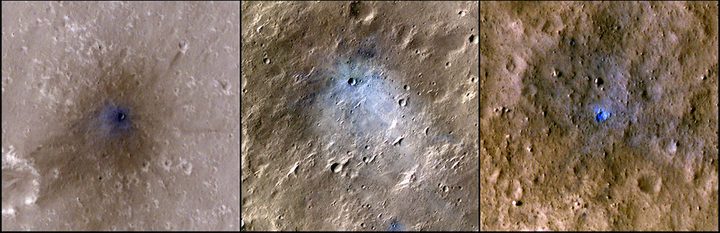
HiRISE sees wavelengths the human eye is unable to detect, so scientists change the camera’s filters to enhance the color of the image. “The areas that appear blue around the craters are where dust has been removed or disturbed by the blast of the impact,” NASA explained. “Martian dust is bright and red, so removing it makes the surface appear relatively dark and blue.”
While the detection of meteoroid strikes is an exciting development for the InSight team, the lander’s main work has been to detect marsquakes, with its sensors detecting more than 1,300 since it went into operation in 2018. In May, it detected the strongest quake ever observed on another planet.
Sadly, InSight will soon end its operations as a gradual accumulation of dust on its solar panels is preventing it from gathering enough power to work effectively.
Still, InSight’s team has lots of data from the mission, which it deems a huge success.
In fact, the team is still sifting through much of it, partly in the hope of finding evidence of other meteoroid strikes that it might’ve missed. It said other impacts may have been obscured by noise from wind or by seasonal changes in the atmosphere, but now that it has a better understanding of the distinctive seismic signature of a rock striking Mars, it’s confident it will find more examples of meteoroid strikes through further analysis of InSight’s past data.