1. Home
  2. Space
  3. News

How to watch NASA astronaut’s speedy ride to ISS on Wednesday

Add as a preferred source on Google
NASA Live: Official Stream of NASA TV

American astronaut Frank Rubio is heading to the International Space Station (ISS) on Wednesday in a speedy trip that will take just three-and-a-half hours.

Recommended Videos

In his first trip to space, the California-born astronaut will blast off on a Russian Soyuz 2.1a rocket from the Baikonur Cosmodrome in Kazakhstan. Rubio will travel to orbit aboard the Soyuz MS-22 spacecraft alongside Russian cosmonauts Sergey Prokopyev and Dmitri Petelin.

The ride to the space station will take a little longer than the current fastest trip from Earth to the ISS, which took just three hours and three minutes in an October 2020 mission that also involved a Soyuz spacecraft.

As part of the Expedition 68 crew, Rubio, Prokopyev, and Petelin will spend the next six months living and working aboard the orbital outpost some 250 miles above Earth.

Speaking with reporters last month, Rubio said that despite international tensions caused by Russia’s war with Ukraine, he hadn’t noticed any issues with NASA’s Russian counterpart, Roscosmos, adding that he was also getting along well with his two travel companions.

The NASA astronaut said the mission “represents the ongoing effort of tremendous teams on both sides and amazing people that make this happen,” adding, “I think it’s important that, when we’re at moments of possible tension elsewhere, human spaceflight and exploration, something that both agencies are incredibly passionate about, remains a form of diplomacy and partnership where we can find common ground and keep achieving great things together.”
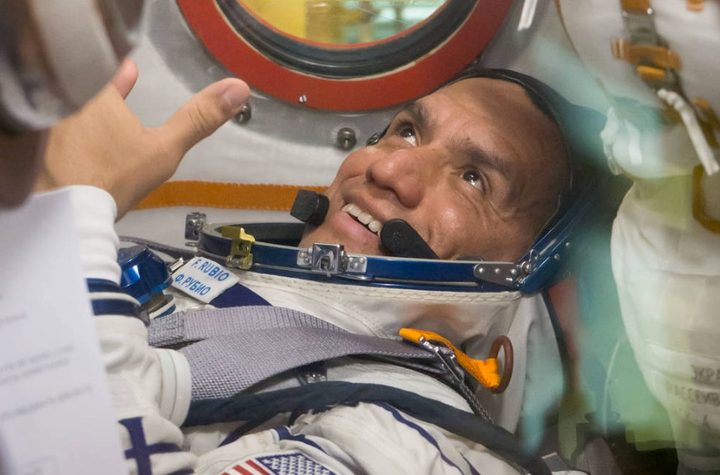
NASA astronaut Frank Rubio.
At the Baikonur Cosmodrome in Kazakhstan, NASA astronaut Frank Rubio performs preflight checkouts in the Soyuz MS-22 spacecraft. NASA/Victor Zelentsov

How to watch

NASA’s Frank Rubio will launch for the ISS at 9:54 a.m. ET (6:54 p.m. Baikonur time) on Wednesday, September 21.

You can watch a livestream of the lift-off and the early stages of the flight via the video player embedded at the top of this page, or by visiting NASA’s website, which will carry the same feed. Coverage will begin at 9 a.m. ET.

NASA will share a livestream of the Soyuz spacecraft docking with the space station about three-and-a-half hours after launch. You can also watch this using the same video player.

Trevor Mogg
Contributing Editor
Not so many moons ago, Trevor moved from one tea-loving island nation that drives on the left (Britain) to another (Japan)…
China’s answer to SpaceX’s reusable rockets literally catches boosters in a net
SpaceX catches boosters on legs. China just used a net.
Ammunition, Missile, Weapon

SpaceX's playbook for recovering a rocket booster generally involves legs, a precisely controlled vertical landing, and either a concrete pad or a drone ship. 

China just managed to pull off something similar, but in a slightly different way, and on July 10, it tested the method as well.

Read more
Dimming the sun sounds unhinged, but this new study on El Niño makes a surprisingly good case for it
A natural test case, Australia's worst-ever wildfire season, suggests the idea deserves serious consideration.
Nature, Outdoors, Sky

When I first saw "scientists propose dimming the sun," I rolled my eyes. It sounds like a science fiction movie cooked up after watching many climate documentaries. But a new study, published on July 8, 2026, in the journal Science Advances, seems to have a genuinely compelling argument.

A Super El Niño is currently forming in the Pacific, feared to be the most intense in decades. It could escalate floods, wildfires, and extreme heat events worldwide. However, Researchers at UC San Diego's Scripps Institution of Oceanography, led by climate scientists Kate Ricke and Jessica Wan, are now proposing one of the most interesting solutions I’ve come across.

Read more
You can now walk through space and gaze into a black hole at this VR exhibit
Smithsonian Starstruck lets you drift past dying stars and see the origin point of the universe for as little as $18 a person.
Smithsonian Starstruck featured

Most planetarium shows ask you to sit still and look up. The Smithsonian's new VR exhibit takes a different approach, letting visitors walk through the vast expanse of the universe, drifting past stars, planets, and a black hole to get a physical sense of its true scale.

A $29 ticket to the edge of the galaxy

Read more