Nvidia’s anti-cryptomining measure, the Lite Hash Limiter (LHR), seems to be gone for good. This means that Nvidia’s RTX 30-series graphics cards now have access to their full mining potential without any workarounds.
Did Nvidia disable LHR because mining is no longer relevant, or is it really that eager to get rid of the oversupply of last-gen cards?
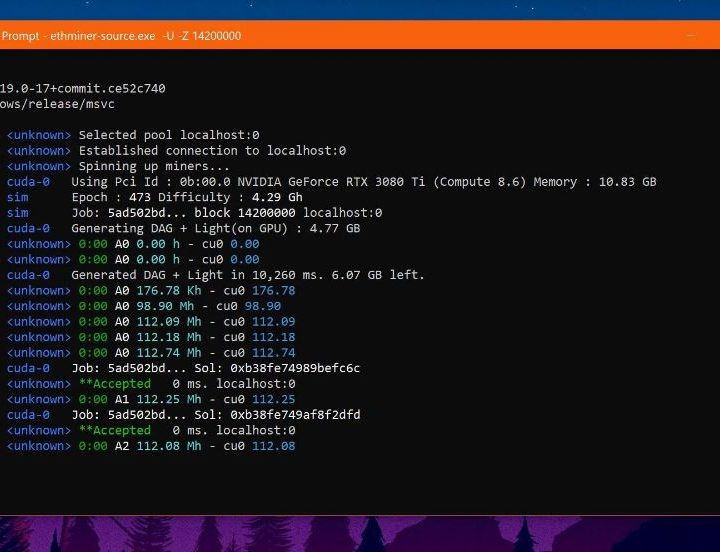
This seems to be the real deal. According to various reports, such as this post made by Reddit user Timbers007 or this YouTube video from Rabid Mining, the Lite Hash Limiter is no more, and the owners of RTX 30-series graphics cards can indulge in cryptomining to their hearts’ content. This appears to have been added (or rather, removed) as part of the latest driver update, which also added support for the RTX 4090 and some gaming performance boosts across the board.
At the height of the GPU shortage, Nvidia introduced LHR graphics cards in May 2021. At the time, this made perfect sense because crypto miners and scalpers bought out the restocks of RTX 30-series so fast that regular users were often left to buy from the second-hand market — often at an inflated price.
LHR limited the mining potential of Nvidia’s graphics cards, but so-called “fixes” were quick to arrive, and eventually LHR was fully unlocked to the point where the card was able to mine at full capacity. However, not all mining software was capable of doing this — at least up until the latest drivers dropped, if the reports are to be believed.
After installing the new Nvidia drivers, both users were able to mine cryptocurrency at their respective card’s full capacity without any specialized software. In the case of the Redditor, the RTX 3080 Ti (which came with LHR enabled from launch) was found to achieve a 112MH/s mining speed. This was done in Ethminer, which doesn’t have any unlocking workarounds, and the speed matched that of mining unlockers. The same is true for Rabid Mining. The YouTuber used Nvidia’s RTX 3060 to mine at 47MH/s without any issues.
Of course, removing LHR now is less of a big deal than it would have been just a few months ago. Ethereum has moved to a proof-of-stake model, rendering mining much less profitable and flooding the market with used mining GPUs. This definitely echoed through Nvidia’s sales of RTX 30-series GPUs.
As Nvidia is moving on to the next generation, having just launched the really expensive RTX 4090, it still has a large supply of last-gen cards that are not selling as well as one might have hoped. This does prompt the question: Is Nvidia clutching at straws and trying to appeal to those who still dabble in cryptomining, or is it simply removing something that is now largely obsolete?
There are no definite answers, but one thing is for sure — Nvidia certainly wants to unload some of these RTX 30-series GPUs, and it priced the next-gen cards accordingly. This is confirmed by Nvidia CEO Jensen Huang’s bold statement: “The idea that the chip is going to go down in price is a story of the past.” With the RTX 40-series being so expensive, and there being an oversupply of the RTX 30-series, it wouldn’t be surprising if Nvidia turned to mining in order to get rid of some of that stock before the next generation is properly here.