1. Home
  2. Space
  3. News

Here’s how NASA will drop off a sample of an asteroid

Add as a preferred source on Google

NASA’s OSIRIS-REx spacecraft scooped up a sample from asteroid Bennu in October 2020, and in May 2021 the spacecraft headed back to Earth to drop that sample off. This week. the spacecraft performed a trajectory correction maneuver to keep it headed toward Earth, where it is scheduled to arrive in September 2023.

OSIRIS-REx Delivers Asteroid Bennu Samples to Earth

NASA has also shared more details on how exactly the spacecraft will deliver the asteroid sample to Earth, as this isn’t a simple process. OSIRIS-REx isn’t designed to be able to handle the incredible heat, friction, and other forces that traveling through Earth’s atmosphere requires so it doesn’t have a way to land on the surface. Instead, it will shoot a capsule filled with the asteroid sample into the atmosphere and only this capsule will arrive at the surface.
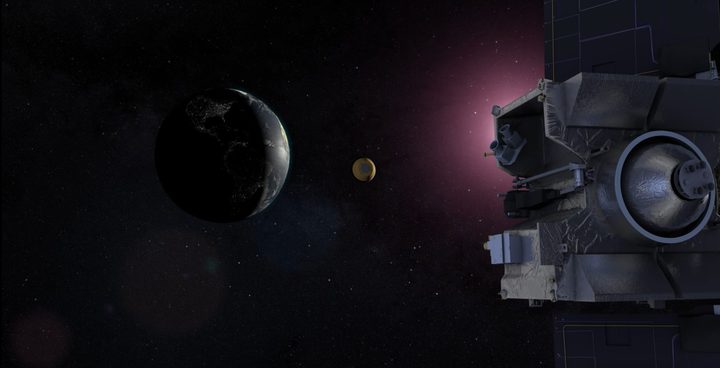
An illustration of OSIRIS-REx returning its sample of asteroid Bennu to Earth. The sample return capsule will enter Earth’s atmosphere, cross the Western U.S., deploy its parachute, and touch down at the Air Force's Utah Test and Training Range in the Great Salt Lake Desert. From there, the capsule will be flown to NASA’s Johnson Space Center in Houston, where its samples of asteroid Bennu will be curated, distributed, and studied for decades to come.
An illustration of OSIRIS-REx returning its sample of asteroid Bennu to Earth.  NASA's Goddard Space Flight Center/Conceptual Image Lab

This maneuever will be tricky too, as Mike Moreau, OSIRIS-REx deputy project manager at NASA’s Goddard Space Flight Center, explained in a statement.” If the capsule is angled too high, it will skip off the atmosphere,” Moreau said. “Angled too low, it will burn up in Earth’s atmosphere.”

Recommended Videos

This is part of the reason that the spacecraft needs to make these trajectory maneuvers, to ensure that it ends up in exactly the right place in September of next year to be able to jettison the capsule at the right angle.

“Over the next year, we will gradually adjust the OSIRIS-REx trajectory to target the spacecraft closer to Earth,” said Daniel Wibben, trajectory and maneuver design lead with KinetX Inc., which is the company responsible for navigating the spacecraft. “We have to cross Earth’s orbit at the time that Earth will be at that same location.”

The recent trajectory maneuver was the first performed by the spacecraft on the return leg of its journey, with further maneuvers scheduled for July of next year. Once the capsule has been released into the atmosphere, it will slow itself with a parachute as it descends. The capsule will hopefully land in an exact planned location at the Air Force’s Utah Test and Training Range in the Great Salt Lake Desert, from where it can be collected by the Air Force and the Army, then taken to facilities for scientific investigation.

Georgina Torbet
Georgina has been the space writer at Digital Trends space writer for six years, covering human space exploration, planetary…
China’s answer to SpaceX’s reusable rockets literally catches boosters in a net
SpaceX catches boosters on legs. China just used a net.
Ammunition, Missile, Weapon

SpaceX's playbook for recovering a rocket booster generally involves legs, a precisely controlled vertical landing, and either a concrete pad or a drone ship. 

China just managed to pull off something similar, but in a slightly different way, and on July 10, it tested the method as well.

Read more
Dimming the sun sounds unhinged, but this new study on El Niño makes a surprisingly good case for it
A natural test case, Australia's worst-ever wildfire season, suggests the idea deserves serious consideration.
Nature, Outdoors, Sky

When I first saw "scientists propose dimming the sun," I rolled my eyes. It sounds like a science fiction movie cooked up after watching many climate documentaries. But a new study, published on July 8, 2026, in the journal Science Advances, seems to have a genuinely compelling argument.

A Super El Niño is currently forming in the Pacific, feared to be the most intense in decades. It could escalate floods, wildfires, and extreme heat events worldwide. However, Researchers at UC San Diego's Scripps Institution of Oceanography, led by climate scientists Kate Ricke and Jessica Wan, are now proposing one of the most interesting solutions I’ve come across.

Read more
You can now walk through space and gaze into a black hole at this VR exhibit
Smithsonian Starstruck lets you drift past dying stars and see the origin point of the universe for as little as $18 a person.
Smithsonian Starstruck featured

Most planetarium shows ask you to sit still and look up. The Smithsonian's new VR exhibit takes a different approach, letting visitors walk through the vast expanse of the universe, drifting past stars, planets, and a black hole to get a physical sense of its true scale.

A $29 ticket to the edge of the galaxy

Read more