1. Home
  2. Space
  3. News

See how the night sky changes over a decade with this NASA time lapse

Add as a preferred source on Google

You might think that the sky above is unchanging, at least on our human timescales, but that isn’t the case. The night sky is active and changing, and it’s visible even on scales of years. Recently, NASA shared a time lapse animation showing the changes in the night sky over a period of more than a decade. Using data collected by the NEOWISE spacecraft, this all-sky map shows how the sky has changed between the launch of the spacecraft in 2009 and today.

NEOWISE: Revealing Changes in the Universe

“If you go outside and look at the night sky, it might seem like nothing ever changes, but that’s not the case,” said Amy Mainzer, principal investigator for NEOWISE at the University of Arizona, in a statement. “Stars are flaring and exploding. Asteroids are whizzing by. Black holes are tearing stars apart. The universe is a really busy, active place.”
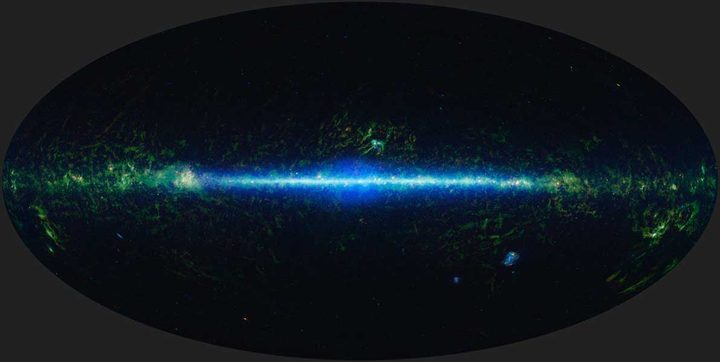
This mosaic is composed of images covering the entire sky, taken by the Wide-field Infrared Survey Explorer (WISE) as part of WISE’s 2012 All-Sky Data Release. By observing the entire sky, WISE can search for faint objects, like distant galaxies, or survey groups of cosmic objects.
This mosaic is composed of images covering the entire sky, taken by the Wide-field Infrared Survey Explorer (WISE) as part of WISE’s 2012 All-Sky Data Release. By observing the entire sky, WISE can search for faint objects, like distant galaxies, or survey groups of cosmic objects. NASA/JPL-Caltech/UCLA

Near-Earth Object Wide Field Infrared Survey Explorer (NEOWISE) was originally a mission to search for objects outside our solar system. NASA’s space-based WISE telescope scanned the entire sky in the infrared from its launch in 2009 until it completed its primary mission in 2011, but the telescope still worked, so it was reactivated and renamed in 2013 and used to look for nearby asteroids and comets, like the famous comet named after it. As the mission has been running for so long, it has provided a wealth of data showing how the sky changes over time.

Recommended Videos

“We never anticipated that the spacecraft would be operating this long, and I don’t think we could have anticipated the science we’d be able to do with this much data,” said Peter Eisenhardt, an astronomer at NASA’s Jet Propulsion Laboratory and WISE project scientist.

The mission is able to complete an all-sky image every six months, and data from the mission has been used to identify feeding black holes — stars which are in the process of forming — and to spot previously hidden brown dwarfs. Its data has been used both by professional astronomers and by citizen scientists, such as in the Backyard Worlds project which identified almost 100 nearby brown dwarfs.

Georgina Torbet
Georgina has been the space writer at Digital Trends space writer for six years, covering human space exploration, planetary…
China’s answer to SpaceX’s reusable rockets literally catches boosters in a net
SpaceX catches boosters on legs. China just used a net.
Ammunition, Missile, Weapon

SpaceX's playbook for recovering a rocket booster generally involves legs, a precisely controlled vertical landing, and either a concrete pad or a drone ship. 

China just managed to pull off something similar, but in a slightly different way, and on July 10, it tested the method as well.

Read more
Dimming the sun sounds unhinged, but this new study on El Niño makes a surprisingly good case for it
A natural test case, Australia's worst-ever wildfire season, suggests the idea deserves serious consideration.
Nature, Outdoors, Sky

When I first saw "scientists propose dimming the sun," I rolled my eyes. It sounds like a science fiction movie cooked up after watching many climate documentaries. But a new study, published on July 8, 2026, in the journal Science Advances, seems to have a genuinely compelling argument.

A Super El Niño is currently forming in the Pacific, feared to be the most intense in decades. It could escalate floods, wildfires, and extreme heat events worldwide. However, Researchers at UC San Diego's Scripps Institution of Oceanography, led by climate scientists Kate Ricke and Jessica Wan, are now proposing one of the most interesting solutions I’ve come across.

Read more
You can now walk through space and gaze into a black hole at this VR exhibit
Smithsonian Starstruck lets you drift past dying stars and see the origin point of the universe for as little as $18 a person.
Smithsonian Starstruck featured

Most planetarium shows ask you to sit still and look up. The Smithsonian's new VR exhibit takes a different approach, letting visitors walk through the vast expanse of the universe, drifting past stars, planets, and a black hole to get a physical sense of its true scale.

A $29 ticket to the edge of the galaxy

Read more