1. Home
  2. Space
  3. News

Do look up to enjoy November’s space treats

Add as a preferred source on Google
What's Up: November 2022 Skywatching Tips from NASA

This month is an exciting one for skywatchers, with a total lunar eclipse, an enormous star, and a meteor shower three highlights to enjoy.

Recommended Videos

Total lunar eclipse

The total lunar eclipse — when Earth blocks all of the sun’s direct light from reaching the moon — takes place early on the morning of Tuesday, November 8, and will be visible to people in North America, the Pacific region, Australia, and East Asia.

Folks located in the Eastern time zone of the U.S. and Canada will have to crawl out of bed early to witness the celestial event, as it’ll begin just after 4 a.m ET.

The full eclipse will take place at about 5:15 a.m. ET, and after that, the moon will set with the eclipse continuing.

With the West Coast of North America three hours behind, the timings mean a late night on Monday as the eclipse will begin just after 1 a.m PT before reaching the full eclipse by around 2:15 a.m. PT.

Anyone with binoculars can enjoy a bonus event in the form of a view of the giant ice planet Uranus, which will be visible a mere finger’s width away from the eclipsed moon.
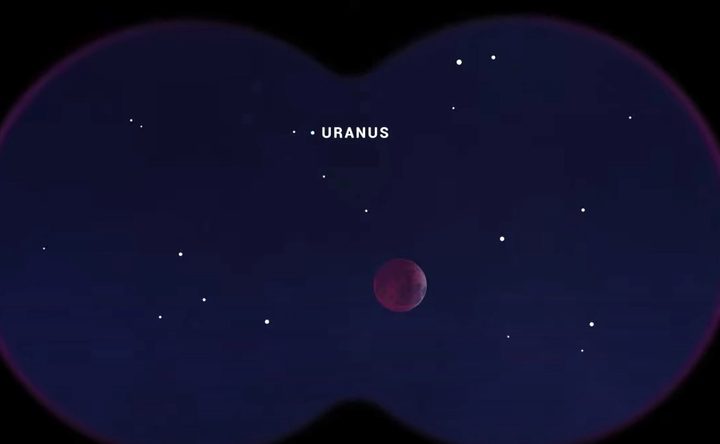
A view of the night sky featuring the moon and Uranus.
NASA

Spica

Spica is a giant star that has 10 times the mass of our sun while also being 12,000 times more luminous. “Fortunately for us, it’s located 260 light-years away,” NASA says.

Despite its vast distance from Earth, you can get a view of its light by gazing skyward in the hour before sunrise on Sunday, November 20. To spot it, look toward the southeast, locate what will be a slim crescent moon, and then look just below for the bright bluish star Spica.

Leonid meteor shower

The annual Leonid meteor shower comprises dusty bits of debris left behind by comet Tempel-Tuttle as it orbits the sun.

It’s viewable throughout November, but the best time to take a look will be as it peaks after midnight on Friday, November 18.

NASA says you may be able to see as many as 20 meteors per hour streaking across the sky, but notes that the moon will be around 35% full that night so its light could interfere with your ability to see the fainter meteors.

However, it also says that Leonid meteors are often bright, with the streaks lasting several seconds, so there should still be plenty of viewable action.

To give yourself the best chance of spotting the Leonids, find a dark spot well away from any light pollution.

NASA advises: “While the moon will be rising in the east with Leo around midnight local time, it’s actually better to view the sky away from the meteors’ apparent point of origin, by lying back and looking straight upward, as any meteor trails you see will appear longer and more spectacular.”

If you want help identifying everything you see in the night sky, you can try one of these excellent astronomy apps for iPhone and Android.

Trevor Mogg
Contributing Editor
Not so many moons ago, Trevor moved from one tea-loving island nation that drives on the left (Britain) to another (Japan)…
Space is becoming Bezos and Musk’s next data center site, and we have every reason to worry
The AI boom is coming for the night sky
How Vast's space station will look in orbit.

AI data centers already consume vast amounts of electricity and water on Earth, so Silicon Valley has begun looking somewhere considerably more spacious... literally.

Elon Musk's SpaceX and Jeff Bezos' Blue Origin, along with several other companies, have proposed enormous constellations of satellites designed to operate as orbital data centers. However, environmental groups and former space officials are now warning that putting them into orbit at the proposed scale could have severe consequences for Earth's atmosphere and the night sky.

Read more
The first possible exomoon is here, and it makes our Moon look hilariously tiny
Scientists may have found the first exomoon, except this one is the size of Jupiter
This artist’s concept depicts a potential volcanic moon between the exoplanet WASP-49 b, left, and its parent star. New evidence indicating that a massive sodium cloud observed near WASP-49 b is produced by neither the planet nor the star has prompted researchers to ask if its origin could be an exomoon.

We have already discovered more than 6,000 planets outside of our immediate neighborhood. Yet, finding a moon orbiting one of those distant worlds has proved considerably harder. Astronomers may finally have something close to the real deal, but this particular object stretches the word “moon” almost beyond recognition.

Using the European Southern Observatory’s Very Large Telescope in Chile, researchers detected strong evidence for a moon-like object in the CD-35 2722 system. Further observations are still necessary to confirm the discovery, but it could become the first confidently detected natural satellite outside our solar system. There is still one tiny complication though. This moon is apparently massive.

Read more
China’s answer to SpaceX’s reusable rockets literally catches boosters in a net
SpaceX catches boosters on legs. China just used a net.
Ammunition, Missile, Weapon

SpaceX's playbook for recovering a rocket booster generally involves legs, a precisely controlled vertical landing, and either a concrete pad or a drone ship. 

China just managed to pull off something similar, but in a slightly different way, and on July 10, it tested the method as well.

Read more