
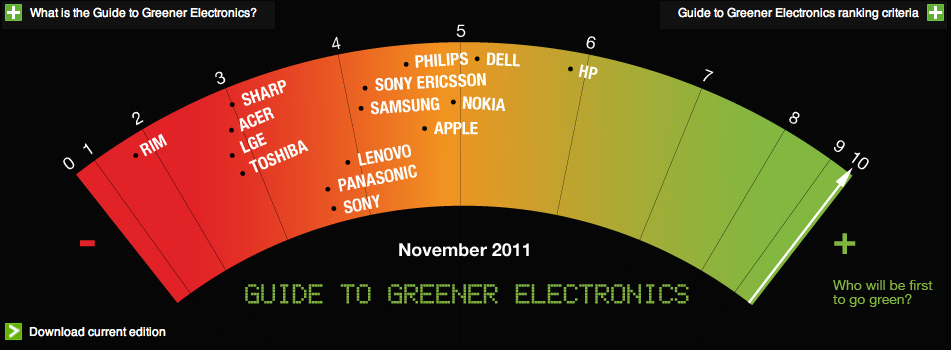
 Hewlett-Packard (HP) has come top of the tech companies in Greenpeace’s latest ranking table of the greenest electronics firms. Research In Motion took the 15th spot – out of 15 companies.
In compiling the table, part of its Guide to Greener Electronics report, Greenpeace looked closely at the green policies and work practises of 15 leading mobile phone, TV and PC manufacturers, including the likes of Apple, Samsung and Nokia. Companies such as Nintendo, Motorola, Fujitsu and Microsoft are absent from the list due to a limited product portfolio, Greenpeace said.
HP scored 5.9 out of 10, moving them up to top spot from the number 4 position a year ago. It performed strongly in the area of sustainable operations, which includes the management of its supply chain. It was also praised for having the best program for measuring and reducing greenhouse gas emissions from its suppliers.
Greenpeace’s report also noted that HP and Dell were the only companies among the 15 “that effectively exclude the sourcing of paper from suppliers linked to illegal logging or deforestation.”
Along with Apple (4th place), HP also performed well regarding policies and practises linked to the sourcing of conflict minerals.
Dell certainly looks as if it’s been taking a close look at its green credentials in the past 12 months, jumping eight places to the number two spot. The computer maker scored particularly well for its commitment to reducing global greenhouse gas emissions from its facilities by 40 percent by 2015. However, Dell scored poorly on green products.
Climbing five places to the number 4 spot was Apple, which scored well on green products and sustainable operations.
Sadly for RIM, appearing for the first time in the table, it found itself in last place. “RIM needs to improve reporting and disclosure of its environmental performance compared to other mobile phone makers,” Greenpeace said, adding: “It also risks a penalty point in future Guide editions as it is a member of a trade association that has commented against stringent energy efficiency standards; it needs to distance itself from such regressive positions with a strong statement.”
Looking at the marks scored by each company, it’s clear that in Greenpeace’s eyes there’s still much work to be done by the electronics firms before they can claim to be truly green, but over the past few years, as consumers have become better educated about the merits of a greener world, the tech companies are also beginning to realize the value and importance of working toward making more eco-friendly products using greener work practises.
Below is Greenpeace’s list.
1 – HP 5.9/10
2 – Dell 5.1/10
3 – Nokia 4.9/10
4 – Apple 4.6/10
5 – Philips 4.5/10
6 – Sony Ericsson 4.2/10
7 – Samsung 4.1/10
8 – Lenovo 3.8/10
9 – Panasonic 3.6/10
9 – Sony 3.6/10
11 – Sharp 3/10
12 – Acer 2.9/10
13 – LG Electronics 2.8/10
13 – Toshiba 2.8/10
15 – RIM 1.6/10


