British processor 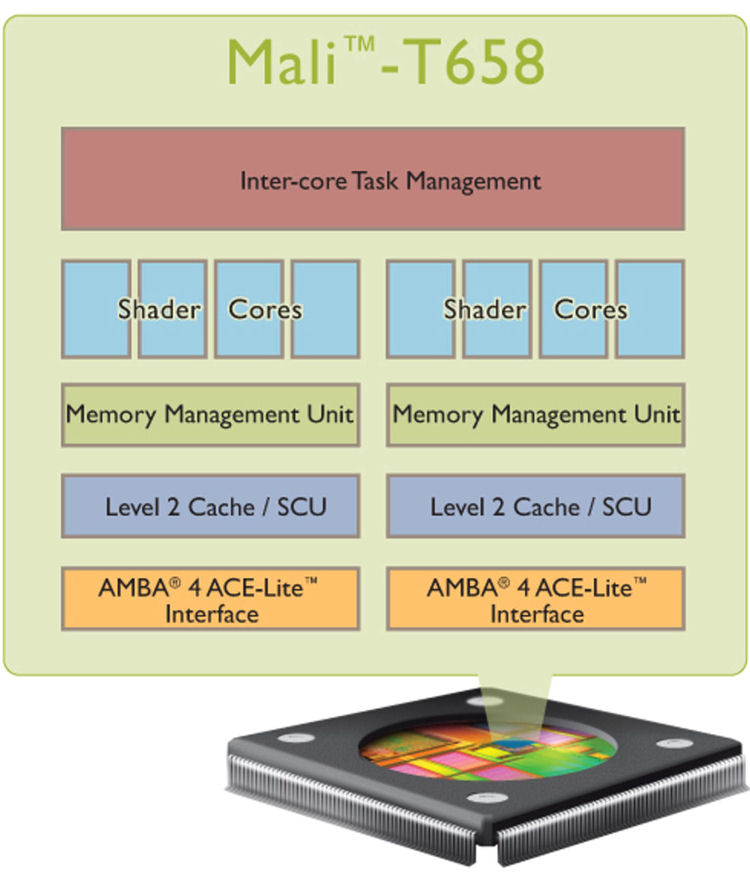 designer ARM has taken the wraps off its new Mali-T658 graphics processor, which packs eight graphics processing cores where the company currently offers only four—and each of those eight cores runs twice as fast as its predecessors. According to ARM, the Mali-T658 will be an important step in delivering PS3-quality graphics on smartphones and tablets—and it could start appearing in mobile devices by 2013. The chip will likely also get consideration from makers of smart TVs and in-vehicle information and entertainment systems.
“Next generation consumer devices based on the Mali-T658 GPU will address the growing user expectation for slick user interfaces and desktop-class graphics,” said the general manager of ARM’s Media Processing Division Pete Hutton, in a statement. “Intuitive user interfaces will mean that consumers can access the full functionality of their connected devices, for richer user experiences. This includes HD gaming and new compute-intensive applications, such as augmented reality.”
The Mali-T658 is designed to worth seamlessly with ARM’s Cortex A7 and A15 processors, either as a standalone system or in ARM’s big.LITTLE mode, which essentially combines ARM’s Cortex A15 and A7 processors, enabling hardware to jump up to more serious (and more power-consumptive) processing when needed, while scaling back to power-sipping processing during less demanding tasks. The availability of GPU units to take on discrete processing tasks could also help with non-graphical mobile applications, including speech recognition and augmented reality apps.
The 2013 date for the Mali-T658 graphics processor reflects the length of ARM’s technology roadmap: the T658 is actually the follow-on to the Mali-T604, which has four graphics processing cores. The T604 itself hasn’t shipped in any products yet: it should start appearing in smartphones and tablets during 2012.
Although a wide variety of portable devices use processors based on ARM designs, not all use ARM’s graphics technology: Samsung’s Galaxy line is perhaps the best-known user of ARM graphics, and Fujitsu and LG have also signed on to use the Mali-T658 when it’s available. However, Nvidia and Qualcomm also makes graphics processing systems for ARM-based systems (Nvidia and Adreno, respectively), and the UK’s Imagination Technologies designed the graphic processors used by Apple’s iPad and iPhone products.