1. Home
  2. Space
  3. News

China’s new space station, Tiangong, gets its third module

Add as a preferred source on Google

China continues to progress in building its own space station, named Tiangong. This week the third module of the new station arrived in orbit and was added to the station, and Chinese astronauts entered it for the first time.
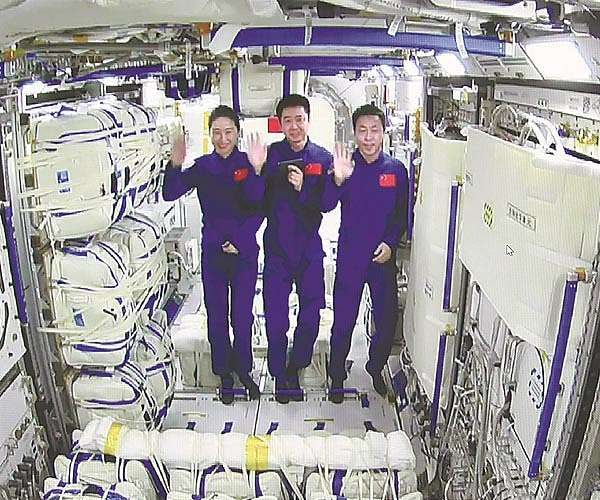
Shenzhou-14 astronauts Chen Dong (C), Liu Yang (L) and Cai Xuzhe waving inside the Mengtian lab module.
This screen image captured at Beijing Aerospace Control Center on November 3, 2022, shows the Shenzhou-14 astronauts Chen Dong (C), Liu Yang (L), and Cai Xuzhe waving inside the Mengtian lab module. The Shenzhou-14 astronauts successfully entered the Mengtian lab module of China’s space station Tiangong at 3:12 p.m. (Beijing Time) on Thursday, according to the China Manned Space Agency. Sun Fengxiao/Xinhua

As reported by China’s state news agency Xinhua, the astronauts entered the new lab module for the first time on Thursday, November 3. Astronauts Chen Dong, Liu Yang, and Cai Xuzhe have been at the new space station since June as part of the Shenzhou-14 mission, which docked to the station’s core module Tianhe. The new lab module, named Mengtian, was launched on October 31. It arrived at the core module’s forward port, before being relocated to a different port on November 3.

Recommended Videos

The Tiangong space station now has its three modules in place: the Tianhe core module which contains the living quarters and service section plus a docking hub, the Wentian module which houses avionics and propulsion systems plus backup functions, and now the Mengtian module which includes both a pressurized section in which the crew can work and an unpressurized cargo section.

The Shenzhou-14 crew currently on the station will soon be joined by the Shenzhou-15 crew in a mission expected to launch this month. Three more crew members will arrive at the station and have a 10-day handover between the two crews. A handover period wasn’t previously possible when the station only had its core module, but with the addition of the Wentian module which can be used as spare crew quarters, it is now possible for two crews to be on the station at the same time.

The crew is also expecting the arrival of the Tianzhou-5 cargo craft which is expected to launch soon and will carry fuel and supplies to the station.

Georgina Torbet
Georgina has been the space writer at Digital Trends space writer for six years, covering human space exploration, planetary…
Space is becoming Bezos and Musk’s next data center site, and we have every reason to worry
The AI boom is coming for the night sky
How Vast's space station will look in orbit.

AI data centers already consume vast amounts of electricity and water on Earth, so Silicon Valley has begun looking somewhere considerably more spacious... literally.

Elon Musk's SpaceX and Jeff Bezos' Blue Origin, along with several other companies, have proposed enormous constellations of satellites designed to operate as orbital data centers. However, environmental groups and former space officials are now warning that putting them into orbit at the proposed scale could have severe consequences for Earth's atmosphere and the night sky.

Read more
The first possible exomoon is here, and it makes our Moon look hilariously tiny
Scientists may have found the first exomoon, except this one is the size of Jupiter
This artist’s concept depicts a potential volcanic moon between the exoplanet WASP-49 b, left, and its parent star. New evidence indicating that a massive sodium cloud observed near WASP-49 b is produced by neither the planet nor the star has prompted researchers to ask if its origin could be an exomoon.

We have already discovered more than 6,000 planets outside of our immediate neighborhood. Yet, finding a moon orbiting one of those distant worlds has proved considerably harder. Astronomers may finally have something close to the real deal, but this particular object stretches the word “moon” almost beyond recognition.

Using the European Southern Observatory’s Very Large Telescope in Chile, researchers detected strong evidence for a moon-like object in the CD-35 2722 system. Further observations are still necessary to confirm the discovery, but it could become the first confidently detected natural satellite outside our solar system. There is still one tiny complication though. This moon is apparently massive.

Read more
China’s answer to SpaceX’s reusable rockets literally catches boosters in a net
SpaceX catches boosters on legs. China just used a net.
Ammunition, Missile, Weapon

SpaceX's playbook for recovering a rocket booster generally involves legs, a precisely controlled vertical landing, and either a concrete pad or a drone ship. 

China just managed to pull off something similar, but in a slightly different way, and on July 10, it tested the method as well.

Read more